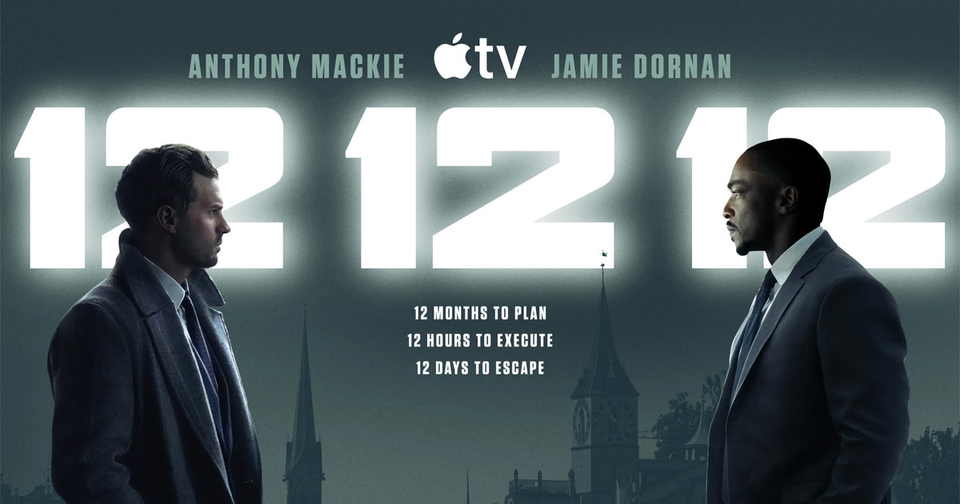
An eight-episode thriller that is still unfolding
A streaming launch can remain relevant well after its premiere when the story is still being released. That is the situation with 12 12 12, an eight-part crime thriller that began its global run on November 13, 2026. Two episodes arrived together at launch, followed by a weekly schedule running to December 25. By November 21, the first three installments had reached their scheduled release dates, while five remained ahead. Rather than presenting the November launch as a new announcement, this guide examines the production, its unusual storytelling structure and the practical viewing calendar that continues to matter to audiences.
The central attraction is an elaborate crime conceived over a long period, executed in a compressed burst and pursued through a short aftermath. The series builds those different scales of time into its very identity. Its title is a promise about how viewers are asked to process a robbery, not simply a sequence of numbers decorating an otherwise conventional police drama. That approach gives the project an immediate formal challenge: each movement through time must clarify motive, danger or consequence without making the audience repeatedly reconstruct the same information.
The three clocks at the centre of the story
The premise moves between a year spent preparing a robbery, the twelve hours in which the plan must operate and the twelve days that follow. Those periods are connected by a pursuit involving a disgraced FBI agent and an American career criminal. A vault beneath Zurich provides the central target, while the wider European setting creates opportunities for changing alliances and competing pressures. The structure invites viewers to examine decisions from more than one direction, watching consequences before some causes have been completely revealed.
The preparation period
A long planning window gives a heist narrative room to establish relationships, money, risk and fragile trust. In this series, the twelve-month clock is especially important because a detailed robbery should feel like an operation assembled through choices rather than an effortless collection of tricks. For viewers, the useful question is not merely whether the criminals have a plan. It is whether the relationships holding that plan together can survive the personal interests of everyone involved.
The execution period
The twelve-hour window offers a contrasting rhythm. Preparation permits revision; execution does not. Once a robbery is under way, a missed detail can turn confidence into improvisation. The Zurich vault supplies a recognisable objective, yet the real dramatic potential lies in the relationship between what the participants expected and what the moment demands. A carefully managed screenplay can use that difference to create tension even when the audience already knows fragments of the outcome.
The aftermath period
The twelve days following the crime provide the third perspective. An escape is not complete when a vault is emptied, and the series turns pursuit into its own measure of time. This part of the framework allows emotional and strategic consequences to develop after the immediate spectacle. It can also test the logic of what the audience believed earlier. The result is a structure in which the consequences of one decision may be understood before its original motivation becomes fully visible.
Anthony Mackie and Jamie Dornan lead the confrontation
Anthony Mackie plays the disgraced federal investigator, while Jamie Dornan plays the American criminal operating on the opposite side of the contest. Both actors also hold executive producer credits. Their casting establishes an obvious conflict, but the premise is more interesting when viewed as a confrontation between two professionals whose choices are shaped by different pressures. One is trying to pursue a case from an unstable position within law enforcement; the other must navigate the demands of a criminal operation. The series has room to make those pressures as important as its physical action.
The supporting ensemble includes Jack Kesy, Agathe Rousselle, Sallie Harmsen, José Garcia and Kali Reis. Their involvement points toward a story that extends beyond a two-person duel. In a robbery narrative, supporting characters can transform an apparently clear objective into a chain of competing loyalties. It would be premature to assign unconfirmed motivations to each character, so the sounder way to approach the ensemble is through its confirmed involvement and the broader possibilities of the show's multi-character design.
The European setting and the mechanics of a heist
Zurich is more than a stylish backdrop in the confirmed story premise. A heavily protected bank vault is a location that immediately concentrates questions of security, access, timing and surveillance. Moving the characters through Europe expands the contrast between the tightly controlled target and a pursuit that can spread across borders. The production uses the familiarity of a bank robbery to make a complex timetable accessible: even viewers unfamiliar with the characters understand why an intricate plan might fail once a single variable changes.
A three-timeline arrangement also changes how places are read on screen. A corridor that appears ordinary during planning can acquire menace during the heist, and the same location may carry a different meaning after the police investigation advances. That possibility is the storytelling value of revisiting a setting, as opposed to merely repeating footage for emphasis. The technique works best when every return adds information rather than relying on chronology alone to produce suspense.
The creative team behind the production
Dudi Appleton and Jim Keeble created the series and serve among its executive producers. Kari Skogland directs multiple episodes, including the pilot, and also serves as an executive producer. The project is produced by Paramount Television Studios and Anonymous Content. Additional executive producers include the two leads, Samantha Corbin-Miller, David Knoller and Jason Spire. These are confirmed production roles, not a guarantee of any particular creative outcome. What matters to viewers is whether the work unifies the script's competing timelines into a coherent dramatic experience.
A pilot has a particularly demanding task in this kind of programme. It must introduce personalities, explain enough of the three clocks to establish the rules and still leave meaningful questions unanswered. Too little orientation risks confusion; too much explanation reduces momentum. The directors and editors therefore carry an unusually visible responsibility. Rhythm, visual distinctions and carefully chosen transitions have to guide audiences across time without repeatedly drawing attention away from the characters.
Why the weekly release calendar matters
The practical timetable is straightforward. Episodes one and two premiered on Friday, November 13, followed by episode three on November 20. The remaining episodes are scheduled for November 27, December 4, December 11, December 18 and December 25. That makes Christmas Day the announced date of the season's final installment. Viewers catching up now can begin with the first three scheduled episodes and then follow the unfolding narrative one week at a time, subject to regional platform availability and any later schedule adjustments.
A weekly rhythm may be particularly suitable for a story told out of order. Individual episodes can end with questions about both what happened and when viewers will finally understand it. That design encourages discussion without requiring a marathon viewing session. On the other hand, it also places pressure on each installment to provide enough progression to reward a week's attention. The release pattern is not an incidental marketing detail. It becomes part of how an audience experiences suspense and remembers information across three timelines.
Early reaction without confusing a preview with a review
Initial critical reactions have been mixed, with some reviewers appreciating the polished heist construction and performances while others have questioned the complexity and familiar genre ingredients. Those contrasting responses suggest a production whose formal ambition may be experienced differently by viewers. This article is an editorial guide based on confirmed production and release information, not a personal evaluation of every episode. No numerical reception score is presented as fixed or current, because audience and critic aggregates can change as additional reviews appear.
There is also a useful distinction between being innovative and being effective. A story that travels through three periods can produce fascinating revelations, but novelty alone cannot replace character development. Conversely, a familiar crime setup can still entertain when its performances, action and editing are persuasive. Viewers may therefore find the most rewarding discussion in how the timelines influence emotional understanding, rather than in deciding whether a complicated structure automatically makes a show more sophisticated.
What is confirmed and what remains open
The confirmed facts are an eight-episode series, a November 13 global debut with two episodes, a Friday release cadence through December 25, the named leading and supporting cast, the creative team and the Zurich-centred robbery premise. An official first look and a later trailer preceded the November launch, while a New York promotional photo call took place on November 10. Those earlier events belong to the development and publicity chronology and should not be relabelled as fresh announcements in a historical recovery article.
Whether the programme continues beyond this eight-part run is a separate question. Nothing in the verified launch details supplies a renewal announcement, and this article does not invent one. Likewise, a critical response to the episodes released so far should not be presented as a verdict on the completed season. The outstanding installments and the finale are the meaningful future developments. Readers interested in an up-to-date assessment should distinguish new episode information from repeated recaps of the original launch.
The viewing proposition
12 12 12 offers a recognisable heist framework with a storytelling experiment built into its title. Its November premiere is now a matter of record, but its December conclusion is still ahead. That is the reason this story remains useful in the present: readers can identify the cast and makers, understand how the three clocks operate, and follow the remaining weekly schedule without being misled by recycled publicity. The ultimate measure of the series will be how convincingly the planning, the crime and the pursuit come together by the finale.
PUBLISHED BY SUYASH PACHAURI, FOUNDER & OWNER, GLOBAL BOLLYWOOD | THE HOLLYWOOD SCOPE.