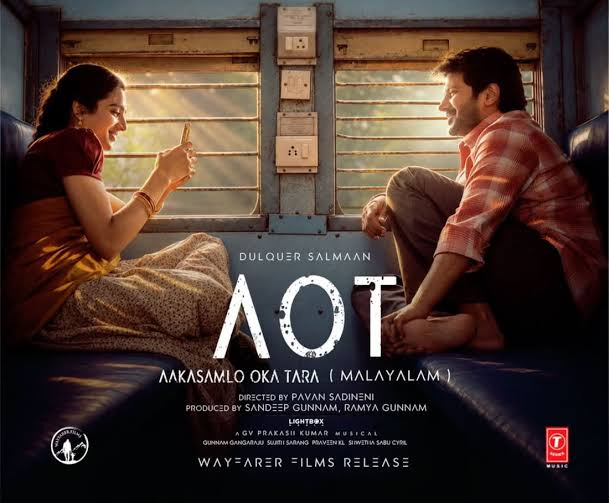
A dream that refuses to remain earthbound
Aakasamlo Oka Tara builds its emotional world around Kalpana, a young woman raised in a conservative rural household who wants to become an astronaut. Her ambition is not treated as a decorative childhood fantasy. It becomes the organising force of the story, revealing how geography, gender expectations and family decisions can narrow a talented person’s future before she has a chance to choose it. The film’s central question is therefore larger than whether Kalpana can reach space. It asks whether a marriage arranged without regard for her goal can unexpectedly become the place from which that goal survives.
The answer arrives through Krishna, played by Dulquer Salmaan, whose role is designed around support rather than heroic possession. After Kalpana is pushed into marriage, Krishna recognises the seriousness of her aspiration and helps her continue moving toward it. That change gives the film its most appealing quality. The relationship does not ask Kalpana to surrender her identity in exchange for affection. Instead, partnership becomes meaningful because it creates room for her intellectual ability, discipline and hope. The approach gives familiar inspirational material a tender domestic foundation.
Satvika Veeravalli carries the emotional trajectory
Satvika Veeravalli’s Kalpana has to move through disappointment, hesitation and renewed purpose without allowing the character to become a slogan. Her performance benefits from restraint. The character’s determination is expressed through attention, preparation and the emotional weight of opportunities that almost disappear. That makes the larger moments credible because they grow from a recognisable struggle. Kalpana’s journey also gives the film a useful perspective on education. Talent alone cannot overcome structural barriers, but encouragement, access and sustained work can change the direction of a life.
Dulquer Salmaan brings an easy warmth to Krishna and understands that the role works best when he does not compete with Kalpana’s arc. His screen presence gives the film commercial assurance, yet he repeatedly redirects the emotional focus toward her decisions. Shruti Haasan and the supporting cast add texture to a narrative that moves between village expectations, marriage and the demanding path toward scientific achievement. The performances are strongest when the film remains close to ordinary conversations rather than announcing its themes too loudly.
Pavan Sadineni balances romance and aspiration
Director Pavan Sadineni frames the story as an accessible emotional drama rather than a technical account of astronaut training. That decision broadens its appeal, although it also means some stages of Kalpana’s progress can feel streamlined. The film is more interested in the people who enable or obstruct a dream than in procedural detail. At its best, this focus produces scenes in which small acts of belief carry more force than grand speeches. Krishna’s support matters because it changes practical circumstances, not merely because he says the correct things.
The screenplay risks becoming overly polished when setbacks are resolved with convenient momentum. A more searching treatment of institutional obstacles and the psychological cost of repeatedly proving oneself could have given the second half greater complexity. Even so, the film maintains emotional clarity. Its message about women’s ambitions is expressed through a specific marriage and a specific dream, which prevents the narrative from becoming entirely generic. The space motif also provides an attractive visual contrast between the limits of Kalpana’s early environment and the scale of what she imagines.
Final verdict on Aakasamlo Oka Tara
Aakasamlo Oka Tara succeeds as a hopeful mainstream drama because it understands that encouragement is not a passive virtue. Krishna’s belief is valuable only when it is converted into time, opportunity and freedom for Kalpana. The film’s romantic core is therefore tied to respect. Satvika Veeravalli gives the story its emotional conviction, while Dulquer Salmaan uses his charisma in service of a relationship built on shared purpose. The result is uplifting without losing sight of the social pressure that almost closes the path ahead.
The treatment can be sentimental and some difficult transitions receive less scrutiny than they deserve, but the central idea remains strong. A young woman’s dream does not need to be reduced to make a marriage work. A marriage can expand when both people recognise that love and ambition need not be rivals. That conviction gives the film its most memorable quality and makes its optimism feel earned more often than manufactured.
What comes next
The film’s long-term impact will depend on how audiences respond to Kalpana as the true centre of the narrative rather than viewing her achievement only through Krishna’s support. Its strongest legacy would be to encourage more popular stories in which women’s scientific and professional ambitions receive the same dramatic seriousness traditionally reserved for male protagonists.
For Dulquer Salmaan, the project reinforces his ability to move across industries while adapting his star image to the needs of a story. For Satvika Veeravalli, it provides a substantial emotional showcase built around purpose, vulnerability and persistence.
A gentle celebration of ambition that finds its strongest orbit in empathy, partnership and perseverance.
PUBLISHED BY SUYASH PACHAURI, FOUNDER & OWNER, GLOBAL BOLLYWOOD | THE HOLLYWOOD SCOPE.