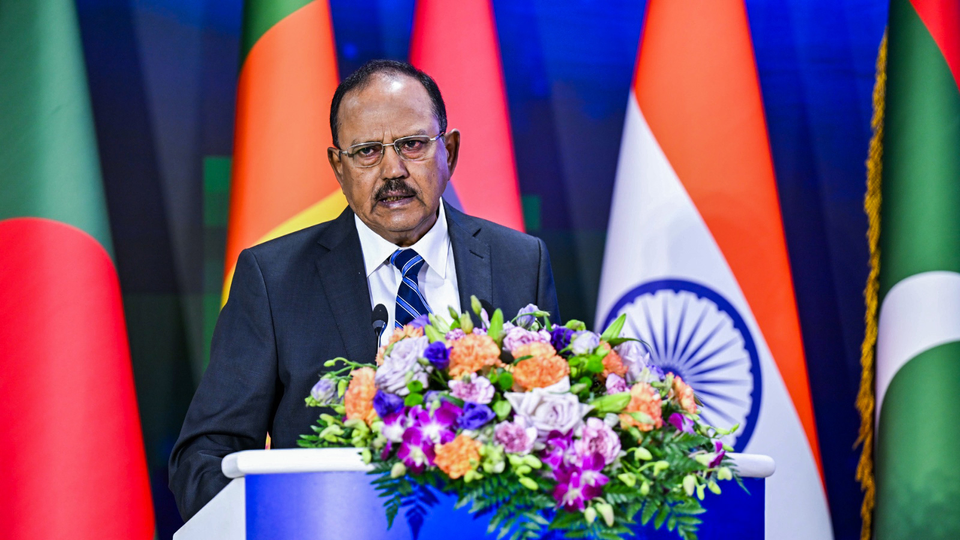
India presses for collective regional capacity
National Security Advisor Ajit Doval has called for deeper cooperation among Indian Ocean nations to respond to evolving security threats. Speaking at the eighth national security adviser-level meeting of the Colombo Security Conclave in Male, he said India remained committed to strengthening the collective capacity of member countries. The message places practical coordination at the centre of India's regional approach, linking maritime security with transnational crime, disaster response, cyber risks and the protection of critical sea routes.
The conclave began in 2020 when India, Sri Lanka and the Maldives expanded an earlier trilateral maritime-security dialogue. Its membership and agenda have grown as governments recognised that threats do not stop at national borders. Smuggling networks, illegal fishing, cyberattacks and maritime accidents can affect several countries at once. Smaller states may lack specialised surveillance, forensic or emergency-response resources, making shared training and information particularly valuable.
The Indian Ocean is an economic lifeline
A large share of global energy shipments and container trade moves through the Indian Ocean. Ports, undersea cables and narrow shipping passages connect Asia, Africa, the Middle East and Europe. Disruption can raise freight and insurance costs far beyond the location of an incident. Regional security is therefore not only a defence issue. It supports food supplies, energy access, tourism and the everyday movement of commercial goods across some of the world's fastest-growing economies.
Doval described the conclave as an intersection of India's Neighbourhood First policy and its MAHASAGAR vision. That framing emphasises consultation and capacity-building rather than a single-country security architecture. The practical test will be whether members can share timely information, agree response procedures and maintain trust when their wider foreign-policy relationships differ. Meetings create a forum, but operational value comes from exercises, secure communications and officials who can cooperate during a real emergency.
Threats now cross traditional categories
Maritime security once focused mainly on naval competition and piracy. The current agenda is broader. Commercial vessels face drone and missile risks in conflict zones. Criminal groups move narcotics, weapons and people across sea routes. Cyberattacks can interrupt ports and logistics systems without a ship being targeted directly. Extreme weather can overwhelm coastal infrastructure, while illegal fishing undermines livelihoods and creates friction between neighbours. A regional mechanism must be flexible enough to address all these problems without losing focus.
Information-sharing is essential but sensitive. Governments must protect sources and sovereign data while exchanging enough detail to act quickly. Common standards for maritime-domain awareness, cyber incident reporting and search-and-rescue coordination could reduce delays. Training programmes can also build professional relationships before a crisis. India has significant naval, coast-guard, satellite and technical capacity, but cooperation will be more durable if programmes are designed around the stated needs of every participating country.
Delivery will define the conclave's relevance
The Male meeting offers an opportunity to translate political support into measurable projects. Possible priorities include coordinated patrols, coast-guard exercises, cyber training, counter-terror financing and stronger disaster-relief planning. Member states could also improve the resilience of ports and undersea communications. Progress should be assessed through completed exercises, response times and shared capabilities rather than the number of declarations issued after meetings.
The latest statement does not announce a military alliance or a new treaty obligation. It reaffirms India's willingness to work with regional partners and invites closer strategic cooperation. That distinction matters in a region where countries value autonomy and maintain relationships with multiple major powers. The Colombo Security Conclave can be useful precisely because it concentrates on practical regional problems. Its credibility will grow if members turn that shared interest into dependable systems that protect people, trade and infrastructure across the Indian Ocean.
The conclave's expansion should also preserve clear lines of accountability. Wider membership can bring more intelligence, coast-guard capacity and geographic coverage, but it can make consensus slower. A focused annual work plan with named lead agencies would help convert broad priorities into action. Members could publish non-sensitive results such as exercises completed, officials trained and emergency protocols tested. That transparency would show coastal communities and commercial operators how regional cooperation improves safety without exposing operational secrets. It would also reduce the risk that the forum becomes defined only by geopolitical competition among larger powers. The strongest case for the conclave is practical: neighbouring countries share the same waters, trade routes and disaster risks, so coordinated preparation serves every participant regardless of its wider diplomatic alignments.
PUBLISHED BY SUYASH PACHAURI, FOUNDER & OWNER, GLOBAL BOLLYWOOD | THE HOLLYWOOD SCOPE.