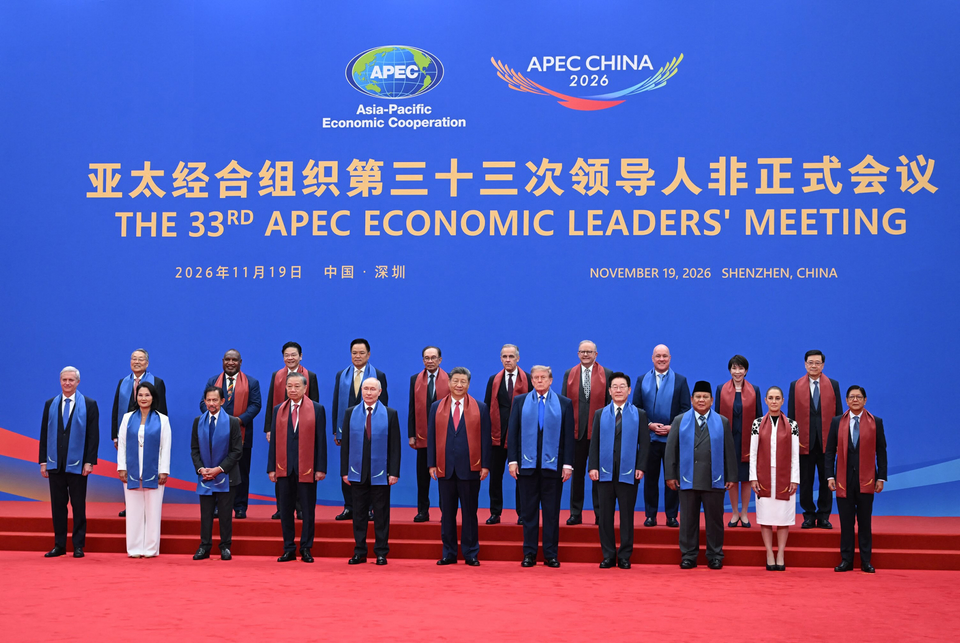
The 2026 Asia-Pacific Economic Cooperation summit opened in Shenzhen with leaders presenting sharply different ideas about trade, technology and economic power. Chinese President Xi Jinping urged the region to support open commerce, improve market access and cooperate on the digital economy and artificial intelligence. Russian President Vladimir Putin criticised sanctions, tariffs and export restrictions while arguing that the Asia-Pacific is central to Russia's future. US President Donald Trump arrived in China after meetings in the Philippines, bringing Washington's tariff policy and technology controls into the centre of the gathering.
The summit matters because its 21 economies account for about 60 percent of global economic activity, half of world trade and roughly 40 percent of the global population. APEC does not issue binding decisions, but it has spent 37 years building consensus around regional cooperation. This year's meeting is taking place as supply chains are being reshaped by strategic competition, advanced chip restrictions, slower Chinese growth and new alignments among countries trying to reduce their dependence on any single major power.
China uses Shenzhen to argue for open trade
Xi told business executives that China would continue cutting tariffs, expanding access and pursuing reforms in rules, regulations and standards. His message positioned China as a predictable partner for investment and technological development. The location reinforced that argument. Shenzhen grew from a fishing community into a major manufacturing, finance and technology centre, making it a visible example of how access to global investment and export markets transformed China's economy over four decades.
That message also reflects pressure at home. China's economy is growing at more than 4 percent, but retail spending and investment remain weak amid a prolonged property downturn. Strong exports have supported activity, yet the country's trade surplus is on track to exceed $1 trillion for a second consecutive year. Trading partners increasingly question whether they can absorb the volume of Chinese goods, so calls for openness are being heard alongside demands for more balanced competition.
Washington's tariff and chip strategy hangs over the summit
The US approach points in another direction. Higher tariffs and controls on advanced technology reflect a policy designed to protect domestic industry and restrict Chinese access to leading artificial intelligence hardware. Those measures clash with APEC's long-term ambition of a more integrated Pacific economy. The tension is particularly visible in semiconductors, where commercial supply chains overlap with military and national-security concerns. Companies must now navigate rules that can change where products are sold, how data centres are built and which partners can use advanced chips.
Trump's emphasis on his relationship with Xi may leave room for extending the trade truce reached after earlier tariff escalation. At the same time, a friendly summit appearance does not erase structural disagreements over technology, industrial policy and market access. The practical test is whether the two sides can prevent new restrictions from producing another cycle of retaliation. Businesses want clarity because investment decisions in factories, cloud infrastructure and supply networks often extend far beyond a single political term.
Russia seeks a larger Asia-Pacific role
Putin used his first in-person APEC leaders meeting since 2017 to reject what he described as instruments of economic dominance. He said sanctions, tariffs and export controls had lost much of their power to intimidate and highlighted the fact that the Asia-Pacific now accounts for more than half of Russia's trade. Moscow has submitted a bid to chair APEC in 2035, signalling that it wants a long-term place in the region's economic architecture despite isolation from many Western markets.
The planned meeting involving Trump, Xi and Putin adds a security dimension that goes beyond the normal trade agenda. It is expected to be the first summit bringing the three leaders together in that format. Their discussions will take place against a background of war, sanctions, technology restrictions and competing visions of global order. Even without a binding agreement, their public positions can influence markets, diplomatic partnerships and the calculations of smaller countries that trade with all three powers.
Middle powers are pursuing more flexible partnerships
The summit also shows that regional countries are not simply choosing between Washington and Beijing. Canada has moved to deepen economic ties with China and the European Union after tensions with the United States, including an agreement with Beijing to reduce tariffs on each other's goods. Malaysia has argued that large economies should leave room for developing countries to pursue trade and investment according to their own circumstances. These positions reflect a desire for resilience through several relationships rather than dependence on one dominant partner.
APEC's closed-door leaders meeting will reveal whether those interests can produce practical cooperation. The organisation works through consensus, so progress is likely to appear in shared language, working groups and incremental commitments rather than dramatic treaties. Still, the choices made in Shenzhen may shape how the region handles artificial intelligence, supply chains and market access. In an era of strategic competition, even maintaining a forum where rival powers sit at the same table has become an important economic asset.
PUBLISHED BY SUYASH PACHAURI, FOUNDER & OWNER, GLOBAL BOLLYWOOD | THE HOLLYWOOD SCOPE.