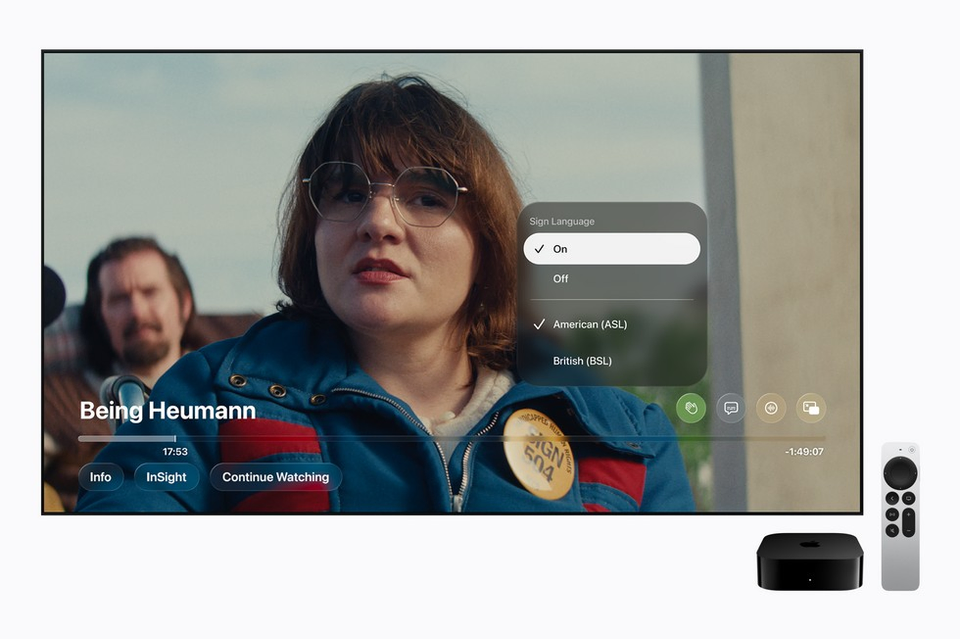
Apple TV brings sign language interpretation into the main viewing experience
An accessibility feature announced on 10 November 2026 began rolling out on 13 November through the Apple TV app, allowing viewers to select sign language interpretation while watching supported films. Its introduction alongside the streaming arrival of Being Heumann makes this more than an ordinary product update. It is a practical change in how a streaming service can make moving-image storytelling accessible to audiences who rely on signed language. The historical launch date matters, but the feature remains useful to viewers now because it changes the options available whenever they choose a compatible title.
Rather than requiring audiences to locate an entirely separate edition of the film, the player can offer the interpretation as a viewing option. That design is important for anyone comparing accessibility choices across devices. It also makes a broader point for producers and distributors: access should be considered part of how a finished work reaches people, not an afterthought that viewers have to discover independently. The feature has a limited initial catalogue, so neither its existence nor a compatible device means every film in the app offers a signer.
What the November 13 launch actually included
The opening film was Being Heumann, a drama about disability rights campaigner Judy Heumann. Directed by Siân Heder and starring Ruth Madeley, the film recounts a defining chapter of disability activism, including the 1977 protest in San Francisco. Launching a sign language viewing option with this story gives the technology a direct relationship to the themes on screen. The choice also invites discussion about the difference between representing disabled lives in a film and ensuring disabled audiences can experience that film through appropriate access services.
American Sign Language and British Sign Language interpretation were announced for Being Heumann and the film F1. Additional support for Way of the Warrior Kid and Greyhound was included in the platform's plans for later in 2026, with more original titles expected subsequently. Those are title-specific commitments, not a promise of instant coverage for the entire library. Readers should check the individual film page for a sign language badge instead of assuming that a new accessibility capability applies to everything distributed through the same app.
Why two signed languages are worth distinguishing
American Sign Language and British Sign Language are distinct languages, not interchangeable visual versions of English. Identifying ASL and BSL separately helps viewers understand the choices offered by a particular title. It also reminds filmmakers that an international streaming launch does not automatically eliminate linguistic barriers. A film can reach multiple territories at the touch of a button while different audiences still require different types of interpretation. Expansion will therefore depend on both the number of titles supported and the signed languages actually available for them.
A viewing option designed with Deaf and native signers
The interpretation experience was designed and tested in consultation with Deaf people and native signers. That production detail matters because a signer is not simply an on-screen visual ornament. The interpretation must carry rhythm, character relationships, emotion and changes in emphasis while fitting the pace of a filmed scene. Decisions about placement and performance affect how comfortably the audience can follow both the storytelling and the language. The quality of that collaboration is a meaningful part of the feature, even though the user interface may make the selection look simple.
Daniel Durant, who appears in Being Heumann, directed the film's sign language interpretation. His involvement illustrates why experienced signers and creative collaborators are essential in accessibility work. The craft has to respect the language and the film at the same time. No amount of software design can substitute for thoughtful interpretation of a dramatic performance. For studios preparing future international releases, the lesson is that accessibility has its own artistic and production requirements, rather than functioning merely as a technical setting applied at delivery.
Different from subtitles and audio description
Subtitles present written language, while audio description communicates relevant visual information through spoken narration. Sign language interpretation serves a different need. Deaf audiences are not a single group with identical language preferences, and written captions do not replace access to a natural signed language for every viewer. A strong accessibility menu can therefore include several complementary options without treating one as sufficient for everyone. This distinction is especially relevant in film publicity, where the convenient word accessible can conceal substantial differences between what is actually offered.
How viewers can find and turn on the option
On a supported title, viewers can look for the Sign Language icon in the Apple TV app. The setting can be enabled in the app's settings, after which a sign language control appears during playback for a compatible original. Search is also intended to help people locate these titles using expressions such as with ASL, and a dedicated Movies & Shows with American Sign Language collection groups suitable programmes for browsing. The precise appearance of controls may differ across supported devices and app versions, so the title-specific indication is the clearest starting point.
The platform specifies iOS 27.2, iPadOS 27.2, macOS 27.2, tvOS 27.2 and visionOS 27.2 or later for Apple devices, as well as supported third-party hardware running the latest app software. This is a software-dependent viewing feature, not a universal guarantee across every older television or streaming box. If a viewer cannot find the option, the sensible checks are whether the film supports it, whether the app or device software is current, and whether the setting has been enabled. An absent button should not automatically be interpreted as a fault in the film itself.
Why discoverability is part of accessibility
A useful access feature can still be difficult to benefit from when nobody knows which titles support it. Clear iconography, reliable search terms and an identifiable collection reduce that friction. These small product decisions have cultural consequences: an audience should not have to conduct complicated research simply to discover a film that meets its language needs. Visible availability also puts pressure on content distributors to describe precisely what an accessible edition includes. Search and labelling may be less glamorous than the original announcement, but they determine whether viewers can make practical choices.
Why Being Heumann is a meaningful launch title
Being Heumann focuses on the life of an activist associated with the fight for equal access and participation. Its subject helps connect the contemporary viewing interface to the much longer history of disability rights. In this sense, the November 13 premiere is also an occasion to consider who is given the opportunity to watch stories about equality. The achievement is not that a technology company has solved every accessibility problem. It is that an additional form of language access has become part of the standard experience offered for a specific new film.
The film also reconnects Siân Heder with a conversation about Deaf representation after CODA. Yet the two projects should not be treated as interchangeable simply because they involve Deaf or disability-related subject matter. The individual story, cast and creative aims deserve their own attention. The availability of sign language interpretation should likewise be judged on its actual language choices, its quality and the audience's ability to use it. Treating those details seriously is more valuable than attaching a broad claim of inclusivity to a promotional headline.
Implications for streaming services and film producers
A platform-level option can make the infrastructure for future signed performances easier to discover, but each new title still requires deliberate creative work. For filmmakers, this means accessibility should enter planning conversations before release week. Budgets, workflows, performer selection, review by native signers and compatibility testing are all relevant questions. Streaming provides global distribution, but global distribution alone cannot decide which languages or access formats a production needs. The most meaningful measure of progress will be how reliably the service expands high-quality choices beyond its initial showcase.
The development is particularly relevant to international cinema industries, including those producing multilingual features and documentaries. A producer considering overseas audiences might already plan subtitles, dubbing and audio description. Signed interpretation deserves a place in that conversation where audience needs and resources warrant it. However, the Apple TV launch does not establish that similar features are available on every other service, and it should not be presented as an industry-wide standard already adopted everywhere. It provides a concrete example of one distribution approach.
What remains uncertain and what audiences should expect
The 10 November announcement identified a starting catalogue and future additions, but it did not give a comprehensive timetable for every planned title or every sign language. Readers should distinguish confirmed availability from planned expansion. Titles intended to receive the option later in 2026 may require a fresh check before relying on the feature for a particular viewing session. The platform's stated software requirements and title labels are stronger practical guidance than speculative lists circulating online. The best information for a viewer is the current option shown on the title they wish to watch.
Seen with that qualification, the launch represents a significant and specific step. Its value lies in normalising a signed-language choice inside an ordinary streaming interface and in involving Deaf and native signers in the work itself. The story is still worth understanding after its original November dates because the questions it raises about language, audience choice and creative responsibility will remain relevant as additional films are added. The future test is whether accessible storytelling becomes a repeatable commitment rather than a one-off feature connected to one high-profile premiere.
PUBLISHED BY SUYASH PACHAURI, FOUNDER & OWNER, GLOBAL BOLLYWOOD | THE HOLLYWOOD SCOPE.