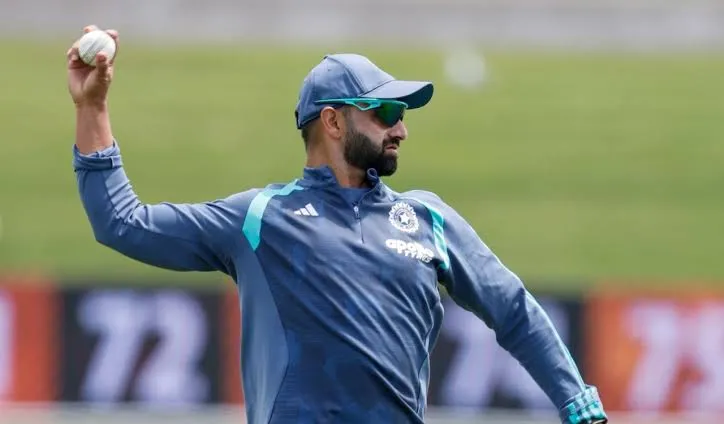
India fast bowler Auqib Nabi has identified the ongoing One Day International series in New Zealand as a valuable opportunity to strengthen his case for the 2027 Men's Cricket World Cup. Speaking before the fourth match, he discussed the adjustment required when bowling in New Zealand conditions and the importance of relying on skill rather than pace alone. India enter the next scheduled game with a 2-0 series lead after victories in the opening two ODIs, while the third fixture was abandoned without a ball being bowled. The fourth ODI is scheduled at Mount Maunganui on November 13, making the comments directly relevant to the team's immediate preparations.
Learning to use the conditions
Nabi has highlighted seam movement as an especially relevant part of bowling in New Zealand, where a delivery hitting the surface can behave differently from one simply sent down quickly. He referred to scrambling the seam and hitting the deck as approaches that may create opportunities. This is an explanation of bowling technique, not a guarantee that a particular method will take wickets in the next match. Conditions can change between venues and within one day's play. A disciplined bowler must read the pitch, watch the batters and adapt his lengths as the match develops rather than relying on a fixed plan.
The pacer has said this is his first experience bowling in New Zealand, making the series a significant test of adaptation as well as execution. He acknowledges that additional pace can be an advantage but has emphasised faith in the skills that earned him selection through earlier performances. That perspective matters for a newcomer trying to establish a place in international cricket. Raw speed is only one component of effective fast bowling. Control, seam presentation, consistency and decisions about when to attack can be equally important, especially when conditions reward subtle movement rather than an exclusively short-pitched approach.
Where India stand in the five-match series
India won the first ODI in Auckland on November 4 by five wickets using the DLS method. The second contest in Wellington on November 7 produced a narrow four-run Indian victory, giving the visitors their second win. The third match in Hamilton on November 10 was washed out without any play, leaving the series at 2-0 ahead of the fourth scheduled fixture. Nabi took two wickets in the second game, providing a concrete contribution on which to build. The fifth and final ODI is scheduled for November 15 at the same Mount Maunganui venue as the fourth.
The sequence of results provides a useful context for assessing individual performances. A comfortable series lead does not mean every place in a future World Cup squad is settled, nor does an abandoned match allow players to demonstrate form. Bowlers competing for places still need evidence that their methods work against international batting orders. The two remaining fixtures in the announced schedule offer opportunities for that assessment, subject to team selection and weather. The relevant question is not whether one interview can secure a World Cup berth, but how the player performs when a genuine opportunity is available.
Why 2027 creates a longer selection horizon
The 2027 Cricket World Cup is still ahead, so a place in the final tournament squad cannot be awarded solely on the strength of one successful spell. Selectors will consider a much wider period of form, fitness, roles and combinations. Nabi's comments show ambition and awareness of the competition for places, but they do not amount to a selection guarantee. A bowler who consistently demonstrates control and versatility will provide stronger evidence than someone who relies on occasional bursts of spectacular speed. The upcoming match is therefore an important step within a longer process of earning trust.
How seam bowling can shape the match
Seam movement can challenge batters by changing the ball's path after pitching, even when the delivery does not move dramatically through the air. A scramble-seam approach alters how the ball presents itself on contact with the surface, sometimes increasing uncertainty for the batter. But conditions, ball condition and accuracy are decisive. The method can be ineffective if the bowler repeatedly misses a useful length or if the pitch offers little assistance. Nabi's comments indicate an interest in applying technical detail to the conditions in front of him rather than treating one preferred delivery as a universal solution.
In a one-day match, a quick bowler's responsibilities also change with the phase of the innings. Early overs may reward attacks on the stumps or edges when movement is available. Middle overs can demand pressure and control, while the closing stages often require variation and clear fielding plans. A bowler seeking sustained selection must show that his strengths translate into more than one phase of play. None of those tactical possibilities establishes what India's actual team plan will be in the fourth ODI. The confirmed development is that Nabi has spoken about adaptability before a match with immediate series significance.
The next test is performance, not prediction
India's 2-0 lead gives the visitors a strong platform, but the remaining New Zealand fixtures will still be assessed on their individual sporting merits. Nabi has already contributed wickets in Wellington and has openly connected the tour to his longer-term international ambition. The responsible conclusion is that he is working to make a case for the 2027 World Cup while learning how to bowl effectively in unfamiliar conditions. The November 13 fixture will offer another opportunity if he is selected. Until performances are recorded, promises about wickets, match results or final squad decisions would go beyond the available facts.
PUBLISHED BY SUYASH PACHAURI, FOUNDER & OWNER, GLOBAL BOLLYWOOD | THE HOLLYWOOD SCOPE.