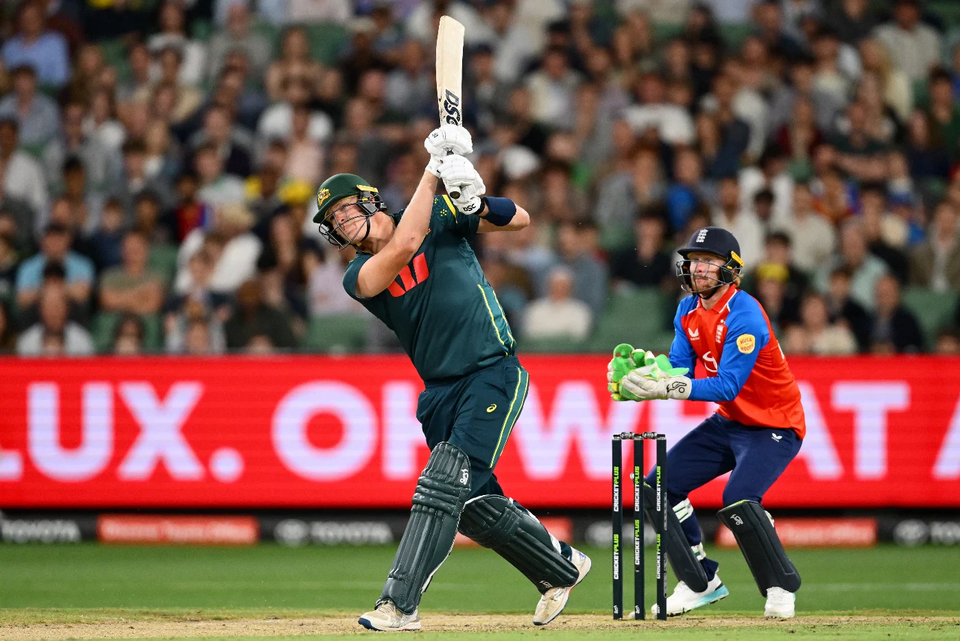
A Chase That Lasted Until the Penultimate Ball
Australia defeated England by three wickets in the first Twenty20 international at the Melbourne Cricket Ground, completing the highest successful T20I chase at the venue. England made 187 for 9, a total that demanded sustained aggression without leaving the lower order an impossible finish. Australia reached the target with one ball remaining when Jack Edwards found the boundary, taking a tense match from uncertainty to a 1-0 series lead.
The result carried significance beyond the opening point in a five-match contest. Australia entered the series after losing the one-day series 2-1 and with several established fast bowlers unavailable. A young and reshaped side needed evidence that it could absorb pressure. The successful chase supplied that proof, although the narrow margin also exposed areas both teams will revisit before the second match.
England Recover From 13 for 2
England's innings began badly when Phil Salt was dismissed from the first ball and another early wicket left the visitors 13 for 2. The recovery came through captain Harry Brook and Tom Banton. Brook struck 65 from 28 balls, while Banton added 39 from 22. Their 97-run partnership required only 41 deliveries and shifted the match from damage limitation toward a total above 200.
Brook's innings contained four fours and six sixes, using the MCG's dimensions with power and placement. Australia contributed to the momentum by missing chances, and England punished those errors. Yet the visitors could not sustain the same rate after the partnership ended. The final five overs produced only 37 runs and four wickets, leaving England at 187 for 9 rather than the total their middle-overs position had promised.
Nikhil Chaudhary Changes Both Innings
Nikhil Chaudhary produced the defining all-round performance. He took two wickets during England's innings and then made 66 from 38 balls in the chase. That combination allowed Australia to stay in the contest at two separate pressure points. His bowling helped prevent England from converting a dominant partnership into an overwhelming score, while his batting rebuilt the pursuit after early disruption.
The chase needed more than power. Australia lost Jake Fraser-McGurk for one, and Mitchell Marsh's 37 from 32 balls did not provide the required tempo on its own. Sam Harper contributed 32, but Chaudhary was the batter who matched the asking rate while preserving a path for the finishers. His innings gave the lower order a target that remained difficult but achievable.
Edwards Delivers the Final Blow
Jack Edwards finished unbeaten on 25 from 11 balls and struck the winning boundary from the penultimate delivery. Sam Curran attempted to defend the remaining runs, but Edwards sliced the ball through the off side for four. The shot ended a chase in which Australia repeatedly appeared one wicket away from losing control.
Late-innings batting often depends on clarity more than an elaborate plan. Edwards entered knowing the required rate and the limited time available. His ability to find a boundary at the decisive moment completed the work started by Chaudhary and turned the match into an Australian record at the MCG. It also rewarded his earlier contribution with the ball, where he claimed two wickets.
England's Missed Opportunity
England can identify two phases that cost the match. The first was the end of its own innings, when the prospect of a total above 200 faded. The second was the inability to close the chase after taking seven wickets. A target of 188 created scoreboard pressure, but the bowlers needed one more controlled over or one more completed chance to protect it.
The visitors still gained encouragement from Brook's authority and the speed of their recovery from 13 for 2. A five-match series gives them time to adjust. The next step is to extend the batting contribution beyond the central partnership and improve execution against lower-order hitters. Small changes in field placement or death-over length could be decisive in another close finish.
Australia's New-Look Group Passes an Early Test
Australia were missing several frontline fast bowlers. Mahli Beardman, Xavier Bartlett and Nathan Ellis were unavailable, while Pat Cummins and Josh Hazlewood were being rested before a later Test assignment. That absence created opportunities for players who need to establish themselves at international level. Beating England in a high-scoring chase is an important result for that developing group.
The victory should not conceal imperfect fielding or the periods when England controlled the match. Australia dropped chances and allowed Brook and Banton to accelerate rapidly. Improvement will be necessary because repeated mistakes may not be recoverable in the remaining games. The encouraging element is that younger players responded after those errors rather than allowing the match to drift away.
Australia lead the series 1-0 after a match that tested batting depth, fielding composure and late-over decision-making. Chaudhary's 66 and two wickets made him the central figure, while Edwards supplied the boundary that settled the contest. England showed enough through Brook and Banton to remain dangerous, but a weakened finish with the bat and an incomplete defence proved costly. The record chase gives Australia momentum, yet the closeness of the result suggests the series could remain unsettled.
PUBLISHED BY SUYASH PACHAURI, FOUNDER & OWNER, GLOBAL BOLLYWOOD | THE HOLLYWOOD SCOPE.