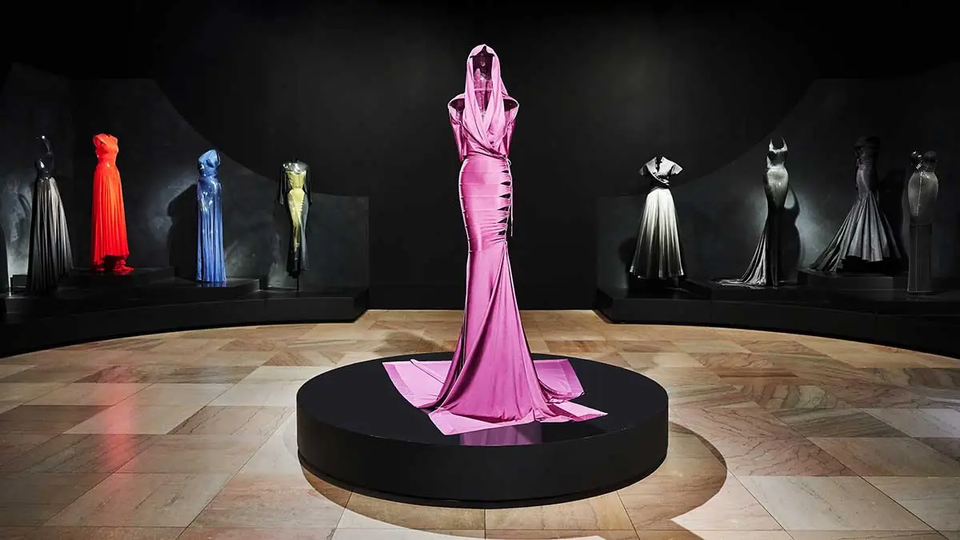
A Landmark American Survey of Alaïa's Work
Azzedine Alaïa's influence on modern fashion is receiving its most extensive American museum examination yet. Azzedine Alaïa: Sculpting Fashion opened at the Legion of Honor in San Francisco on November 21, 2026, bringing together approximately 80 garments that trace the designer's command of shape, movement and material. The exhibition continues through April 11, 2027 and is the first major United States retrospective devoted to his work.
The scale matters because Alaïa is often reduced to a single, memorable label: the King of Cling. His body-conscious dresses made that description understandable, but the phrase cannot contain the full range of his practice. The San Francisco presentation places familiar signatures beside tailoring, denim, leather, knitwear and haute couture. It argues that the designer's legacy rests not only on close-fitting silhouettes, but also on an unusually patient way of making clothes and an instinctive understanding of the body in motion.
Eighty Garments Reveal a Wider Creative Vocabulary
The exhibition begins with the women who helped make Alaïa's work visible. A spring and summer 1986 couture dress associated with Grace Jones sets an immediate tone of performance and physical confidence. Elsewhere, visitors encounter the sheer red halter gown worn by Rihanna at the 2013 Grammy Awards and a silk organza dress embroidered with gold-tone beads that Tina Turner wore in 1989. These pieces connect the designer's technical discipline with performers who understood how clothing can magnify presence.
Celebrity history is only one layer. Displays explore bandage construction, zippered dresses, sculptural knits, denim experiments and less frequently seen early work. The selection also shows how Alaïa could move between severe control and apparent ease. Fabric follows the body closely in one gallery, while volume and architectural structure take over in another. That variation makes the exhibition useful to audiences who know the famous photographs but have never studied the garments as engineered objects.
Fashion Meets the Legion of Honor Collection
The setting creates a conversation that goes beyond a conventional fashion retrospective. Looks from Alaïa's spring and summer 1992 collection appear near eighteenth-century European paintings and furnishings. The pairing encourages visitors to notice how silhouette, ornament and social presentation travel across centuries. A dress can echo the line of a painted figure, while a piece of furniture can clarify the designer's interest in contour and construction.
That curatorial approach also resists treating fashion as a separate or lesser decorative art. Alaïa's work is presented as part of a longer history of visual culture, craft and collecting. The exhibition was developed by Laura L. Camerlengo, the museum's curator responsible for costume and textile arts, with Olivier Saillard, director of the Fondation Azzedine Alaïa. Their collaboration brings museum scholarship together with intimate knowledge of the designer's archive.
The Designer Was Also a Student of Fashion History
Alaïa did not approach the past as a catalogue of references to copy. He collected historic clothing because construction itself fascinated him. Pieces from his personal holdings appear alongside his designs, including work by houses and couturiers he admired. The comparison reveals how closely he studied proportion, seams and fabric behavior, then transformed those lessons into clothes that felt unmistakably contemporary.
His independence from the industry's calendar was equally significant. Alaïa preferred to show a collection when it was ready rather than allow a seasonal timetable to dictate the final result. That position can sound romantic today, but it was also a practical defense of workmanship. It gave fittings, cutting and revision the time they required. In an era now defined by accelerated product cycles and constant visual turnover, the method feels newly relevant.
Why Alaïa's Human Touch Resonates in 2026
The retrospective arrives while fashion is debating automation, overproduction and the value of skilled labor. Alaïa's garments offer a precise response without becoming a slogan. Their power comes from knowledge held in the hand: where a seam should turn, how stretch can support rather than restrict, and how a cut changes when a wearer moves. The result is sensual, but never casual about technique.
His designs also complicate the familiar tension between freedom and control. Close-fitting clothes can appear restrictive, yet Alaïa's experiments with stretch jersey and flexible fibers were intended to let the body move. The best pieces do not hide their structure, but neither do they treat the wearer as a static mannequin. They create a partnership between garment and person, which helps explain why performers with commanding stage identities returned to his work.
For San Francisco, the exhibition is more than a display of glamorous dresses. It is a study of how one designer built a language by combining memory, craft and physical observation. Visitors may arrive for the famous names, but the lasting impression should come from the clothes themselves. Azzedine Alaïa: Sculpting Fashion restores complexity to a career too often summarized by one silhouette and gives American audiences the rare opportunity to see how rigor can become emotion.
PUBLISHED BY SUYASH PACHAURI, FOUNDER & OWNER, GLOBAL BOLLYWOOD | THE HOLLYWOOD SCOPE.