Introduction
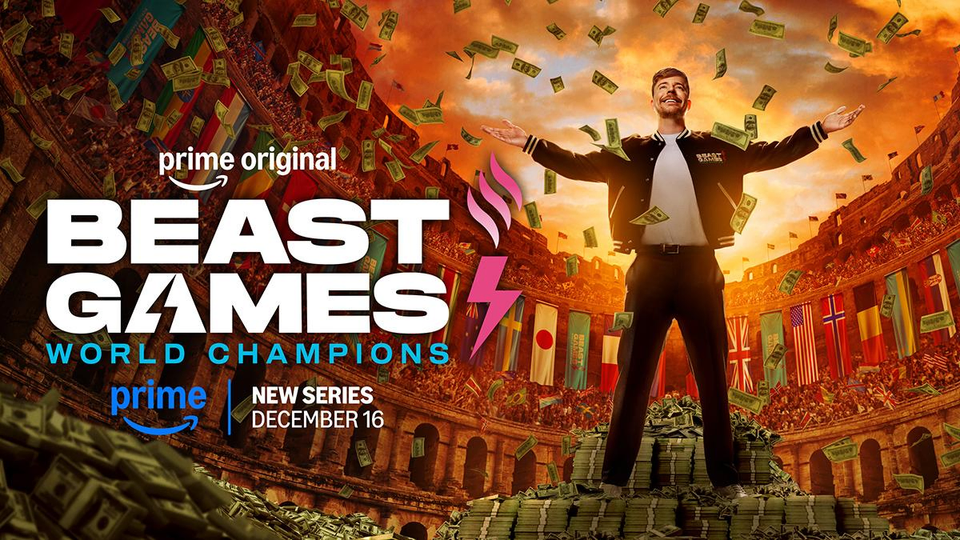
A global competition has a new date on the streaming calendar. Beast Games: World Champions, the third season of Jimmy Donaldson's large-scale reality series, is scheduled to begin on Prime Video on December 16, 2026. The launch plan, detailed in a November 16 announcement following a presentation at TwitchCon in San Diego, gives viewers a concrete timetable for a season built around national representation rather than a straightforward replay of the earlier contests. The programme has not premiered yet, so its quality and competitive outcomes cannot responsibly be assessed.
The central confirmed numbers are unusually ambitious: participants associated with 196 nations, a $5 million winner's prize and international settings that include Rome's Colosseum. The figures describe the announced format, not an independently measured audience or a completed outcome. They also explain why the new season matters beyond the personality of its host. This is a test of whether an internet-born contest can build a coherent television narrative around a geographically broad field of players.
The New World Champions Format
The World Champions subtitle changes the organising principle of the contest. Instead of simply assembling competitors into a large anonymous pool, the series presents its challengers as representatives of different nations. This approach immediately gives audiences potential points of connection, including regional pride, cross-border alliances and rivalries. It does not automatically mean that every participating country has an equal chance, or that all national representatives will receive equal screen time. Those judgments require the finished episodes and a clearer understanding of the selection process.
What the 196-Nation Figure Does and Does Not Establish
A field connected to 196 nations is a statement about geographic ambition. It should not be converted into an invented roster, a claim about exactly one contestant from every territory, or an assertion that each participant will appear in every episode. The announcement establishes the scale of national representation while leaving the detailed contestant list and elimination order outside the information confirmed so far. An accurate preview preserves that distinction rather than filling gaps with speculative biographies.
A Spectacle Built for International Screens
The advance material positions the Roman Colosseum among the season's striking backdrops and describes a stadium setting with a live audience numbering in the tens of thousands. Those images suggest a shift in production emphasis from enormous enclosed challenge spaces toward locations that have immediate global recognition. The locations also make the season visually legible across languages. A monument or stadium can communicate magnitude before a viewer has learned the rules of a particular game.
Spectacle, however, is not a substitute for transparent competition. Production scale can heighten a contest only when viewers understand the stakes, the rules and the consequences of each choice. The teaser is designed to create interest, not to disclose the complete rulebook. It would be premature to claim which challenges are toughest, which nations dominate or whether the series has improved its pacing. The more useful question is how the announced settings will support a season-long story rather than functioning merely as promotional imagery.
The Prize and the Strategic Stakes
The announced grand prize for the third season is $5 million. That is an important current figure because the prize eventually awarded in the first season reached $10 million. Treating the earlier record as the third season's promised payout would misinform viewers. The new season is described as a contest of physical ability, tactical judgment and social decision-making, with opportunities for collaboration and betrayal. Those mechanics can create drama, but the specific financial bargains and individual decisions remain unknown until the episodes are shown.
Why Alliances May Matter More Than Geography
A national framing naturally encourages predictions about teams and blocs, yet nothing in the preview proves that the entire event will operate as a country-versus-country tournament. People might form temporary alliances for practical reasons that have little to do with flags. Others may decide that cooperation is too risky when only one overall winner is expected. The tension between collective identity and an individual financial reward is one of the genuine storytelling possibilities opened by the advertised concept.
The Confirmed Release Schedule
Prime Video plans to release the first three episodes on Wednesday, December 16, 2026. Two additional episodes are then scheduled each week, ending with a single-episode season finale on Wednesday, January 13, 2027. This schedule gives prospective viewers a clear way to distinguish the initial launch from the later conclusion. It does not provide a verified release hour in every country, and viewers should check the platform in their own region rather than assume a United States time applies globally.
The relatively concentrated rollout makes the series a significant part of the year-end streaming calendar. It places the opening episodes ahead of the Christmas holiday and carries the competition into January. A batch of three premiere episodes may help establish the scale and mechanics before the slower weekly rhythm begins. Whether the pacing actually delivers a satisfying narrative will depend on editing and the balance between event-sized challenges and the human stories of competitors.
How Earlier Seasons Built the Franchise
The programme's history helps explain the confidence behind the World Champions label. The first season assembled 1,000 contestants and grew its eventual top prize to $10 million. Prime Video disclosed that its debut had attracted 50 million viewers in its first 25 days, a milestone that made the series its most-watched unscripted production at the time. That is a historical first-season audience figure, not a fresh measurement for season three, which has yet to launch.
Season two reduced the field to 200 participants and organised the central rivalry around a Strong versus Smart premise. It also included a collaboration with Survivor. This change demonstrated that the series could alter its structure rather than merely escalate numbers from one year to the next. Season three appears to take that experimentation in another direction, placing the idea of a global championship above the earlier binary competition. Comparing the three formats is more informative than assuming every later season must simply be bigger in every numerical category.
The Creative Team Behind the Camera
Jimmy Donaldson, widely known as MrBeast, returns as host and executive producer. Tyler Conklin, who co-created the programme, is returning as an executive producer and series director. The announced executive-producing team also includes Michael H. Miller, Rob Buchta, Chris Keiper, Josh Kulic, Michael Cruz and Jeff Housenbold. These credits matter because a production spread across huge live-event settings must coordinate complex competitive sequences, audience reaction, safety and comprehensible on-screen storytelling.
Creator-Led Television and Its Wider Significance
The franchise sits at the intersection of digital creator culture and conventional subscription television. Its central personality developed an audience through online challenges before moving the format into long-form streaming. World Champions expands that meeting point: national representation may attract people who have never followed the creator's online catalogue, while longtime followers will arrive with expectations of scale and rapid surprises. Success should ultimately be judged by the finished programme, not simply by the total number of flags or the size of an arena.
Where It Will Be Available
The season is announced as a Prime Video exclusive across more than 240 countries and territories. The first two seasons are already available on the platform for audiences interested in understanding the competition's evolution. Access conditions and subscription pricing vary by location, so an American membership figure should not be presented as a universal price. The platform's regional listing will be the practical source for local playback availability and any later changes to the release schedule.
What Viewers Still Need to Learn
Several elements are not established by the announced teaser and dates: the detailed contestant roster, the full order of eliminations, each challenge's scoring rules and a reliable release hour for every market. Likewise, no winner or audience response to season three exists to evaluate before the December premiere. A responsible preview can discuss the format's possibilities without claiming to have seen unreleased episodes. Subsequent coverage should make a clear separation between new confirmed announcements, on-screen events and the analysis that follows them.
Final Perspective
The November announcement offers a useful advance guide to a competition that is still weeks away. Beast Games: World Champions has a confirmed December 16 start, a January 13 finale, a $5 million grand prize and an unusually international premise. The dramatic promise lies in whether the programme can turn that premise into identifiable human stakes while maintaining fair, understandable rules. Until the first episodes arrive, the strongest assessment is of what has been announced and what remains open, not of a victory or critical verdict that has yet to happen.
PUBLISHED BY SUYASH PACHAURI, FOUNDER & OWNER, GLOBAL BOLLYWOOD | THE HOLLYWOOD SCOPE.