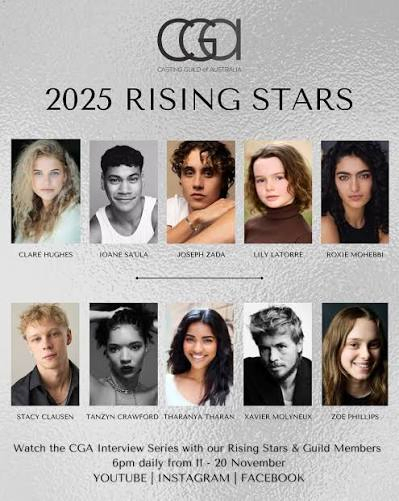
The Casting Guild of Australia unveiled its 2026 Rising Stars class on 16 November, naming ten performers whose work spans international streaming drama, major studio filmmaking, Australian independent cinema and live theatre. The selection arrives ahead of the guild's 27 November awards ceremony at Arts Centre Melbourne. Rather than predicting who will become famous, the announcement provides a useful record of performers whom working casting professionals have identified for their range, readiness and promise.
The ten names are Arlo Green, Catherine Laga'aia, Daniel R Nixon, Gemma Chua-Tran, Jack Patten, Joe Bird, Kala Gare, Lila McGuire, Luke Wiltshire and Vincent Miller. Their careers have developed through different routes, from conservatory training and stage performance to genre films and television. Considered together, the class offers a snapshot of how contemporary casting increasingly connects regional industries with international productions without erasing the importance of local work.
Why the Rising Stars selection matters
The annual initiative is now in its twelfth year. Its significance rests on the professional perspective behind the selections: casting directors assess not just visibility but the ability to inhabit roles, adapt across formats and sustain a career. An established screen credit may draw attention, yet stage experience, short films and independent productions remain equally revealing measures of an actor's craft. Recognition is an opportunity for wider consideration, not a guarantee of a new contract, film role or commercial success.
Previous honourees have included performers who later became familiar to audiences well beyond Australia, including Milly Alcock, Katherine Langford, Eliza Scanlen, Yerin Ha, Olivia DeJonge and Joseph Zada. Their varied paths underline why a collective talent list can be useful long after its announcement date. It invites producers and casting teams to examine work that might not have appeared in the same conversation otherwise.
Catherine Laga'aia and Gemma Chua-Tran connect local work with international screens
Catherine Laga'aia has already entered a global franchise through the title role in Disney's live-action Moana, opposite Dwayne Johnson. Her casting followed an extensive search, and the role placed a young Australian performer at the centre of a widely recognised story. The 2026 honour also reflects an emerging career beyond one signature part: her other screen work includes The Lost Flowers of Alice Hart, while projects associated with her next phase include the thriller Crashout and the series Spaceship Earth.
Gemma Chua-Tran brings a contrasting trajectory rooted in television, animation and independent storytelling. Audiences know her as Sasha So from Heartbreak High, a character whose presence across three seasons required sustained ensemble work rather than a single moment of impact. She has also contributed a voice performance to Lesbian Space Princess and has been linked to forthcoming screen projects including Gundam and Dustfall. Her inclusion shows that the guild's idea of versatility is not limited to live-action feature roles.
Jack Patten and Joe Bird: two different routes through genre storytelling
Jack Patten has built an international profile through the title role in Robin Hood, appearing in a production alongside Sean Bean and Connie Nielsen. His training at the National Institute of Dramatic Art forms part of a career that also includes War Machine and work on Greyhound 2. The transition between period adventure, contemporary action and large-scale screen productions demands different physical and dramatic registers, making the breadth of his casting a notable feature of his career so far.
Joe Bird came to wider attention through Talk to Me, a horror film that placed intense emotional performance inside a high-concept premise. Subsequent credits include Wolfram and Leviticus, while Crashout is another project bringing him into the same professional conversation as Laga'aia. His trajectory demonstrates how genre cinema can function as a powerful showcase for character work rather than merely as a route to name recognition.
Lila McGuire and Daniel R Nixon demonstrate the value of distinct acting foundations
Lila McGuire gained national notice by portraying tennis champion Evonne Goolagong Cawley in Goolagong. Her performance led to recognition at the 2026 Logie Awards, including the Graham Kennedy Award for Most Popular New Talent. Her career highlights the particular demands of portraying a real person: the actor must convey an identifiable public life while building an emotionally credible interpretation that remains more than imitation. Other work associated with her career includes Dustfall and Two Birds.
Daniel R Nixon has established a substantial foundation in theatre. His performances in Drizzle Boy and The Curious Incident of the Dog in the Night-Time display experience with material in which concentration, physicality and shifts in perspective are central to the storytelling. He received a Best Newcomer honour at the 2024 Sydney Theatre Awards, and his screen credits include Goolagong and The Newsreader. His presence in the class makes a broader point about casting: performance technique can mature across the stage and screen rather than following a single predetermined track.
Arlo Green's range across national and international projects
Arlo Green's work crosses New Zealand and international production environments. His credits include Nautilus, M3GAN and Cowboy Bebop, while Mum, I'm Alien Pregnant reached the 2026 Sundance Film Festival. These projects occupy different tonal worlds, from adventure and speculative storytelling to contemporary independent film. For casting professionals, such variety can be evidence that an actor is willing to move between unfamiliar narrative structures and production scales.
The selection of Green alongside performers whose careers developed primarily in Australia also reflects the practical interconnectedness of screen work across the region. An emerging artist may build credibility through local theatre or television before encountering broader distribution through a global platform. The guild's collective recognition allows those different routes to stand beside one another without treating a single market as the only measure of achievement.
Kala Gare and Luke Wiltshire broaden the definition of screen talent
Kala Gare's experience in major musical theatre productions, including Six, Rent and My Brilliant Career, provides a reminder that vocal work, live performance and character interpretation all contribute to screen readiness. Theatre performers often develop a direct relationship with audience response, musical timing and ensemble discipline that can carry into dramatic work in different media. Her inclusion widens the class beyond performers primarily recognised through feature films or streaming series.
Luke Wiltshire is both an actor and writer. His role in Homebodies and his work in the short film Boyish illustrate the importance of smaller-scale storytelling in developing an identifiable voice. Short films remain an essential proving ground, particularly when they give actors room to explore specificity without the attention generated by a studio campaign. Wiltshire's career also places creative authorship alongside performance, suggesting another way emerging screen talent can influence the material that reaches audiences.
Vincent Miller and the strength of independent drama
Vincent Miller attracted attention through Inside, appearing opposite Guy Pearce and Cosmo Jarvis in an Australian prison drama. A role in that setting asks a performer to communicate tension and vulnerability within a concentrated dramatic environment. Miller has also appeared in Plum and worked on the coming-of-age thriller Bluebottle. These credits point toward a career developing through varied supporting and leading opportunities rather than one highly publicised franchise appearance.
The range of the ten recipients resists the idea of a single blueprint for a successful actor. Some have led international productions; some have excelled in intimate drama; others are distinguished by musical theatre, character-based television or the collaborative demands of independent cinema. Their selection is therefore as much a statement about casting's search for versatility as it is a celebration of individual résumés.
What happens at the 27 November ceremony
The Rising Stars are scheduled to receive formal recognition at the Casting Guild of Australia Awards on 27 November 2026 at Arts Centre Melbourne. Joel Creasey and Kat Stewart have been announced as hosts. The ceremony will also recognise casting achievements across film, television, theatre and related production fields. As of the 16 November announcement, the ten rising performers were selected honourees; the wider competitive award results had not yet been announced. The distinction matters when presenting this historical development accurately.
The initiative also gives the recipients a point of contact with working casting professionals, including planned interview conversations about their careers and creative process. Such exchanges can introduce audiences to the people who evaluate talent behind the scenes, a part of film and television production that is often less visible than directing or acting itself. For emerging performers, professional relationships and repeated auditions remain fundamental even after public recognition.
A lasting record of the next generation
As a November 2026 industry document, the Rising Stars announcement remains worthwhile because the names, credits and selection date are fixed, while the later direction of each career is still unfolding. It would be misleading to treat the announcement as a newly occurring event or to project future box-office results from the guild's endorsement. The useful story is more considered: casting directors have identified ten performers with distinctive experience, and readers can now explore the roles and creative traditions behind each name.
For filmmakers and producers, the class is a prompt to look beyond headline familiarity when evaluating a performer. An audition, a short-film performance, a theatre production or a demanding supporting role can reveal precisely the quality a new screenplay requires. The 2026 cohort demonstrates that emerging talent is not confined to one screen, genre or production system, and that an actor's most significant future role may still be the one no audience has yet seen.
PUBLISHED BY SUYASH PACHAURI, FOUNDER & OWNER, GLOBAL BOLLYWOOD | THE HOLLYWOOD SCOPE.