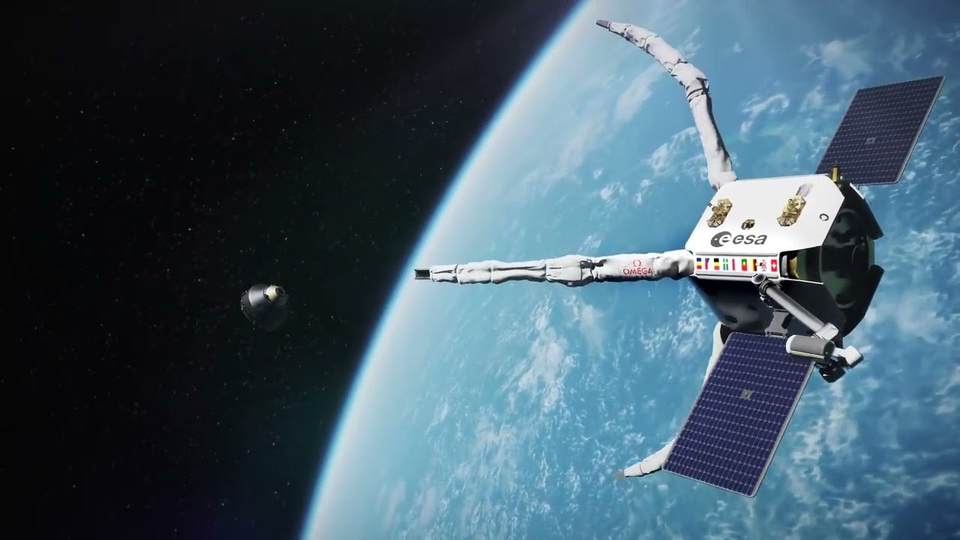
Europe's effort to clear abandoned objects from orbit reached a practical milestone on 17 November 2026. At Space Tech Expo Europe in Bremen, Germany, the European Space Agency and OHB System formalised a contract that moves ClearSpace-1 into construction. The spacecraft is intended to approach, capture and remove the ageing Proba-1 satellite. The development matters not as a completed cleanup operation, but as the start of a demanding engineering phase with consequences for future satellite operators.
ClearSpace-1 is being developed as a demonstration of active debris removal, a field that aims to deal with objects already left in space rather than simply prevent new waste. The consortium's current plan identifies 2030 as the launch year. This is a target rather than a guaranteed date, and the mission still has significant design, integration, testing and operational hurdles ahead. The November decision makes the next stage more tangible without settling those uncertainties.
What changed at the November contract signing
The Bremen signing places OHB System in the lead for the implementation phase, translating an established mission concept into hardware and flight preparations. The industrial group includes ClearSpace SA, Indra and OHB Sweden. Its immediate work is not the removal itself; it is to finish the equipment, integration and validation needed to attempt such an operation responsibly. For the European space industry, that distinction marks the difference between a promising technical proposal and a funded construction programme.
The announcement followed earlier design revisions and project challenges. Those setbacks are important to the chronology because robotic capture of a spacecraft that was never designed to be collected is substantially harder than docking two cooperating vehicles. The latest agreement should therefore be read as renewed progress after technical reassessment, not as evidence that all risks have disappeared. Success will depend on the spacecraft's performance in orbit, not the signing ceremony on Earth.
Why Proba-1 is the target
The target is Proba-1, a European experimental satellite launched in 2001. Its regular operations ended in 2022, leaving a spacecraft in low Earth orbit that was not built to accept a future retrieval vehicle. The satellite has a mass of roughly 95 kilograms. Although that makes it small compared with some abandoned rocket stages, it still poses the navigational and mechanical problems associated with close operations around an uncooperative object.
A satellite that cannot provide a dedicated docking port or actively assist a capture attempt creates a different engineering problem from a vehicle designed for servicing. Its attitude, rotation and location must be characterised without relying on the normal cooperation that makes crewed or robotic rendezvous more manageable. ClearSpace-1's value as a demonstration is that lessons from a difficult but defined target could inform future services for other objects. The mission does not promise to remove the wider debris population by itself.
How active debris removal could work
Precision navigation before physical contact
A cleanup spacecraft must first find and approach its target while preserving enough distance to avoid an accidental collision. Relative navigation, onboard sensing and carefully calculated manoeuvres will be essential. The final approach is especially sensitive because even small errors in position, velocity or orientation can produce contact forces that a non-cooperative satellite was never designed to withstand. Demonstrating control in this environment is as important as the eventual capture.
Operators also need a safe decision process for pauses, retreats and unexpected behaviour. A robotic mission cannot assume that every reading remains reliable or that the target will present a convenient capture position. The programme is consequently a test of systems engineering as much as robotics. A successful demonstration would show that a vehicle can reduce uncertainty progressively, move closer in controlled steps and retain the ability to abandon an unsafe manoeuvre.
Capture and controlled removal
After a secure capture, the removal vehicle would undertake a planned sequence to bring the combined system toward atmospheric reentry. The precise flight profile remains a matter for mission design and approval. That sequence should avoid generating new fragments or endangering other orbital users during the process. Capture alone would not meet the broader goal: the operation must handle the object through the end of the disposal sequence while respecting the applicable safety requirements.
The mission's underlying principle is straightforward even if its execution is not. Objects already stranded in orbit cannot always be helped by regulations governing new launches. A separate servicing vehicle may be needed to reduce their long-term collision risk. Demonstrating a reliable method with Proba-1 would provide data about autonomy, tracking, mechanical interaction and end-of-life disposal that future removal services can build upon.
The European team and the commercial opportunity
OHB System's prime-contractor role combines with specialised work from ClearSpace SA, Indra and OHB Sweden. Each organisation contributes to an industrial project where responsibility must cross technical and national boundaries. The arrangement reflects an emerging market in which traditional spacecraft manufacturers and companies focused on in-orbit services develop complementary capabilities. It is not evidence that a mass-market debris-removal business already exists; it is a concrete effort to establish the technologies and operating experience such a business would require.
If the demonstration succeeds, future customers could include satellite operators, agencies and organisations responsible for large pieces of obsolete hardware. However, any commercial service would face challenging questions about price, mission liability, insurance, permissions and the right to approach another owner's spacecraft. These are not settled by the November agreement. Public investment in demonstration missions can reduce technical uncertainty, but commercial viability will still depend on reliable operations and workable contracts.
Why the debris problem cannot be left to future launches
Earth orbit is an essential working environment for communications, navigation, weather observations and scientific research. Hardware left after its useful life can increase collision exposure, particularly as orbital activity becomes more intensive. A collision may create fragments that threaten functioning satellites far beyond the original participants. Better spacecraft disposal practices are therefore vital, yet they do not automatically resolve the risks created by objects launched decades earlier.
A practical debris strategy needs prevention and remediation together. Prevention includes safer design, post-mission disposal plans and responsible operational behaviour. Remediation addresses selected objects already stranded in useful orbital regions. ClearSpace-1 sits in the second category and could help demonstrate whether a carefully managed removal service is achievable. It cannot establish that every type of debris can be economically collected, and it will not remove the countless small fragments that are difficult to track individually.
A test for Europe's Zero Debris ambitions
The agency's Zero Debris approach seeks better environmental performance across future missions and points toward 2030 as an important policy horizon. ClearSpace-1 relates to that ambition because effective removal technologies could complement rules intended to reduce the creation of more debris. The project also gives regulators and insurers a case study in the practical conditions required for servicing uncooperative spacecraft. Any future standards will need evidence about accuracy, failure modes and end-to-end operational safety.
The broader test concerns how much responsibility the space industry accepts for equipment after its commercial or scientific usefulness ends. That responsibility cannot rest only on promising improved disposal plans for new satellites. Orbital infrastructure will continue to coexist with older objects. The challenge is to develop procedures that reduce risk without introducing new hazards, and to establish who pays for those procedures when the target is no longer economically productive.
The 2030 schedule and the questions still open
The November 2026 construction announcement identifies a planned launch in 2030. Some older mission summaries have listed different planned years, making the newly announced schedule the appropriate reference for this specific milestone. A planning date should not be mistaken for a final launch booking or for a promise that retrieval will happen immediately after launch. Ground qualification, spacecraft readiness, orbital conditions and regulatory clearances can still affect the eventual sequence.
There is also a measurement question. A successful mission will need to demonstrate more than the fact that two objects made contact in orbit. Observers should look for evidence of controlled approach, stable capture, successful disposal and avoidance of new debris. Independent understanding of those outcomes will matter to policymakers, companies and taxpayers assessing whether active removal merits broader deployment. Until flight operations occur, this remains a construction-stage mission with a defined objective rather than a completed space-cleaning achievement.
The enduring significance of the November decision
ClearSpace-1's transition into construction is valuable because it focuses attention on the practical work required to make orbital sustainability more than a slogan. The Bremen agreement dated 17 November 2026 establishes industrial responsibilities and advances a mission aimed at removing a real, retired satellite. Its relevance will continue as the team works toward 2030, with technological milestones and safety evidence still to come.
For readers following the space economy, the central point is the difference between aspiration and demonstration. Europe is preparing to test whether an uncooperative satellite can be removed through a purpose-built service vehicle. The task is difficult, expensive in engineering effort and operationally sensitive, yet it addresses a long-term problem that future generations of spacecraft will inherit. The outcome will help determine how realistic large-scale orbital cleanup can become.
PUBLISHED BY SUYASH PACHAURI, FOUNDER & OWNER, GLOBAL BOLLYWOOD | THE HOLLYWOOD SCOPE.