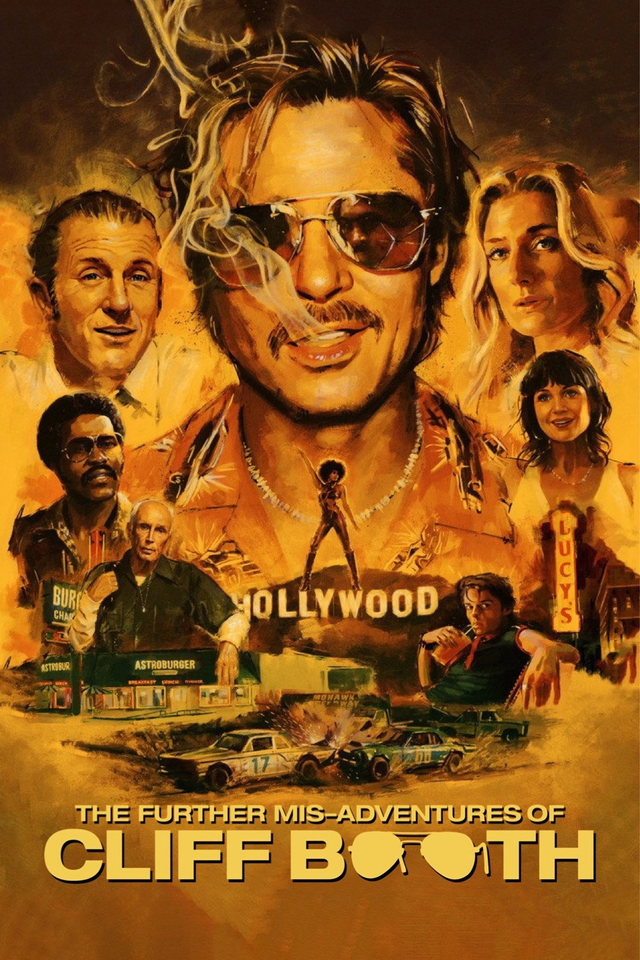
A familiar character enters a different filmmaking machine
The Further Mis-Adventures of Cliff Booth returns Brad Pitt to the relaxed stuntman and fixer first introduced in an alternative version of 1969 Hollywood. The new film moves to 1977, places David Fincher behind the camera and retains Quentin Tarantino as screenwriter. That combination is the central attraction, but it also creates the movie’s defining tension: two powerful creative temperaments appear to want different things from the same wandering hero.
Tarantino’s script treats Cliff as a figure who can drift from one encounter to another, carrying the mythology of an earlier film into a changing industry. Fincher brings controlled compositions, measured movement and an interest in the darkness beneath Hollywood surfaces. The result has craft and atmosphere, yet the looseness of the writing often resists the exacting momentum that normally gives Fincher’s films their grip.
Brad Pitt keeps Cliff watchable without forcing emotion
Pitt understands that Cliff’s appeal depends on withholding effort. The character listens, watches and acts with the confidence of someone who assumes he can survive whatever arrives. That quiet control remains engaging, particularly in scenes where Cliff performs ordinary work, trades guarded conversation or moves through Los Angeles as if the city’s hidden rules were written for him alone.
The limitation is that familiarity sometimes replaces development. Eight years have passed inside the story, but Cliff can feel less like a man changed by time than a legend continuing to circulate. Pitt provides small signs of age, amusement and fatigue, yet the screenplay rarely forces the character to confront a choice that would permanently alter his self-image. Charisma carries individual scenes farther than the dramatic arc carries the film.
The supporting cast offers sparks around the margins
Elizabeth Debicki brings intelligence and restraint to Karen Crosby, a figure able to recognise both Cliff’s usefulness and the danger of romanticising him. Scott Caan plays actor Charlie Peters with an awareness of inherited Hollywood masculinity, while Yahya Abdul-Mateen II adds energy as the rising performer Hot Rod Harrison. Carla Gugino, Peter Weller, Matt Groove and JB Tadena contribute to the film’s crowded period world.
Several performers are memorable without receiving enough space to transform the narrative. The episodic construction introduces personalities, tensions and possible routes, then moves onward before many of them can deepen. That approach suits a hangout movie, but the material repeatedly hints at darker consequences. When those threads remain secondary, the film’s carefully populated Hollywood begins to feel more like an impressive environment than a complete dramatic system.
1977 Los Angeles becomes the strongest character
The production design and location work build a convincing late-seventies Los Angeles shaped by fading counterculture, commercial cinema and people adjusting to a new blockbuster era. Cars, streets, bars, theatres and industry offices feel selected rather than merely decorated. Fincher’s eye turns the city into a network of professional favours and private threats, where every casual meeting may conceal a transaction.
That visual precision sometimes clashes with the screenplay’s preference for digression. Fincher appears to search for structural meaning in the city’s shadows, while the writing enjoys conversation, reference and detour for their own sake. Neither instinct is inherently wrong, but the film rarely merges them into a single rhythm. The surface remains polished even when the story feels as though it is waiting for its real destination.
A stylish continuation that lacks a decisive reason
The movie is most successful when it simply allows Cliff to move through a world that is slowly becoming less suited to his kind of masculine myth. Moments of professional obsolescence and cultural transition suggest a richer film about a man whose legend may outlast his usefulness. Those ideas remain visible, but they do not consistently govern the plot or reshape the character.
As a continuation, the film offers pleasure in performance, craft and recognition. As a self-contained drama, it is less secure. The central mis-adventure never accumulates enough emotional pressure to justify the long, episodic journey. Fincher and Tarantino each leave distinctive marks, but their strengths sit beside one another more often than they combine, producing an intriguing collaboration that remains artistically divided.
What comes next
The film begins an exclusive two-week IMAX theatrical run on November 25 before moving to Netflix on December 23. That strategy suits a production whose period detail and controlled imagery benefit from a large screen, while its existing character recognition can later drive a wider streaming audience.
The Further Mis-Adventures of Cliff Booth is not without considerable pleasures, especially Pitt’s ease and Fincher’s command of environment. Yet the movie never completely answers why this character needed another chapter beyond the opportunity to spend more time in his company. The return is handsome, watchable and curiously distant from the urgency its talent suggests.
A legendary Hollywood drifter returns in a film whose precision never fully matches its swagger.
PUBLISHED BY SUYASH PACHAURI, FOUNDER & OWNER, GLOBAL BOLLYWOOD | THE HOLLYWOOD SCOPE.