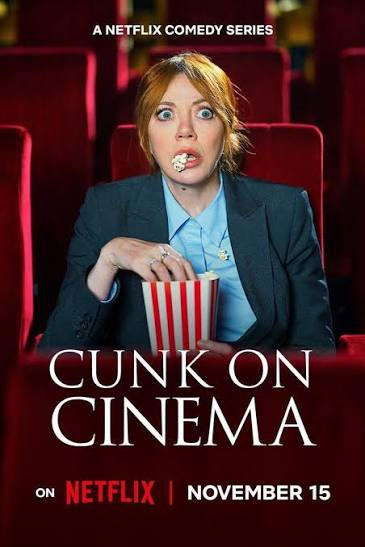
Film history has rarely been packaged quite like Cunk on Cinema. The British comedy brings Diane Morgan back as Philomena Cunk, a presenter whose confidence remains entirely disproportionate to her understanding of the subject. This time the object of her curiosity is the moving image itself. The British launch on 12 November 2026 and international streaming coverage on 15 November make this a particularly relevant title for readers interested in filmmaking as well as comedy. As of 24 November, the Indian catalogue lists the programme with an adult classification.
Why the international cut matters
The distinction between the two viewing editions is worth explaining before audiences begin the series. In Britain, the programme was scheduled for three weekly television instalments from 12 November, with the complete collection also made available on the domestic catch-up service that morning. The international Netflix edition is described as six instalments of approximately fifteen minutes each. The difference in packaging is not evidence of a second season or six additional stories. Nor should audiences assume that every sequence is identical across the versions without comparing them directly.
The territorial arrangement also matters. Netflix is the distributor outside the United Kingdom and Ireland under the announced release plan. Indian viewers can find the title in their local Netflix catalogue, where it carries an A classification. Availability in one territory does not establish availability elsewhere. The official listing does not establish an exact Indian activation time or confirm every optional audio track, so viewers should consult the playback menu rather than assume that a Hindi dub is included.
The fictional interviewer as a filmmaking device
At the centre of the comedy lies a productive mismatch between documentary grammar and the behaviour of its presenter. In a conventional educational programme the host establishes authority by asking carefully researched questions, summarising complex arguments and directing the viewer towards an intelligible conclusion. Cunk reverses that relationship. Her confidence becomes a source of uncertainty, and the viewer is invited to recognise the gap between the seriousness of the presentation and the absurdity of the inquiry.
That device requires more than an amusing script. A reaction shot can determine whether a line appears merely foolish or becomes unexpectedly revealing. A measured pause can make an interviewee's response more entertaining than another punchline. The tension between carefully constructed framing and seemingly uncontrolled conversation is particularly interesting to directors who work with documentary conventions. Comedy of this kind depends on knowing the rules of factual television well enough to break them deliberately.
A conversation about the mechanics of film
The scope extends across early cinema, twentieth-century movements and the technological changes that continue to alter production. Among the participants featured in the promotional material are actor Benedict Cumberbatch, filmmaker Michael Bay, composer Daniel Pemberton and screenwriter Steven E. de Souza. Their different professional backgrounds help position cinema as a collaborative enterprise rather than a history that belongs exclusively to actors or directors.
The people constructing the comedy
Charlie Brooker created the series, with Al Campbell directing. The writing group includes Ben Caudell, Erika Ehler, Eli Goldstone, Jason Hazeley, Dan Maier, Joel Morris, Michael Odewale, Kali Varghese and Sam Ward, alongside Morgan and Brooker. Brooker, Jessica Rhoades, Morgan and Ward are credited as executive producers. Pacesetter Productions is responsible for the production. The collective writing arrangement is especially appropriate for a format in which a short sequence may move between historical observation, an intentionally illogical question and a carefully timed visual joke.
Morgan's performance is also a reminder that comic acting need not be overtly expressive. The fictional host has to appear convinced of her own reasoning. If the performer announces the joke through a knowing smile or an exaggerated reaction, the audience loses part of the pleasure of discovering the absurdity independently. Maintaining a consistent character across conversations, narration and staged material is a demanding form of screen performance.
What film students can take from the format
The programme is entertainment rather than a substitute for a cinema studies course. Its deliberately unreliable presenter makes it particularly unsuitable as a standalone factual reference. Nevertheless, there is considerable value in watching how a familiar subject can be approached through an unfamiliar point of view. An aspiring documentary director might examine the juxtaposition of archival imagery and narration, while an editor might study the placement of reaction shots and the rhythm of interview exchanges.
Separating the joke from the historical record
A useful exercise would be to identify a film movement or technical process mentioned in a segment and then explore it independently. The contrast between the comic treatment and a serious account can clarify how much meaning depends on context. This is also a timely question as filmmakers consider the impact of computer-generated imagery and artificial intelligence: technological history is not simply an inventory of inventions, but a history of artistic choices, industrial constraints and audience expectations.
A compact comedy with a specific audience
For viewers who enjoy satire about the entertainment industry, the combination of a fictional presenter and real practitioners offers a different experience from a conventional celebrity interview. Those seeking a detailed chronological survey of world cinema should approach it with different expectations. The programme's short international episodes are designed around comic momentum, not comprehensive coverage. Its Indian adult classification is another reason to check suitability before planning a family screening. The enduring appeal of the format lies in its ability to make the familiar language of film commentary feel strange again.
PUBLISHED BY SUYASH PACHAURI, FOUNDER & OWNER, GLOBAL BOLLYWOOD | THE HOLLYWOOD SCOPE.