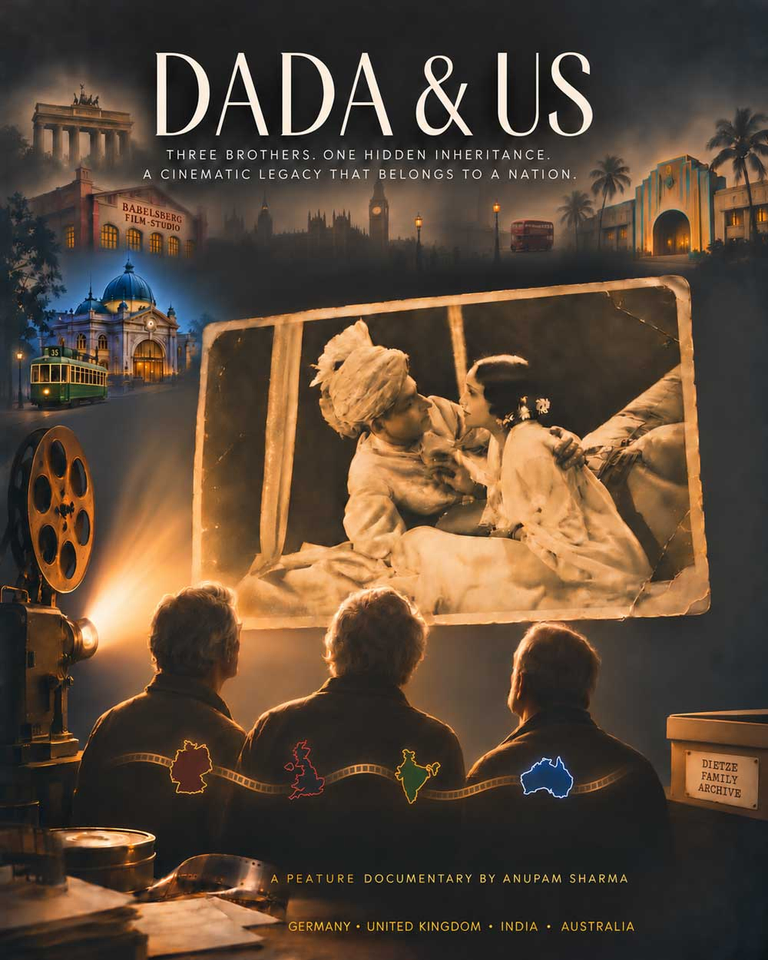
A Family Discovery Opens a Film-History Mystery
Three brothers raised in Melbourne are at the centre of Dada & Us, a documentary project that links their family to the foundations of Indian cinema. Walter, Peter and Paul Dietze grew up understanding their background through a European family story. A photograph discovered in an attic eventually led them to Himansu Rai, the pioneering filmmaker and Bombay Talkies co-founder who was their grandfather. The revelation transformed private curiosity into a much larger historical responsibility. Their suburban home contains thousands of letters, photographs and studio documents connected to Rai and Devika Rani. The project is not simply about discovering famous ancestry. It asks what happens when a family unexpectedly becomes custodian of material that belongs to the cultural memory of an entire film industry.
Why Himansu Rai and Devika Rani Matter
Bombay Talkies helped professionalise Hindi filmmaking and became a training ground for artists who would shape popular cinema for decades. After Rai's death, Devika Rani guided the studio through a period of war, financial pressure and social change. Her leadership helped launch or advance performers including Ashok Kumar, Dilip Kumar and Madhubala. She later became the first recipient of the Dadasaheb Phalke Award, recognition of a career that joined acting, production and institution-building. Dada & Us has access to correspondence that can reveal her thinking in her own words rather than through later legend. That material may deepen public understanding of a woman who exercised unusual creative and business authority at a time when the film industry offered few such positions.
An Archive in a Spare Room
The Dietze family holds more than 3,000 items, including roughly 1,100 pieces of correspondence associated with Devika Rani's years running the studio. Paper archives are vulnerable to heat, moisture, handling and the simple passage of time. Cataloguing and priority digitisation have therefore become part of the documentary's work, not merely background research. The project can record the brothers' emotional journey while also showing the practical labour required to preserve cinema history. Their collection gains additional significance because personal belongings and surviving artworks connected to Devika Rani have remained entangled in a long legal and institutional dispute in India. The contrast between a private Australian collection and unresolved heritage questions in India gives the film a naturally dramatic structure.
A Cross-Border Production by Design
Filmmaker Anupam Sharma plans to shoot across Australia and India, following both the family and the wider effort to understand, preserve and possibly repatriate knowledge about the archive. The project is in late development and has been presented through the documentary strand of the WAVES Film Bazaar Co-Production Market. Its budget and financing plan position it as an international production rather than a small family record. The Australia-India co-production framework also gives the story an institutional relevance that mirrors its subject. Dada & Us is Australian through the brothers' lives and Indian through the cinematic legacy they inherited. That dual identity is not a marketing device. It is the reason the story exists.
The Documentary's Larger Responsibility
The strongest version of Dada & Us will allow the archive to complicate familiar history instead of merely celebrating famous names. Letters can reveal disagreements, financial pressures, professional ambitions and personal compromises that polished retrospectives often omit. The brothers' discovery also raises questions about who owns cultural memory and how private families, governments, archives and film institutions should cooperate. With the main shoot planned for 2027, the immediate task is securing partners capable of restoration, documentary production and responsible access. If the project succeeds, it can give audiences an intimate route into Bombay Talkies while helping protect source material that may otherwise remain scattered and fragile. A photograph in an attic has opened a story stretching across continents and nearly a century of cinema.
Preservation Must Include Public Access
Digitising the documents will protect information, but preservation is incomplete if the resulting material remains inaccessible to scholars, filmmakers and the public. The family and production will need to consider permissions, cataloguing standards, translation and the long-term home of digital copies. Letters may contain personal information alongside major historical evidence, requiring decisions that respect privacy without hiding the archive's significance. Partnerships with an established film archive or heritage organisation could provide conservation expertise and a framework for responsible access. The documentary can make that process visible, helping audiences understand that cultural history survives through patient technical work as much as dramatic discovery. If Dada & Us encourages institutions in India and Australia to cooperate on the collection, its impact may extend well beyond the film's running time and release cycle.
A Family Story with Institutional Reach
The brothers' participation keeps the story grounded in present-day discovery rather than turning the documentary into an illustrated lecture. Their reactions, uncertainties and decisions about stewardship can help viewers understand why an archive matters before they know every historical name. That emotional access should complement scholarship, not replace it. The film's unusual strength is its ability to make family identity, international law and cinema heritage part of one unfolding narrative.
PUBLISHED BY SUYASH PACHAURI, FOUNDER & OWNER, GLOBAL BOLLYWOOD | THE HOLLYWOOD SCOPE.