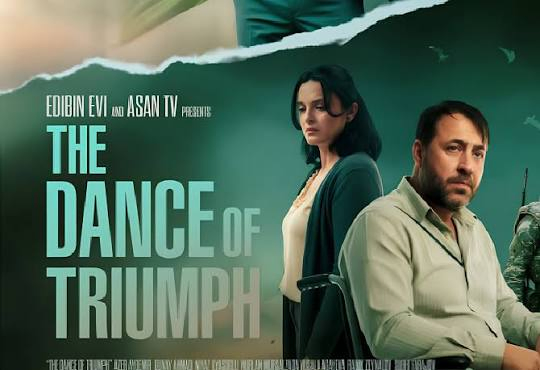
An Azerbaijani short film has added an important international distinction to its 2026 festival journey. The Dance of Triumph, also known as Zəfər Rəqsi, received the Global Peace, Harmony and Human Rights category prize at the International Film Festival The Hague, which took place in the Netherlands from 13 to 15 November. This account looks back at the completed event, rather than presenting the result as a new announcement. Its significance lies in how a compact drama about the aftermath of war found an audience beyond the country where its story originated.
The film screened at Pathé Buitenhof on 14 November, and the festival concluded with its awards ceremony on 15 November. The announcement circulated more widely on 16 November. Those dates matter for a historical cinema archive: the screening, the judging decision and the first broader reports are connected developments, not three separate news stories. The film's recognition can still be useful to readers today because the award, creative credits and selection history form a lasting part of its festival record.
A defined peace and human rights competition
The prize was awarded within a named thematic category, not as an unspecified victory across every programme at the event. A jury of thirteen evaluated submissions that eventually produced a festival lineup of sixty-three films representing twenty-three countries. The reported submission pool numbered 503. These figures explain the scale of the selection, but should not be used to imply that every submission competed directly for this one category's final honour. The distinction is especially important when presenting festival achievements accurately.
Four finalists were associated with the Global Peace, Harmony and Human Rights competition: Azerbaijan's The Dance of Triumph, Montenegro's Obraz / The Tower of Strength, the Palestinian-Portuguese production Free Fish and the United Kingdom's Bystander. The winning film was chosen unanimously in the final assessment. That decision gives the award a clear competitive context without reducing the other films to a ranking they did not receive. The shortlist itself illustrates how filmmakers from different societies approach human dignity, conflict and social responsibility through contrasting narratives.
What the jury recognition does and does not establish
The jury's recognition concerned the submitted film and the criteria of its festival category. It does not independently establish a theatrical release date, streaming agreement, box office figure or universal critical consensus. None of those details should be attached to the award without separate confirmation. The useful conclusion is narrower and stronger: a specific work, evaluated alongside named finalists, received an identifiable prize at an identifiable festival on the basis of a completed selection process.
For independent filmmakers, such clarity is more than a matter of wording. Festival citations travel into pitch documents, grant applications, biographies, international catalogues and distributor conversations. An overstated award can undermine confidence in a project, whereas a correctly described honour remains valuable for years. This is why the exact name of the winning category belongs near the top of any permanent article about the film.
A veteran's difficult journey toward ordinary life
The Dance of Triumph follows Jalal, a war veteran who lost both legs and faces a painful struggle to reconstruct daily life after combat. The central conflict is not simply whether a former soldier receives public gratitude. It is whether a person surrounded by memories of sacrifice can recover purpose within the private spaces of home, family and relationships. That shift from ceremonial victory to intimate uncertainty gives the film a human-scale premise capable of reaching audiences unfamiliar with the original conflict.
A promise offers Jalal an emotional direction. He had intended to dance to the traditional Heyvagulu song at the wedding of his fallen friend's sister. Physical injury makes that undertaking difficult, yet the obligation carries a meaning beyond the dance itself. It connects a surviving friend with someone who did not return and turns an apparently ordinary wedding celebration into a test of loyalty, grief and hope. The premise gives the protagonist an immediate goal without making recovery seem simple.
The dance as an element of storytelling
The traditional music and planned wedding dance supply a culturally specific thread to the drama. They are not decorative background details added merely to create an emotional climax. Instead, the promise becomes a means of exploring what it feels like to remain bound to a friendship after the friend's death. The film's central question concerns how a person can honour that bond while continuing to participate in life, especially when the body can no longer perform familiar gestures in familiar ways.
The premise also allows several feelings to exist at once. Family affection may coexist with frustration, pride with vulnerability, and gratitude with isolation. Nothing in the award announcement proves that every difficult aspect of rehabilitation is resolved within the story. A responsible description therefore emphasises the struggle and the narrative direction rather than inventing scenes or declaring a final emotional outcome that has not been independently established.
Creative team and production background
The project is a joint production associated with ASAN TV and the Ədibin Evi literature-support organisation. Its director is credited in the festival's own programme as Geray Hasan, while some English-language coverage transliterates the name as Garay Hasan. The festival programme also lists Emin Musavi as producer and Yashar Bunyad as writer. Keeping the variant spelling visible, rather than silently treating two renderings as different people, helps readers connect the film's international and domestic records.
The screenplay draws from Bunyad's story Heyvagulu, associated with the Mir Jalal Short Story Competition. Azer Aydemir is the film's principal named performer in the festival listing, with Gunay Ahmad, Nurlan Mursalzada and Niyaz Ilyasoglu also identified in broader cast credits. An accurate archive should retain the supplied names while acknowledging variations in English transliteration. It should not assign specific character names or screen time to supporting performers without a reliable cast breakdown.
The film runs approximately thirty-nine minutes. That duration positions it as a substantial short-form fiction work rather than a full-length feature, although some publicity calls it a short feature. The festival's programme gives a running time of 39 minutes and 41 seconds, which reasonably explains why a rounded 39-minute description also appears. This small distinction illustrates why practical editorial precision matters when several public listings use different conventions for the same production.
Participation beyond professional casting
The production received support from Balakhani Operating Company, and war veterans employed by the company reportedly appeared in some scenes. Their involvement is a notable part of the production history, but it should not be taken as evidence that the entire cast consists of veterans or that every element of the fiction is documentary material. The work remains a dramatic adaptation. Its engagement with lived experience can be acknowledged without collapsing the distinction between performed narrative and firsthand testimony.
Why The Hague mattered to this production
The Hague is internationally associated with institutions of justice and diplomacy, which gave the screening a symbolic setting for a film about the human consequences of conflict. Symbolism alone, however, did not determine the result. The film was selected for the festival programme, shown to an international audience and then recognised through the competition's stated award process. The achievement is best understood as a combination of artistic work, festival access and the ability of a local narrative to communicate across language and geographical boundaries.
At the ceremony, a representative of the producing organisation, Shafag Mehraliyeva, accepted the prize and spoke about the importance of human dignity and humanitarian principles. Azerbaijan's ambassador to the Netherlands, Anar Ajamov, also attended. These details help establish the event's public and cultural context. They should not distract from the filmmakers and their subject: the experience of one fictional veteran, the ties between surviving friends and families, and the challenge of living with permanent consequences after a war has ended.
The Hague appearance formed one stop on a wider 2026 international festival journey. The production had previously received attention at events in several countries, and the Hague recognition was described as its seventh international success that year. The number is useful as a reported milestone, but each award should be assessed by its own category and organiser. A cumulative count cannot substitute for a precise filmography, and it is not proof of a commercial distribution deal.
An enduring record for independent cinema
The film's festival success is relevant beyond its immediate ceremony because short-form fiction often struggles for the visibility routinely afforded to mainstream theatrical releases. Awards can help an independent project enter later conversations with festival programmers, educators and commissioning editors. The process remains uncertain: an accolade may improve discoverability without guaranteeing further screenings or revenue. For audiences, it can nonetheless provide a reason to seek out an unfamiliar film and learn about a filmmaking community rarely represented in everyday coverage.
This is also a case study in how personal storytelling can give conflict-related material an accessible shape. The broad theme of peace is expressed through one character's ordinary ambition, a promised dance, rather than solely through speeches or institutional settings. That connection between large historical events and specific human relationships is an important creative choice. Readers can appreciate the premise while remaining free to evaluate the actual film's performances, direction and writing when they have an opportunity to watch it.
No confirmed general streaming platform, global theatrical release, or public ticketing plan has been established in the information available for this retrospective. Readers should therefore distinguish festival selection and award recognition from immediate viewing availability. Similarly, no later competitive result is assumed here. Future public updates may clarify the film's distribution pathway, but the November festival outcome stands on its own as a dated and verifiable event.
The lasting significance of the November result
The appropriate historical record is straightforward: The Dance of Triumph screened in The Hague on 14 November 2026, was recognised in the Global Peace, Harmony and Human Rights category during the festival ending on 15 November, and drew subsequent coverage on 16 November. The award belongs to the film and its team, while the wider selection demonstrates the presence of international competitors from several countries. This factual chronology is stronger than any attempt to make an older announcement sound newly breaking.
For the film's creators, the distinction adds a meaningful line to an already international festival history. For readers, it offers a point of entry into Azerbaijani short cinema and into a story concerned with grief, responsibility, resilience and the complicated work of rebuilding a life. The award is not a verdict on every war story or every aspect of the film's craft. It is a concrete achievement that deserves accurate preservation, with room for later reporting if further festival, screening or distribution information becomes available.
PUBLISHED BY SUYASH PACHAURI, FOUNDER & OWNER, GLOBAL BOLLYWOOD | THE HOLLYWOOD SCOPE.