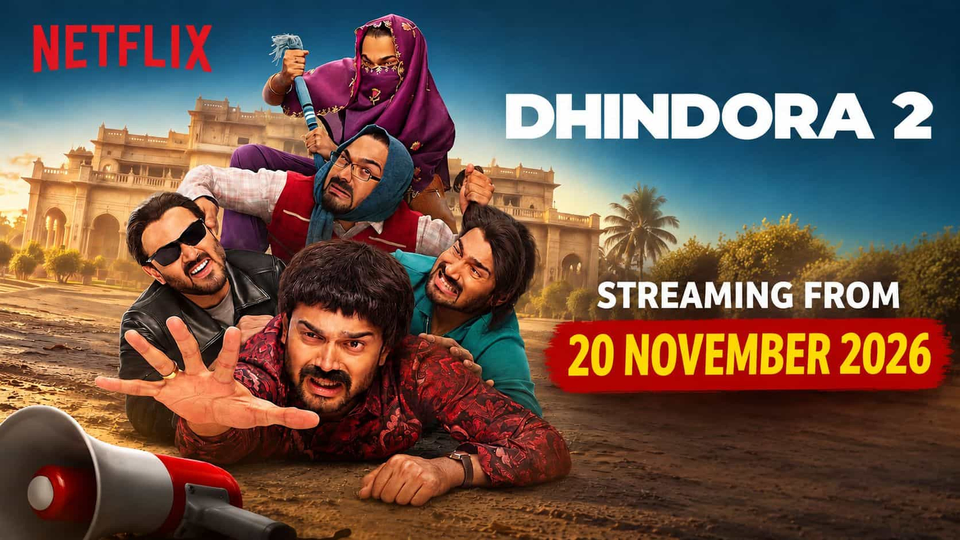
Titu Mama brings the family chaos to a global platform
Dhindora Season 2 has begun streaming on Netflix, returning Bhuvan Bam to the interconnected family of characters that grew from the BB Ki Vines universe. The eight-episode season places Titu Mama at the centre of a new domestic crisis involving an ₹11 crore loss, strained family equations and an attempt to repair relations with his in-laws. As usual, a simple plan quickly becomes a much larger public spectacle.
The move gives the series a substantially wider platform five years after its first season. Long-time viewers already understand the personalities, grudges and comic rhythms inside the family, while Netflix introduces those characters to audiences who may not have followed the original online series. The challenge is to welcome new viewers without repeatedly explaining jokes that existing fans know by heart.
Bhuvan Bam continues a demanding multi-character performance
Bhuvan plays nine characters across the season, including Titu Mama, Babloo ji, Janki, Sameer and Bancho. The format requires more than costume and voice changes. Each member of the family needs a distinct emotional rhythm so that conversations feel like genuine clashes among relatives rather than a technical exercise built around one performer.
That versatility has always been the foundation of the BB Ki Vines world. Bhuvan can move from swagger to embarrassment, affection and panic within the same sequence while maintaining the illusion that every character has independent motives. A longer streaming canvas gives those personalities more room, but it also demands stronger plotting because character recognition alone cannot sustain eight episodes.
From independent digital phenomenon to streaming franchise
Dhindora’s return reflects a larger change in Indian entertainment. Creator-led characters that once lived primarily in short online sketches can now support full seasons, production teams and international distribution. The relationship is not simply a platform acquiring a familiar face. It is a creator bringing an established audience, comic language and world-building system into a more conventional streaming structure.
For Netflix India, the series adds a highly local comedy with immediate digital recognition. For Bhuvan and producer Rohit Raj, it provides reach without requiring the humour to abandon its Hindi-language specificity. The most effective partnership will preserve the looseness and cultural detail that made the characters popular while applying enough narrative discipline to justify the longer format.
Family conflict gives the new season its engine
The ₹11 crore problem creates stakes large enough to push every character into action, but the season’s emotional engine remains family pride. Titu Mama’s effort to make peace with his in-laws is vulnerable to the same overconfidence that repeatedly creates trouble. The comic promise lies in watching his performance of control collapse as relatives, money and reputation pull the plan in different directions.
This structure allows the series to combine situational comedy with recognisable anxieties about marriage, extended families and financial responsibility. The jokes can travel because the emotions underneath are familiar. Viewers do not need to know every old catchphrase to understand a man trying to protect his image while the people closest to him know exactly how unreliable that image can be.
Eight episodes require more than familiar catchphrases
The longer format gives the writers space to build consequences across episodes instead of resetting every conflict after a short sketch. The ₹11 crore loss can create a season-long objective, while individual family members pursue competing solutions. Each episode still needs its own comic shape, but those smaller stories should change the central problem rather than simply delay its resolution.
Returning jokes will satisfy established fans, yet the season cannot rely exclusively on recognition. New viewers need relationships that make sense without online history, and familiar characters need fresh pressures that reveal unexpected sides of them. A successful balance would let nostalgia operate as an extra reward instead of the main reason to continue watching.
Production scale is another important test. Moving to Netflix can provide larger sets, more locations and a polished visual finish, but Dhindora’s humour depends on intimacy and timing. The series should use its expanded resources to support the family world rather than making the characters feel lost inside a show designed to prove how much bigger it has become.
What comes next
The season’s reception will show whether the BB Ki Vines universe can become a durable streaming franchise rather than a periodic nostalgia event. Completion rates, repeat viewing and the response of viewers discovering the characters for the first time will be particularly important.
Dhindora Season 2 arrives with a valuable advantage: a loyal community already wants these characters back. Its longer-term success depends on converting that affection into a satisfying eight-episode story and giving Titu Mama’s latest disaster enough emotional consequence to support future chapters.
PUBLISHED BY SUYASH PACHAURI, FOUNDER & OWNER, GLOBAL BOLLYWOOD | THE HOLLYWOOD SCOPE.