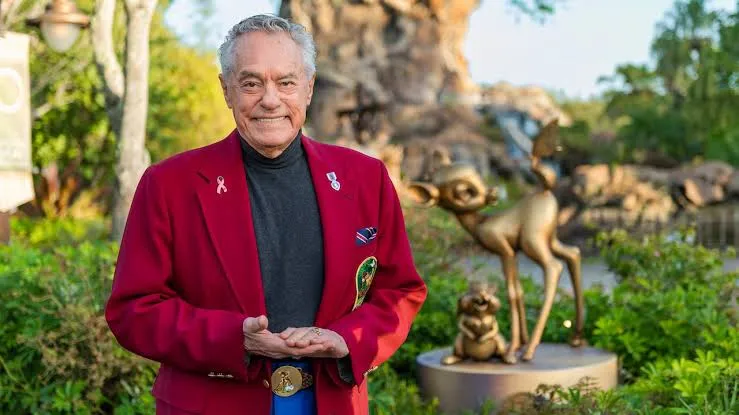
A life that connected two worlds
Donnie Dunagan, remembered by generations of viewers as the young voice of Bambi, has died aged 92. News of his death emerged on November 9, 2026, bringing renewed attention to an unusually varied life. Long before his military career, Dunagan had been a child performer in Hollywood, appearing in prominent productions and contributing to one of the most emotionally enduring animated films ever made. Later he chose a radically different path, earning distinction through a long period of service in the United States Marine Corps.
The remarkable contrast between those chapters has always been central to his story. Few performers become familiar to millions of children through a voice recording and then spend decades in a profession where their colleagues know little of that artistic history. Dunagan did exactly that. His career is a reminder that public recognition and personal identity do not always follow the same course, and that a person can lead more than one consequential life without viewing either as a contradiction.
The childhood performance that travelled across generations
Bambi, released in 1942, is celebrated for an animated world that combines natural beauty with sudden vulnerability. Dunagan was just six years old when he contributed the voice of the young deer. His work arrived at a time when animation production demanded painstaking coordination between drawings, recordings and music. Technology has changed enormously since then, yet the emotional impact of the film still depends on how convincingly a young character expresses confusion, innocence and fear.
The moment involving the loss of Bambi's mother became particularly memorable because it transformed what initially appeared to be a gentle woodland story into an experience of grief. Dunagan later recalled receiving guidance about the emotional situation while recording his lines. His youthful voice helped establish the relationship between a frightened child and an audience trying to understand a painful event. The scene's endurance owes as much to its emotional restraint as to the larger artistry surrounding it.
A short Hollywood career with unforgettable collaborators
Before his animation work became his defining screen credit, Dunagan appeared in live-action films including Son of Frankenstein and Tower of London. As a child actor he worked in an industry populated by performers who would become legendary names in screen history. His appearances placed him alongside figures such as Basil Rathbone and Boris Karloff, linking his early filmography to the golden age of studio horror cinema.
Dunagan's recollections of playing checkers with Karloff, even while the older actor wore his monster makeup, reveal a charming difference between a film's intimidating imagery and the everyday life of its set. For a young performer, such experiences could turn apparent screen terror into something almost familiar. His early work also illustrates how many careers in classical Hollywood were shaped by studio opportunity and short periods of intense activity rather than by a lifelong attachment to acting.
The Marine who kept Hollywood at a distance
After his years as a child performer and his education, Dunagan joined the military in 1952. He went on to serve for approximately 25 years, earning a Bronze Star and three Purple Hearts. Those decorations belong to a very different system of public recognition from the credits of an animated feature. They reflect his service and the serious consequences of military life, not a theatrical role. His history requires both chapters to be acknowledged without using one merely as a dramatic contrast to the other.
For much of that period, Dunagan did not openly share his connection with Bambi among colleagues. He later expressed regret about withholding a part of himself from people he valued. The admission is moving because it suggests the decision did not arise from rejecting the film. Rather, he was living within a professional world in which the image of a Disney child actor seemed far removed from the responsibilities of an officer and veteran.
Why the Bambi performance still matters
The longevity of Bambi provides a case study in the lasting power of animation. Children encounter the story as an immediate emotional adventure, while adults often see themes of responsibility, uncertainty and recovery. Dunagan's contribution helped give the central character an identifiable early vulnerability. Even viewers who never knew the actor's name may have absorbed that quality into their first experience of the movie. This is a quiet form of cinematic influence: a performance so integrated into the story that the voice becomes inseparable from the character.
The film also belongs to a broader tradition of hand-drawn animation in which expression and sound must work together with extraordinary precision. Today's digitally animated releases have inherited many of those storytelling principles. The ability to make audiences empathize with a nonhuman character remains foundational to family filmmaking. Dunagan's recording is one example of how carefully chosen vocal performances can carry the emotional truth of an entire scene.
Remembering a complicated and accomplished legacy
In later years, Dunagan spoke warmly about the joy of discovering that children still cared about his brief film career. That reaction is understandable. Military service and cinema rarely invite direct comparison, but both can create experiences that shape the lives of other people in unexpected ways. His legacy is not reducible to a single character, a list of decorations or a surprising anecdote about keeping a secret. It consists of several forms of commitment lived over a long period.
His death invites audiences to revisit Bambi with a fuller awareness of the person behind the familiar voice. For those interested in film history, it is also a chance to remember the working conditions and human experiences of child actors in the classic studio era. Dunagan leaves a rare story of early artistic contribution, personal reinvention and distinguished public service. Each chapter deserves recognition in its own right, and together they form a life unlikely to be repeated.
PUBLISHED BY SUYASH PACHAURI, FOUNDER & OWNER, GLOBAL BOLLYWOOD | THE HOLLYWOOD SCOPE.