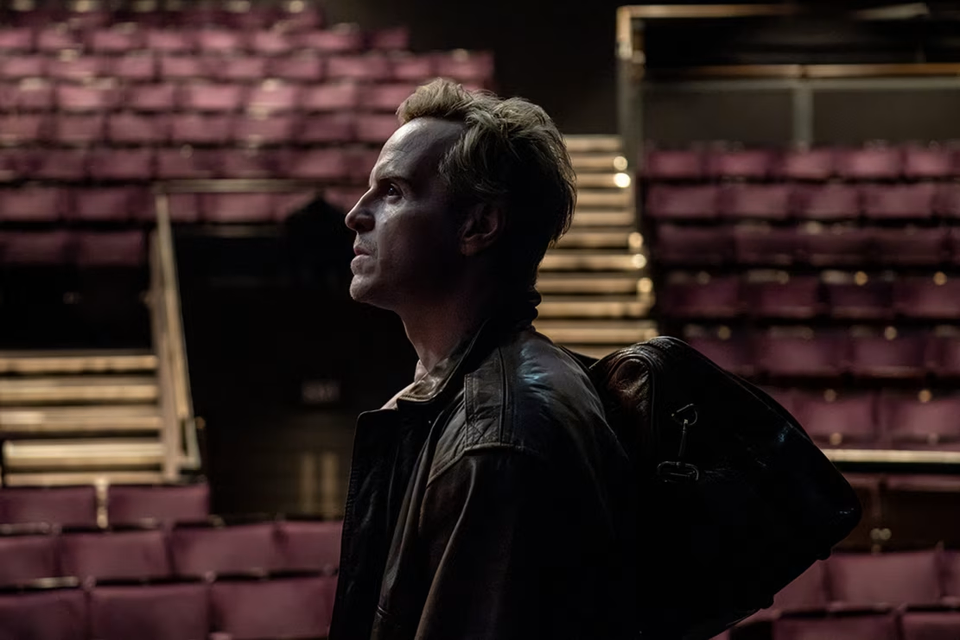
A Performance Against Time
Elsinore dramatises the period when actor Ian Charleson stepped into Hamlet at the National Theatre while living with HIV and facing the progression of AIDS. Andrew Scott leads the film as a performer who understands both the opportunity and its physical cost. The story could easily become a solemn march toward tragedy, but its strongest reported qualities are energy, wit and the thrill of artistic concentration. Ian does not accept the role because he is unaware of danger. He accepts because playing Hamlet is an ambition that gives the remaining time shape. The production treats theatre as work requiring discipline, memory and collaboration, while allowing the stage to become a place where fear can be transformed without disappearing.
Andrew Scott Plays the Man and the Actor
Scott's task is unusually layered. He must create Ian as a person, show him developing a public performance and then let that Hamlet reflect experiences Ian cannot openly discuss. The result depends on distinctions between social charm, private exhaustion and theatrical command. Ian is quick, magnetic and capable of using humour to redirect uncomfortable attention. He is also a working-class actor navigating an institution shaped by privilege, conscious that one great role may define how he is remembered. Scott reportedly avoids presenting him as a symbol first. Detail, timing and flashes of anger keep the character specific, which makes the historical circumstances more affecting than a performance built around dignified suffering.
Theatre and Life Begin to Overlap
The screenplay moves between rehearsal, treatment, friendship and performance, allowing Shakespeare's language to echo Ian's reality without forcing every scene into a direct parallel. Hamlet is a play obsessed with mortality, performance and the difficulty of acting when thought becomes overwhelming. Ian's situation gives those ideas an unavoidable charge. Editing reportedly crosses between life and stage until each begins to comment on the other. The approach could have become schematic, but the film appears most persuasive when it trusts physical transitions and the actors' responses. A rehearsal line can carry into a hospital scene, while private fear returns in a public gesture before an audience.
A Wider Portrait of the AIDS Era
The supporting roles place Ian within a community rather than isolating him as a heroic exception. Olivia Colman appears as physician Margaret Johnson, Johnny Flynn plays director Richard Eyre, and figures from theatre and Ian's personal life reveal different attitudes toward illness, secrecy and responsibility. The film acknowledges the stigma that pushed many gay men to hide both identity and diagnosis. It also contrasts Ian's caution with artists who spoke publicly. That tension is presented as emotional and professional, not as a simple test of courage. An actor who feared being denied straight roles had material reasons for secrecy, even while silence carried costs for others seeking recognition and solidarity.
A Story About Art Refusing to End
Elsinore appears to work because it does not confuse uplift with denial. Ian's condition is serious, treatment is exhausting and the social world around him remains prejudiced. Yet the film allows achievement to be genuinely joyful. Performance is not a cure, but it is a form of agency and connection. The closing emotional force comes from watching an actor read the text of his life through a role he has dreamed of playing. Some viewers may wish for more time with the stage performance itself, a response that reflects how compelling Scott's interpretation reportedly becomes. The film's enduring idea is simple: the show goes on not because mortality is ignored, but because art can make limited time feel intensely alive.
The Limits of a Biographical Frame
A drama based on a celebrated final performance must choose what to compress, omit and interpret. That creates a risk of letting one triumphant stage role eclipse the rest of Charleson's career and relationships. The film's attention to class, secrecy and friendship helps resist that narrowing, though viewers may still want a wider account of the actor beyond the months surrounding Hamlet. Biographical cinema is strongest when it admits that no performance can contain a whole life. Elsinore appears aware of that limitation and uses it productively: the stage becomes the place where Ian concentrates his experience, not proof that art explains everything about him. Scott's work invites curiosity about Charleson's films, theatre and generation, extending the story beyond the closing image rather than sealing it inside a heroic narrative.
History Carried Through Character
The film also offers younger audiences an entry into a period when effective HIV treatment was not yet available and public ignorance intensified private suffering. Historical context is carried through relationships rather than inserted as a lesson. That approach can make the era legible without reducing characters to examples. Elsinore's warmth and humour matter in this respect, restoring everyday personality to people too often represented only through diagnosis and loss.
Elsinore finds exhilaration inside mortality, turning one actor's Hamlet into a celebration of art that refuses to stop.
PUBLISHED BY SUYASH PACHAURI, FOUNDER & OWNER, GLOBAL BOLLYWOOD | THE HOLLYWOOD SCOPE.