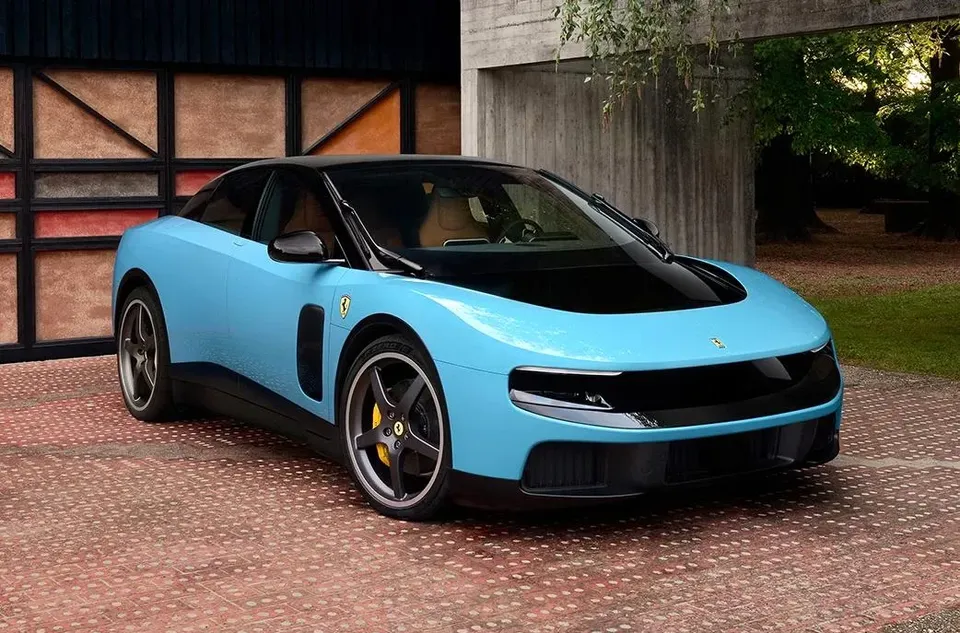
Ferrari's first fully electric car is being positioned as a design statement rather than a battery-powered copy of its combustion models. The Ferrari Luce EV was developed with Jony Ive and the LoveFrom studio over five years, combining the company's engineering culture with an approach shaped by consumer electronics and industrial design. Physical controls, tactile materials and carefully judged interfaces are central to the cabin. The project attempts to answer a difficult question for every heritage performance brand: how can an electric vehicle feel unmistakably distinctive when the familiar engine sound and mechanical rituals are no longer at the center of the experience?
The Origins of the Ferrari Luce EV
Chairman John Elkann has linked the company's decision to explore electrification with a conversation he had with Jeff Bezos in 2016. The broader lesson was to treat new technology as an opportunity to rethink the product rather than protect every convention. Ferrari later began a deep design collaboration with Ive's team in California while its engineers in Maranello developed the vehicle. The partnership studied the brand's history, proportions and user rituals before deciding which elements should continue and which should be reinvented.
That process matters because luxury car design can become trapped between nostalgia and novelty. Repeating old cues may look inauthentic on a silent electric platform, while a screen-filled interior can make a high-priced car feel generic. The Luce emphasizes physical switches and controls where touch and precision add emotional value. This does not reject software. It assigns digital functions to places where they are genuinely useful and preserves direct human interaction for the moments that define driving.
Why Tactile Controls Are Returning
Many electric vehicles adopted large touchscreens to reduce component count and make features easy to update. Drivers have increasingly criticized designs that bury basic climate or vehicle controls in menus. A physical knob can be located by feel without taking attention from the road, and its resistance communicates whether a command has been registered. For a performance car, that feedback is part of the product's character. The Luce can use haptics, materials and movement to replace some of the emotion traditionally supplied by an engine and gearbox.
The challenge is avoiding ornament that exists only to imitate the past. A good physical interface should be durable, intuitive and consistent with electric operation. Controls can help drivers understand energy use, regenerative braking and performance settings without presenting an overwhelming dashboard. Software still needs a clear architecture so that updates do not disrupt established muscle memory. If the collaboration succeeds, it may influence mainstream carmakers that are reconsidering how much interaction belongs on a flat display.
Electric Performance Must Extend Beyond Acceleration
Electric motors can deliver extraordinary speed, but acceleration alone is not enough to create a compelling Ferrari. Weight, steering response, braking feel and thermal management will determine whether the Luce remains engaging through repeated use. Battery placement can lower the center of gravity while adding substantial mass. Engineers must balance range against agility and ensure that power remains available when the vehicle is driven hard. Sound design may also play a role, but artificial noise must feel connected to the machine rather than added as a theatrical layer.
Brand Risk Is Part of the Experiment
Early online reactions included skepticism about the design and the company's electric direction. Heritage brands face intense scrutiny because customers treat change as a statement about identity. The Luce cannot satisfy everyone, and attempting to do so would probably produce a conservative product. The more important test is whether the car feels coherent in person and whether owners see electrification as an expansion of the brand rather than a retreat. Positive reactions after physical viewing suggest that proportion, material and detail may communicate better than initial images.
The business context is equally demanding. Battery costs, charging access and uncertain luxury-EV demand have made manufacturers cautious. Ferrari can operate at lower volume and higher margins than mass-market companies, giving it room to refine the product. Yet exclusivity does not excuse inconvenience. Owners will expect dependable charging, predictable range and service support across major markets. The company must integrate those practical needs without allowing infrastructure concerns to dominate the experience.
A Possible New Language for Electric Luxury
The Ferrari Luce EV is a test of whether industrial design can create new rituals for an electric supercar. Its emphasis on tactile control recognizes that premium technology should not force every action through glass. The best outcome would not mimic an old engine or copy a smartphone interface. It would make electricity, software and physical craft feel like parts of one deliberate object. If the Luce achieves that balance, its influence may extend beyond Ferrari by encouraging the auto industry to design electric cabins around human attention and touch.
PUBLISHED
BY
SUYASH PACHAURI,
FOUNDER & OWNER,
GLOBAL BOLLYWOOD | THE HOLLYWOOD SCOPE