Film Review by Suyash Pachauri
Founder & Owner
Global Bollywood | Director's Daily Clapboard
"Not every hero wears a uniform some wear a nurse's apron and choose humanity over fear."
Introduction
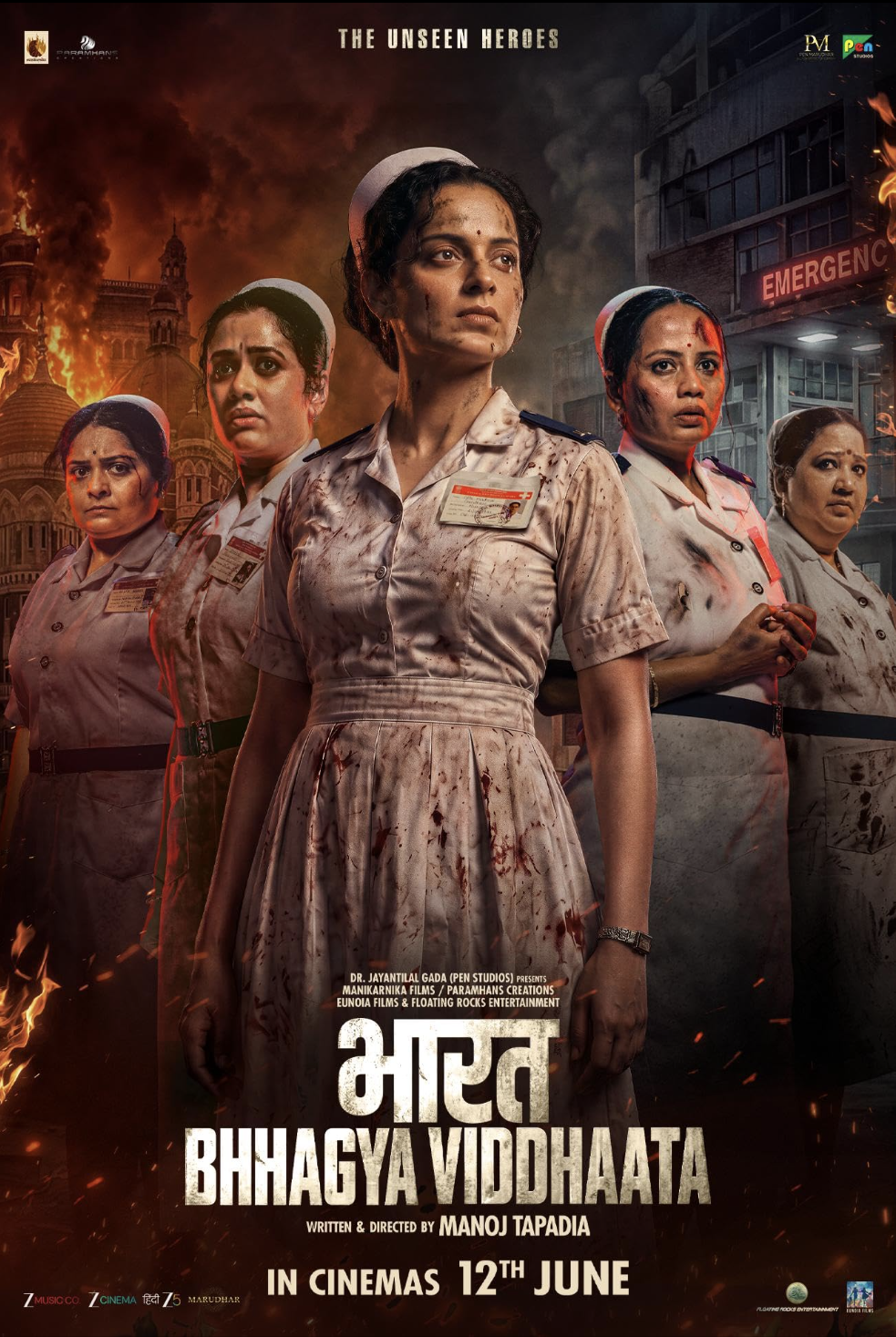
There are films that recreate history, and then there are films that attempt to honour the people history almost forgot. Bharat Bhhagya Viddhaata belongs to the latter category. Instead of revisiting every horrifying chapter of the 26/11 Mumbai terror attacks, writer-director Manoj Tapadia narrows his focus to one specific location the Cama and Albless Hospital and pays tribute to the nurses, doctors and hospital staff who continued saving lives while terrorists roamed the corridors.
This approach immediately distinguishes the film from previous cinematic depictions of 26/11. Rather than relying on large-scale action, explosions or patriotic speeches, it chooses to explore courage born out of compassion. The real battle here is not fought with weapons but with medical instruments, stretchers and unwavering humanity.
At the centre of the story is Kangana Ranaut as nurse Geeta Gandhare, a fictionalised representation inspired by real-life medical professionals who risked everything that terrifying night. While the narrative intends to celebrate collective heroism instead of individual glory, the execution occasionally struggles to balance emotional depth with documentary-like realism.
Bharat Bhhagya Viddhaata deserves appreciation for highlighting an overlooked chapter of Indian history, but whether it transforms into a deeply moving cinematic experience depends largely on the viewer's expectations.
Screenplay & Script Sense
The screenplay takes an unconventional route. Instead of beginning with the terrorist attack, Manoj Tapadia patiently introduces the nurses, their families, hospital politics and their daily responsibilities. This decision has both strengths and weaknesses.
On the positive side, these quieter moments humanise the characters before chaos erupts. We understand their relationships, responsibilities and personal struggles, making their decisions during the attack more meaningful. The camaraderie among the nursing staff feels believable and natural.
However, the first act overstays its welcome. Several scenes establishing discipline, hospital hierarchy and workplace conversations could have been significantly trimmed. The film spends too much time reaching the incident that audiences already know is coming.
Once the terrorists enter Cama Hospital, the screenplay becomes considerably tighter. The atmosphere shifts dramatically as darkness consumes the hospital corridors and every sound becomes a potential threat. Rather than creating exaggerated heroics, the screenplay focuses on ordinary people making extraordinary decisions.
The emotional writing succeeds whenever it concentrates on frightened patients, pregnant women and nurses silently choosing duty over self-preservation. Unfortunately, some emotional opportunities are left underdeveloped. A few character arcs conclude abruptly, preventing the audience from forming stronger emotional attachments.
The screenplay also remains confined almost entirely to Cama Hospital. While this is a deliberate creative choice, it unintentionally reduces the overwhelming scale of the 26/11 attacks. Viewers unfamiliar with the historical events may not fully grasp the nationwide impact of that tragic night.
Nevertheless, the screenplay deserves credit for avoiding unnecessary melodrama and respecting the dignity of the real-life heroes who inspired the narrative.
Direction
Manoj Tapadia directs the film with restraint instead of sensationalism.
This is perhaps the film's biggest strength. Rather than glorifying violence or turning the terrorists into larger-than-life villains, Tapadia keeps the focus firmly on the hospital staff and their humanitarian spirit.
The director understands that silence can often create greater tension than loud background scores or excessive action. Several sequences inside the dimly lit wards effectively build suspense without relying on cinematic gimmicks.
Where the direction occasionally falters is in maintaining emotional rhythm. Certain scenes feel longer than necessary, slowing down the narrative momentum. The transition from character drama to survival thriller could have been sharper.
Tapadia also refrains from making Kangana Ranaut's character overshadow everyone else. In today's star-driven cinema, this decision deserves appreciation. The film consistently reminds audiences that heroism belonged to an entire team, not just one individual.
Overall, the direction remains sincere, respectful and mature, even if it lacks the emotional impact needed to elevate the film into unforgettable territory.
Acting
Kangana Ranaut
Kangana Ranaut delivers one of her most restrained performances in recent years. She deliberately avoids theatrical outbursts and chooses understated realism instead. As Geeta Gandhare, she portrays fear, responsibility and determination with quiet conviction.
Unlike many of her recent films, this performance isn't designed around dramatic monologues or larger-than-life heroics. Instead, Kangana allows the ensemble to breathe. While this may disappoint viewers expecting another powerhouse performance like Queen, Tanu Weds Manu or Thalaivii, it ultimately serves the story well.
Girija Oak Godbole
Girija Oak brings warmth and authenticity to Sheetal. She convincingly portrays the emotional vulnerability of a nurse suddenly trapped in unimaginable circumstances. Her expressions often communicate more than lengthy dialogues.
Smita Tambe Dwivedi
Smita Tambe delivers another dependable performance. As Trupti, she captures both courage and helplessness beautifully. She remains one of the emotional anchors of the film.
Rasika Agashe
Rasika Agashe contributes a grounded and believable performance as Mohini. She never attempts to steal scenes but consistently enhances the emotional realism of every sequence she appears in.
Priya Berde
Priya Berde effectively portrays Harshada. Though her screen time is limited, she leaves a positive impression through natural acting.
Suhita Thatte
As the hospital matron, Suhita Thatte exudes authority and compassion simultaneously. She brings dignity to her character and becomes one of the film's strongest supporting pillars.
Asha Shelar
Asha Shelar performs convincingly as the Medical Superintendent. Her strict administrative approach adds realism to the hospital environment before the crisis unfolds.
Prasad Oak
Prasad Oak delivers a sincere performance as Geeta's husband. His concern for his family feels genuine, providing an emotional contrast to Geeta's unwavering commitment.
Sayaji Shinde
Despite appearing briefly, Sayaji Shinde leaves an impact. His cameo lends credibility and gravitas to the narrative.
Supporting Cast
The film benefits immensely from an extensive supporting ensemble.
Esha Dey as Babita, Sushama Deshpande as Geeta's mother, Dheerendra R.K. Dwivedi, Sunil Paliwal as ACP Dayanand Sathe, Vijay Gokhale, Vivek Kumar Singh, Yashodhan Malvankar, Vikas Laxman Pawar, Ganesh Prabhakar Mayekar, Vikrant Kolape, Rajesh Bhosale, Suresh Dutt, Makarand Navghare and the remaining cast members contribute sincerely.
Among the antagonists, Aditya Mishra as Abu Ismail and Zahid as Ajmal Kasab avoid caricature and portray the cold brutality required for the narrative.
No supporting actor attempts to overpower the story. Instead, everyone contributes to the collective atmosphere, which remains the film's greatest acting achievement.
Cinematography
Ayan Sil's cinematography is undoubtedly among the strongest technical aspects of the film.
The transformation of the brightly lit hospital into dark, haunting corridors significantly enhances suspense. Clever use of shadows, narrow hallways and limited lighting creates an authentic feeling of fear and uncertainty.
The handheld camera movement during tense sequences increases realism without becoming visually distracting. Sil deserves appreciation for making a largely confined location feel dynamic throughout the narrative.
Music & Background Score
The songs by Aman Pant and Krsna remain appropriately understated and never interrupt the narrative.
The background score by Aman Pant performs a much more significant role. Instead of manipulating emotions through excessive orchestration, it quietly supports the tension unfolding on screen.
Several scenes become more effective precisely because the music knows when to remain silent.
Editing
Dev Rao Jadhav's editing delivers mixed results.
The survival-thriller portions maintain solid momentum, but the opening act would have benefited from tighter trimming. Reducing repetitive establishment scenes could have made the narrative considerably sharper.
Once the terrorists enter the hospital, however, the editing becomes much more effective, maintaining suspense without unnecessary distractions.
Final Verdict
Bharat Bhhagya Viddhaata isn't a conventional patriotic blockbuster, nor does it attempt to become one. It tells a smaller, more intimate story about courage hidden inside ordinary people performing extraordinary duties.
Its greatest achievement lies in shining a light on the forgotten heroes of Cama Hospital, reminding audiences that bravery isn't always displayed on battlefields it can also exist inside hospital wards where saving even one life becomes an act of resistance.
While the screenplay occasionally loses momentum and some emotional moments could have been explored with greater intensity, the film succeeds because of its sincerity, mature storytelling and committed performances.
Kangana Ranaut wisely allows the ensemble to remain at the heart of the narrative, resulting in one of her more balanced performances in recent years.
Bharat Bhhagya Viddhaata may not redefine the survival-thriller genre, but it honours a forgotten chapter of India's history with dignity and genuine respect.
On the Plus Side
Sensitive tribute to the unsung heroes of Cama Hospital.
Kangana Ranaut delivers a restrained and mature performance.
Excellent cinematography enhances suspense.
Strong ensemble cast with natural performances.
Avoids excessive nationalism and melodrama.
Realistic atmosphere throughout.
On the Minus Side
Slow first half affects pacing.
Emotional payoff could have been stronger.
Limited scope reduces the scale of the 26/11 tragedy.
Some supporting characters deserved better development.
Editing feels uneven in the opening portions.
One-Liner
"When terror entered the hospital, humanity refused to surrender."
Film Review by Suyash Pachauri
Founder & Owner
Global Bollywood | Director's Daily Clapboard