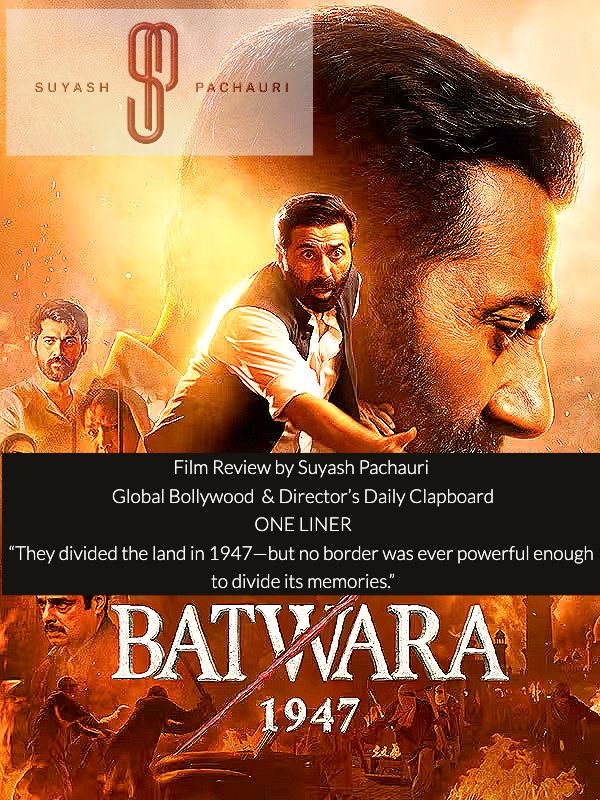
Film Review by Suyash Pachauri
GLOBAL BOLLYWOOD & DIRECTOR'S DAILY CLAPBOARD
ONE LINER
"They divided the land in 1947 but no border was ever powerful enough to divide its memories."
There are historical films that recreate history, and then there are films that attempt to recreate the wounds, memories and emotions left behind by history. Batwara 1947 belongs firmly to the latter. Directed by Rajkumar Santoshi and produced by Aamir Khan and Aparna Purohit under Aamir Khan Productions, the film travels back to one of the most traumatic chapters in the history of the Indian subcontinent the Partition of 1947.
Yet Santoshi does not approach Partition merely as a gigantic political event or reduce it to statistics of migration and violence. Instead, the film repeatedly brings this enormous tragedy down to its most human level: a home suddenly lost, a family displaced, neighbours separated, identities questioned and generations forced to understand that the place they have always called their own can suddenly exist on the other side of a newly drawn border.
At the heart of Batwara 1947 lies a painfully simple question: when politicians draw a border on a map, who ultimately pays the price? The film's answer is equally simple ordinary people. That thought becomes the emotional foundation upon which Rajkumar Santoshi constructs his historical drama.
Screenplay, Story & Dialogues
The film draws its literary strength from Asghar Wajahat's celebrated work Jis Lahore Nai Vekhya, O Jamya E Nai, with Rajkumar Santoshi handling the screenplay and contributing to the writing and dialogues alongside Wajahat.
The material arrives with considerable dramatic depth because it understands that Partition cannot simply be represented through riots, burning neighbourhoods, trains and migration. Indian cinema has visited those images before. What makes such a story meaningful is whether audiences begin caring about the human beings standing inside those images.
That is where the writing of Batwara 1947 finds its greatest strength. Displacement is presented not merely as the loss of property but as the loss of belonging. A house can legally be allotted to somebody else. A city can suddenly become part of another nation.
A border can appear almost overnight. But can memories be divided? Can relationships be partitioned? Can someone simply stop belonging to the street, neighbourhood or house where an entire lifetime has been spent?
These questions give the film its emotional weight. Some portions inevitably retain the theatrical character of the source material, and there are moments when the dialogues announce the film's message more directly than necessary. Yet the sincerity underneath those words is rarely in doubt.
Direction
Rajkumar Santoshi is completely at home with emotionally charged material. His cinema has frequently explored conflict, morality, social tension and powerful human confrontations, and Batwara 1947 provides him with an enormous historical canvas on which to combine all of these elements.
His most important decision is not to turn the film into a catalogue of atrocities. Violence exists, communal tension is unavoidable and the horror surrounding Partition is visible, but human relationships remain at the centre of the narrative.
Santoshi's strongest passages are those in which suffering is presented simply as human suffering rather than being used to manufacture contemporary hatred.
The film repeatedly reminds us that ordinary men and women often inherit the consequences of political decisions made far above them. Santoshi also knows exactly how to utilise the formidable screen personality of Sunny Deol, while giving quieter performers such as Shabana Azmi sufficient emotional space. Their collaboration gives the film both scale and intimacy.
Performances
Sunny Deol, playing Sikander Mirza, brings the physical and emotional authority expected from an actor whose screen presence has defined several generations of Hindi cinema. There are naturally moments of explosive anger, but the more interesting aspect of his performance emerges when that anger turns into helplessness.
This is not simply the Sunny Deol of roaring dialogue and physical confrontation; this is a man witnessing the collapse of a world he once considered permanent. Santoshi understands his actor extremely well and ensures that his intensity serves the character rather than overwhelming it.
Shabana Azmi, as Mai, becomes the emotional soul of the film. Hers is a deeply lived-in performance. She does not require enormous dramatic gestures to communicate displacement. A glance around a familiar house, a pause before speaking or the silent fear of losing a place connected to decades of memories can communicate more than pages of dialogue.
Through Mai, Azmi represents a generation for whom Partition was never a chapter in a history textbook it was lived experience. She gives Batwara 1947 dignity, maturity and tremendous emotional depth.
Preity Zinta, as Hamida Mirza, makes her presence felt with warmth and emotional sincerity. It is genuinely pleasing to see her return to substantial dramatic material. In a narrative dominated by fear, uncertainty and displacement, her natural screen presence humanises several emotionally heavy passages, while she handles both vulnerability and inner strength convincingly.
Ali Fazal, appearing as Nasir Kazmi, delivers a controlled and measured performance. He understands the period and emotional register of the material and wisely avoids unnecessarily contemporary mannerisms. His restraint works particularly well in sequences built around ideological and emotional confrontation.
Karan Deol, as Javed Mirza, receives an important opportunity and approaches the character with sincerity. Sharing the screen with performers of this calibre is demanding, but he succeeds in establishing an individual presence without trying to reproduce Sunny Deol's acting personality.
Abhimanyu Singh, playing Yaqoob Pehalwan, brings tension and unpredictability whenever the screenplay gives him room. His ability to inhabit intense characters once again becomes valuable to a story where fear and uncertainty are constantly present.
The wider ensemble further strengthens the film. Mithun Chakraborty, Khushi Hajare, Kanikka Kapur, Vijayant Kohli, Sandeep Chatterjee, Parminder Singh Kainth and the numerous performers inhabiting this divided world help ensure that Partition never feels like the tragedy of only one protagonist. Even faces appearing briefly contribute to the atmosphere of uncertainty, migration and loss.
Cinematography
The cinematography of Santosh Sivan is among Batwara 1947's strongest technical achievements. The 1940s are not recreated merely through costumes, sets and props; Sivan's frames themselves carry history and atmosphere. Crowded streets, railway platforms, abandoned homes, burning neighbourhoods and frightened faces create an environment in which uncertainty appears permanent.
Sivan understands when historical scale is necessary, but more importantly, he understands when spectacle should disappear completely and the camera should simply remain close to a human face. That balance between magnitude and intimacy is essential to a film about an enormous historical event experienced individually by millions of people.
Music, Lyrics & Background Score
With A. R. Rahman composing the music and Javed Akhtar writing the lyrics, the musical department carries extraordinary expectations. Their contribution respects both the period and the emotional character of the narrative.
Rather than functioning merely as commercial interruptions, the music largely becomes an extension of memory, longing, separation and loss.
Rahman's background score is particularly effective during sequences of displacement and emotional separation. Some of its finest moments arrive when the music refuses to overwhelm the image. Silence is allowed to coexist with melody, giving performers and visuals sufficient space to generate emotion organically.
Editing
Shyam Salgaonkar's editing, supported by associate editor Sahil Tandel, has the difficult responsibility of maintaining narrative clarity across a historical drama involving several characters, relationships and emotional threads.
The first half deliberately spends time establishing people, homes and relationships before Partition changes the meaning of virtually everything around them. The second half consequently becomes heavier and considerably more emotionally intense.
A few passages could have been tightened, and the measured pace may test viewers expecting a conventional action-driven Sunny Deol film. At the same time, excessive compression could have damaged a narrative whose emotional power depends upon audiences first understanding what these characters possessed before watching them lose it.
Production Design & Period Recreation
The contribution of production designers Amit Ray and Subrata Chakraborty deserves particular recognition. Architecture, streets, interiors, household objects and public spaces collectively transport the audience into the 1940s without making the environment feel like a decorative museum exhibit.
This becomes especially significant because locations are effectively characters in the story. A haveli is not merely a set; it represents generations of memory. A street is not simply production design; it represents familiarity and belonging. Once those spaces are threatened, their physical details acquire emotional meaning.
Maxima Basu's costume design further strengthens the period authenticity, ensuring that clothing supports character, geography and social background rather than simply advertising the film's historical setting. Yasmin Rogers' makeup design similarly contributes to the visual credibility of the period and its people.
Sound
Academy Award-winning sound designer Resul Pookutty adds another important dimension to the film's atmosphere, while Ravi Dev Singh's sound mixing helps construct the contrast between crowded public chaos and intensely private emotional moments.
For a Partition drama, sound can be as important as imagery the movement of crowds, distant violence, frightened voices and sudden silence can transform a sequence. The sound department understands this and frequently uses the environment itself to communicate instability and fear.
Casting
The casting assembled under Anmol Ahuja/Casting Bay is one of the film's significant strengths. Batwara 1947 requires performers capable of appearing as people belonging to another era rather than contemporary actors wearing period costumes. The combination of established performers, character actors and younger faces creates a convincing human landscape.
The film benefits enormously from having performers of different generations working together, particularly because its subject itself concerns generations, inheritance, memory and identity.
Action
The action designed by Ravi Varma serves a historical drama rather than transforming it into a conventional action vehicle. This distinction matters enormously in a Sunny Deol film. Physical conflict exists because the world surrounding the characters is collapsing, not simply because the screenplay requires heroic action beats. The more effective sequences maintain danger and urgency without allowing spectacle to overshadow human consequences.
Production
Producer Aamir Khan, alongside producer Aparna Purohit, provides Rajkumar Santoshi with the production scale required to tell this story convincingly. Associate producer Shreyas Khedekar, along with the wider production team, contributes to mounting a story that demands period locations, large crowds, elaborate production design and substantial logistical coordination.
The involvement of Aamir Khan Productions is visible in the film's determination to treat the historical environment as more than a backdrop. The production allows its technical departments cinematography, sound, music, costumes and production design to collectively create one unified world rather than competing individually for attention.
On the Plus Side
The performances, particularly those of Shabana Azmi and Sunny Deol, form the emotional backbone of the film. Rajkumar Santoshi handles the enormous historical and emotional canvas with confidence, Santosh Sivan gives the film striking visual character, A. R. Rahman's music and background score provide musical soul, Javed Akhtar's lyrics carry literary sensitivity, while Resul Pookutty's sound design, Shyam Salgaonkar's editing, Maxima Basu's costumes and the production design of Amit Ray and Subrata Chakraborty collectively create an immersive period atmosphere.
Most importantly, Batwara 1947 attempts to discover humanity inside an event remembered largely through politics, geography and history.
On the Minus Side
The film occasionally becomes melodramatic, while certain sequences visibly retain the theatrical character of the source material. Its measured pace and substantial dramatic emphasis may also challenge audiences arriving specifically for a conventional Sunny Deol action spectacle.
There are additionally moments when the screenplay repeats an idea through dialogue after the performances and imagery have already communicated it effectively. Greater restraint in these passages could have made the emotional impact even stronger.
Final Verdict
Batwara 1947 is not simply a story about British India being divided and two nations emerging from that division. It is about people discovering that the home in which they were born can suddenly exist in another country. It is about neighbours being instructed to see one another as enemies. It is about identities changing even though the human beings carrying those identities have not changed at all.
Rajkumar Santoshi gives the material direction and dramatic force; Asghar Wajahat provides its literary foundation; Aamir Khan and Aparna Purohit give it substantial production backing; Santosh Sivan gives it visual character; A. R. Rahman and Javed Akhtar provide its musical and lyrical soul; Resul Pookutty enriches its sonic world; Shyam Salgaonkar shapes its narrative rhythm; Amit Ray and Subrata Chakraborty recreate its physical world, Maxima Basu and Yasmin Rogers strengthen its period authenticity; and an accomplished ensemble led by Sunny Deol, Shabana Azmi, Preity Zinta, Ali Fazal, Karan Deol and Abhimanyu Singh gives that world its humanity.
The result is a powerful historical drama that occasionally becomes melodramatic but rarely loses sight of its emotional purpose. Above everything else, Batwara 1947 reminds us of the fundamental absurdity and tragedy of trying to divide human beings through lines drawn on maps. Governments can create borders overnight, maps can change and addresses can acquire new countries, but memories do not recognise checkpoints, relationships cannot be redrawn with ink, and humanity cannot be partitioned so easily.
Film Review by Suyash Pachauri
GLOBAL BOLLYWOOD & DIRECTOR'S DAILY CLAPBOARD
ONE LINER