Film Review by Suyash Pachauri
Founder & Owner
Global Bollywood | Director's Daily Clapboard
One-Liner
"A gripping courtroom drama powered by Sunny Deol's commanding screen presence and Akshaye Khanna's restrained intensity, even if the script occasionally takes the easier route to justice."
Introduction
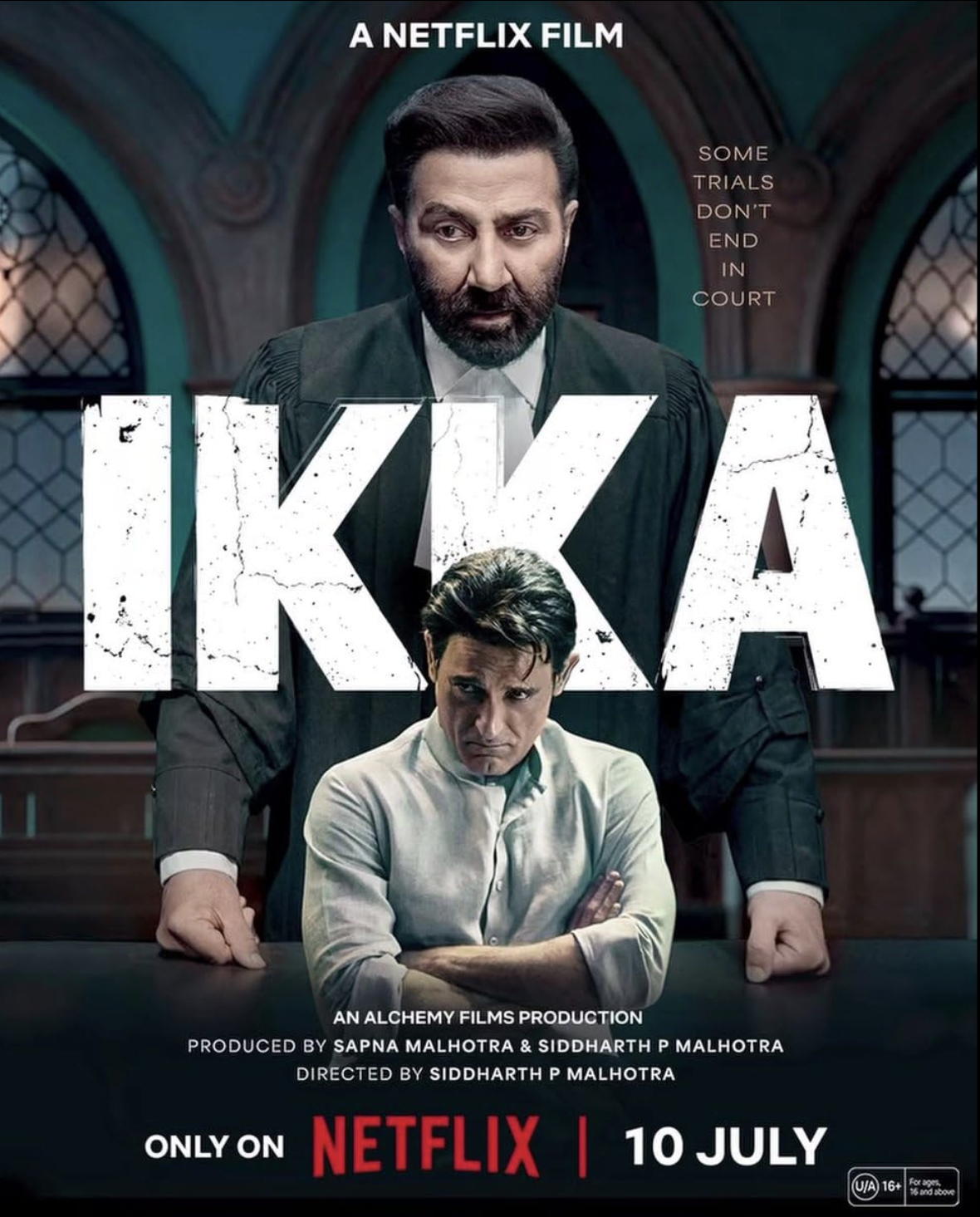
Legal dramas thrive on two essential ingredients strong writing and compelling performances. When both work in harmony, the courtroom becomes more than just a place for arguments; it transforms into an arena where morality, truth, and human emotions collide. Ikka, directed by Siddharth P. Malhotra, attempts to deliver exactly that by placing an experienced lawyer against what appears to be an open-and-shut murder case.
The story follows celebrated advocate Ajay Mehra, a lawyer known not only for his brilliant courtroom strategy but also for fighting cases that align with his moral compass. When he unexpectedly agrees to defend Shouryamann, a wealthy young man accused of murder, the decision shocks both the media and the public. As the trial progresses, every witness, every piece of evidence, and every argument challenges the audience's assumptions about guilt and innocence.
Instead of relying purely on dramatic courtroom speeches, Ikka explores the psychological conflict surrounding justice, public perception, and the burden of defending someone whom everyone believes is guilty. While it occasionally follows familiar legal-thriller conventions, the film manages to remain engaging largely because of its performances and polished presentation.
Screenplay & Script Sense
The screenplay adopts a straightforward approach, avoiding unnecessary diversions and focusing almost entirely on the courtroom proceedings and the investigation surrounding the murder.
One of the screenplay's strengths is that it establishes the central conflict quickly. There is no lengthy build-up before the legal battle begins, allowing viewers to become invested from the outset. Every hearing introduces fresh developments that keep the narrative moving.
However, the writing sometimes makes the legal process appear more convenient than challenging. Important clues emerge at precisely the right moments, and certain breakthroughs arrive with relatively little investigative effort. As a result, the tension occasionally feels manufactured rather than organically earned.
The screenplay is at its strongest whenever it focuses on the intellectual battle between the defence and the prosecution. The exchanges inside the courtroom remain engaging, even if they stop short of delivering the unforgettable legal confrontations seen in the finest courtroom dramas.
The emotional subplot involving Ajay Mehra's family provides additional depth without overwhelming the primary narrative. Some of these personal moments feel underexplored, but they help humanize a protagonist who could otherwise have appeared emotionally distant.
The climax delivers a satisfying payoff by tying together multiple narrative threads without becoming excessively melodramatic. Although seasoned viewers may anticipate a few revelations, the resolution remains emotionally rewarding.
Direction
Siddharth P. Malhotra directs the film with confidence and restraint.
Rather than turning the courtroom into a theatrical battlefield filled with exaggerated speeches, he opts for a relatively grounded tone. The legal proceedings feel believable enough to maintain credibility while still offering enough cinematic flair to keep audiences engaged.
His greatest achievement lies in maintaining a steady narrative pace. Even dialogue-heavy courtroom scenes remain watchable because they are driven by character motivations rather than endless exposition.
The director also deserves credit for giving equal importance to multiple characters instead of making the film solely about its leading star. Every major player contributes to the progression of the story, making the courtroom conflict feel balanced.
Where the direction falls slightly short is in maximising suspense. A few crucial revelations arrive without sufficient build-up, reducing their emotional impact. Stronger staging during some confrontational scenes could have elevated the overall intensity.
Nevertheless, Malhotra succeeds in delivering a polished legal drama that remains consistently engaging.
Acting
Sunny Deol
Sunny Deol delivers a mature and controlled performance as advocate Ajay Mehra. Unlike the fiery courtroom avatars audiences have associated with him over the years, he relies more on quiet confidence than explosive dialogue delivery.
His courtroom arguments carry authority, and he convincingly portrays a lawyer who trusts preparation more than theatrics. His understated performance proves that restraint can often be more effective than loud heroism.
Akshaye Khanna
Akshaye Khanna once again demonstrates why he remains one of Hindi cinema's finest performers. As Shouryamann, he conveys uncertainty, vulnerability and emotional complexity with remarkable subtlety. Much of his performance depends on expressions rather than lengthy dialogues, and he succeeds in keeping viewers guessing about his true nature until the narrative gradually unfolds.
Tillotama Shome
Tillotama Shome delivers one of the film's most impressive performances. As prosecutor Madhura, she refuses to become merely an obstacle for the hero. She presents convincing legal arguments, displays intelligence and commands respect throughout the courtroom proceedings.
Her exchanges with Sunny Deol provide several of the film's strongest moments.
Dia Mirza
Dia Mirza brings warmth and dignity to Avantika. Although her role remains limited compared to the courtroom narrative, she provides emotional grounding to Ajay's otherwise professional world.
Sanjeeda Shaikh
Sanjeeda Shaikh delivers an emotionally effective performance as Shouryamann's wife. She convincingly portrays the anxiety and uncertainty of someone watching her family's future being decided inside a courtroom.
Akansha Ranjan
Appearing in a special role, Akansha Ranjan performs naturally and contributes meaningfully to the story despite limited screen time.
Supporting Cast
The supporting cast consistently strengthens the film.
Shishir Sharma lends authority as Shouryamann's influential father and effectively portrays a man balancing power with personal desperation.
Ivan Rodrigues performs convincingly as Dr. Galvankar, while Jyoti Mukerji delivers an emotionally sincere performance.
Daria Bedi leaves a pleasant impression in her debut as Samaira, displaying remarkable confidence and natural screen presence.
Abhinav Grover performs effectively as Sudhakar Pillai, particularly during crucial courtroom sequences. Madhuri Bhatia, Arun Mallik, Gurinder Singh, Mahesh Sharma and Sajan Kumar perform their respective roles sincerely and help maintain the narrative's realism.
Although most supporting characters have limited screen time, they contribute meaningfully without appearing ornamental.
Cinematography
Jishnu Bhattacharjee's cinematography complements the film's realistic tone.
The courtroom interiors are photographed elegantly without appearing visually monotonous. Close-up shots during witness examinations effectively capture emotional tension, while the restrained camera movement allows performances to remain the primary focus.
The visual presentation may not be flashy, but it suits the narrative perfectly.
Music & Background Score
As expected in a courtroom drama, the music remains understated.
Mithoon's compositions serve the emotional moments without interrupting the narrative flow. Rather than creating chartbusters, the soundtrack functions primarily as emotional support.
Julius Packiam's background score proves more impactful. His music subtly heightens courtroom tension and emotional confrontations without becoming intrusive.
Editing
Shweta Venkat Mathew delivers crisp editing that keeps the proceedings moving efficiently.
The transitions between courtroom sequences, investigations and family drama remain smooth. At just the right moments, the editing allows pauses to build tension without slowing the narrative.
A few investigative portions could have benefited from additional suspense, but overall the pacing remains consistent.
Final Verdict
Ikka succeeds because it understands that courtroom dramas depend more on character conflict than spectacle.
While the screenplay occasionally simplifies legal procedures and introduces convenient discoveries, the film remains engaging through intelligent direction and a uniformly strong cast.
Sunny Deol delivers one of his more restrained performances in recent years, while Akshaye Khanna once again proves why subtle acting often leaves the strongest impact.
Tillotama Shome provides formidable opposition, ensuring the courtroom conflict never feels one-sided.
Technically polished and emotionally balanced, Ikka may not redefine the legal-thriller genre, but it tells its story with sincerity, confidence and enough suspense to keep viewers invested until the final verdict.
For audiences who enjoy courtroom dramas driven by performances rather than spectacle, Ikka is a satisfying watch that delivers both entertainment and thoughtful legal intrigue.
On the Plus Side
Strong performances by Sunny Deol, Akshaye Khanna and Tillotama Shome.
Engaging courtroom confrontations.
Mature direction with balanced pacing.
Effective background score.
Crisp editing and polished technical execution.
On the Minus Side
Some legal developments feel overly convenient.
Emotional tension could have been explored more deeply.
Certain twists become predictable.
Supporting characters deserved greater depth.
One-Liner
"Justice isn't decided by public opinion it is earned through truth, courage and the arguments that survive inside the courtroom."
Film Review by Suyash Pachauri
Founder & Owner
Global Bollywood | Director's Daily Clapboard