Film Review by Suyash Pachauri
Founder & Owner
Global Bollywood | Director's Daily Clapboard
One-Liner
"Powered by Vijay's magnetic screen presence and explosive action, Jan Neta entertains in parts but struggles under the weight of an overstuffed narrative."
Introduction
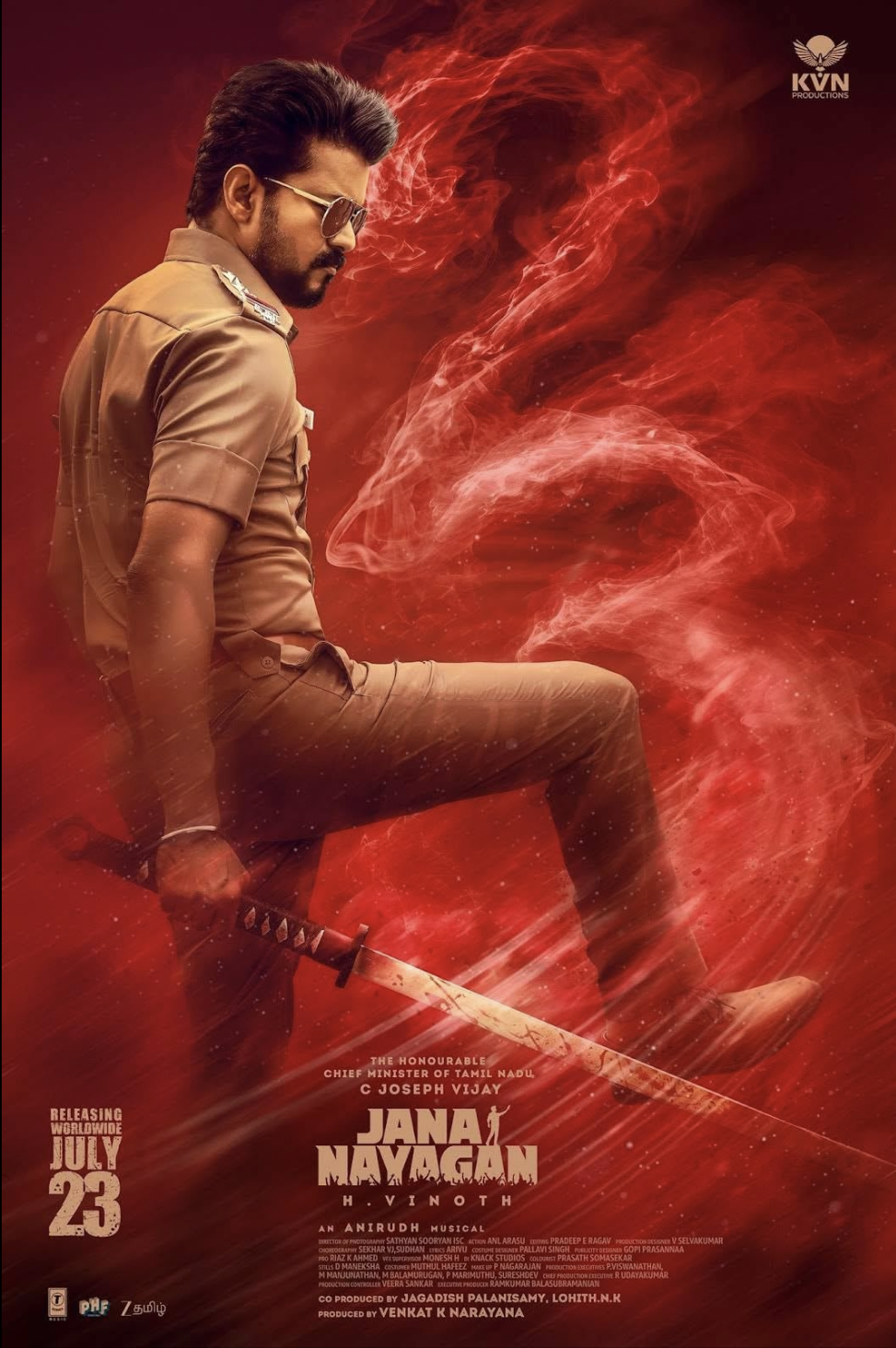
Mass entertainers are built on larger-than-life heroes, memorable confrontations and emotionally charged storytelling. Jan Neta, the Hindi dubbed version of the Tamil film Jana Nayagan, checks all those boxes while attempting to blend political drama, action, family emotions and social commentary into one ambitious package. Directed by H. Vinoth, the film revolves around the ideological battle between a people's leader and a ruthless man driven by power and control.
At the heart of the story is Vetri Kondan, a man who believes leadership is earned through service rather than authority. Standing opposite him is John Himler, a powerful antagonist whose methods threaten democratic values. Their conflict forms the backbone of the narrative, while several parallel tracks involving family relationships, political conspiracies and personal redemption unfold alongside it.
The film never lacks ambition. It aims to be an action spectacle, an emotional family drama and a political entertainer simultaneously. While that ambition creates several engaging moments, it also becomes the film's biggest weakness as the narrative occasionally loses focus.
Screenplay & Script Sense
The screenplay is both the film's greatest strength and its most noticeable flaw.
The central conflict between Vetri Kondan and John Himler is compelling enough to sustain a commercial entertainer. Their ideological differences provide dramatic tension, and the gradual revelation of their shared past adds emotional intrigue.
However, instead of allowing this conflict to remain the primary focus, the screenplay introduces numerous subplots involving politics, family dynamics, mentorship and flashbacks. Individually, many of these portions are interesting, but together they make the narrative feel crowded.
The first half spends considerable time establishing characters and relationships before the central conflict gains momentum. As a result, the pacing occasionally feels uneven. The second half improves significantly, with stronger confrontations, emotional revelations and action sequences that keep viewers invested.
The dialogues suit the larger-than-life nature of the film. While they don't always produce memorable punchlines, several confrontational exchanges effectively establish the ideological divide between hero and villain.
Overall, the screenplay delivers entertainment but would have benefited from tighter writing and greater narrative discipline.
Direction
H. Vinoth demonstrates technical confidence throughout the film.
He stages large-scale action sequences with impressive control and gives the film a polished visual identity. His handling of emotional moments also reflects sincerity, particularly during scenes exploring mentorship and family relationships.
The director deserves appreciation for balancing commercial cinema with social messaging without becoming excessively preachy. However, his desire to include multiple themes results in an overextended narrative.
Several scenes that work individually lose impact because the film frequently shifts between timelines and subplots. A more focused approach would have made the overall experience considerably stronger.
Despite these issues, Vinoth succeeds in delivering a commercially entertaining action drama that remains visually engaging.
Acting
Vijay
Vijay effortlessly carries the film on his shoulders. His commanding screen presence, confident dialogue delivery and effortless charisma make Vetri Kondan an engaging protagonist. Whether performing action sequences or emotional scenes, he maintains complete control over the character. His dance performances once again remind audiences why he remains one of Indian cinema's biggest entertainers.
Bobby Deol
Bobby Deol portrays John Himler with convincing intensity. His calm yet threatening demeanor makes the antagonist formidable. Although the Hindi dubbing somewhat reduces the impact for audiences familiar with his natural voice, his physical performance remains impressive.
Mamitha Baiju
Mamitha Baiju performs sincerely as Viji. Her character contributes emotionally to the story, and she shares a convincing rapport with Vijay despite receiving limited opportunities to shine independently.
c
Pooja Hegde looks graceful and performs confidently within the limited scope provided to her. Unfortunately, her character remains underdeveloped and doesn't influence the narrative as much as expected.
Prakash Raj
Prakash Raj once again proves why he excels in politically charged dramas. His scenes are filled with authority, intelligence and subtle humour. His interactions with Vijay rank among the film's most entertaining moments.
Priyamani
Priyamani delivers a dignified performance despite limited screen time. She brings emotional maturity whenever she appears.
Nasser
Nasser lends credibility to his role with his trademark composure. Though brief, his performance adds weight to important sequences.
Gautham Vasudev Menon
Gautham Vasudev Menon leaves a pleasant impression as Viji's father. His understated acting makes the character believable.
Revathi
Revathi brings warmth and emotional depth to her scenes as Vetri Kondan's mother, although the screenplay gives her very little to explore.
Sunil
Sunil provides enjoyable support and injects light moments into an otherwise serious narrative.
Supporting Cast
The supporting ensemble contributes effectively to maintaining the film's scale.
Lithanya performs confidently as the younger Viji, while Narain, Reba Monica John, Monisha Blessy, Baba Bhaskar, Teejay Arunasalam, Nizhalgal Ravi and Srinath all fit comfortably within the narrative.
Although many supporting characters receive limited development, they help populate the film's expansive political and emotional landscape without becoming distractions.
Cinematography
Sathyan Sooryan's cinematography is among the film's strongest assets.
The action sequences are captured with impressive clarity, while the political gatherings and dramatic confrontations benefit from striking visual compositions.
The film consistently looks polished, making excellent use of lighting, colour and camera movement. The visual scale successfully complements the larger-than-life storytelling.
Music & Background Score
Anirudh Ravichander's soundtrack blends well with the commercial tone of the film.
The songs enhance the narrative without significantly interrupting its flow, although none emerge as unforgettable chartbusters for Hindi audiences.
The background score effectively supports the action and emotional moments, particularly during the hero's entry sequences and major confrontations. A few dramatic scenes, however, could have benefited from greater musical restraint.
Editing
Pradeep E. Ragav keeps the narrative moving despite its considerable length.
The editing during action sequences remains crisp and energetic, but several dramatic passages and flashbacks could have been trimmed to improve overall pacing. A shorter runtime would have made the film considerably tighter and more impactful.
Final Verdict
Jan Neta is a classic mass entertainer that delivers exactly what Vijay's fans expect—heroic moments, energetic action, emotional family drama and a powerful central performance.
While the screenplay occasionally becomes overcrowded with multiple storylines, the film compensates through strong performances, impressive technical craftsmanship and entertaining confrontations.
Vijay dominates the screen with confidence, Bobby Deol makes for a capable antagonist, and Prakash Raj once again demonstrates his remarkable ability to elevate every scene he appears in.
The film may not offer the tightly woven storytelling of the finest political dramas, but it succeeds as a commercial entertainer driven by star power and spectacle.
For fans of Vijay and large-scale South Indian action cinema, Jan Neta provides enough memorable moments to justify the journey, even if the road occasionally becomes longer than necessary.
On the Plus Side
Vijay's commanding screen presence.
Strong action choreography.
Excellent cinematography.
Engaging second half.
Effective performances by Bobby Deol and Prakash Raj.
Polished production values.
On the Minus Side
Overloaded screenplay with multiple subplots.
Uneven pacing in the first half.
Predictable climax.
Underutilized female characters.
Runtime feels excessive.
Film Review by Suyash Pachauri
Founder & Owner
Global Bollywood | Director's Daily Clapboard