Film Review by Suyash Pachauri
Founder & Owner
Global Bollywood | Director's Daily Clapboard
Introduction
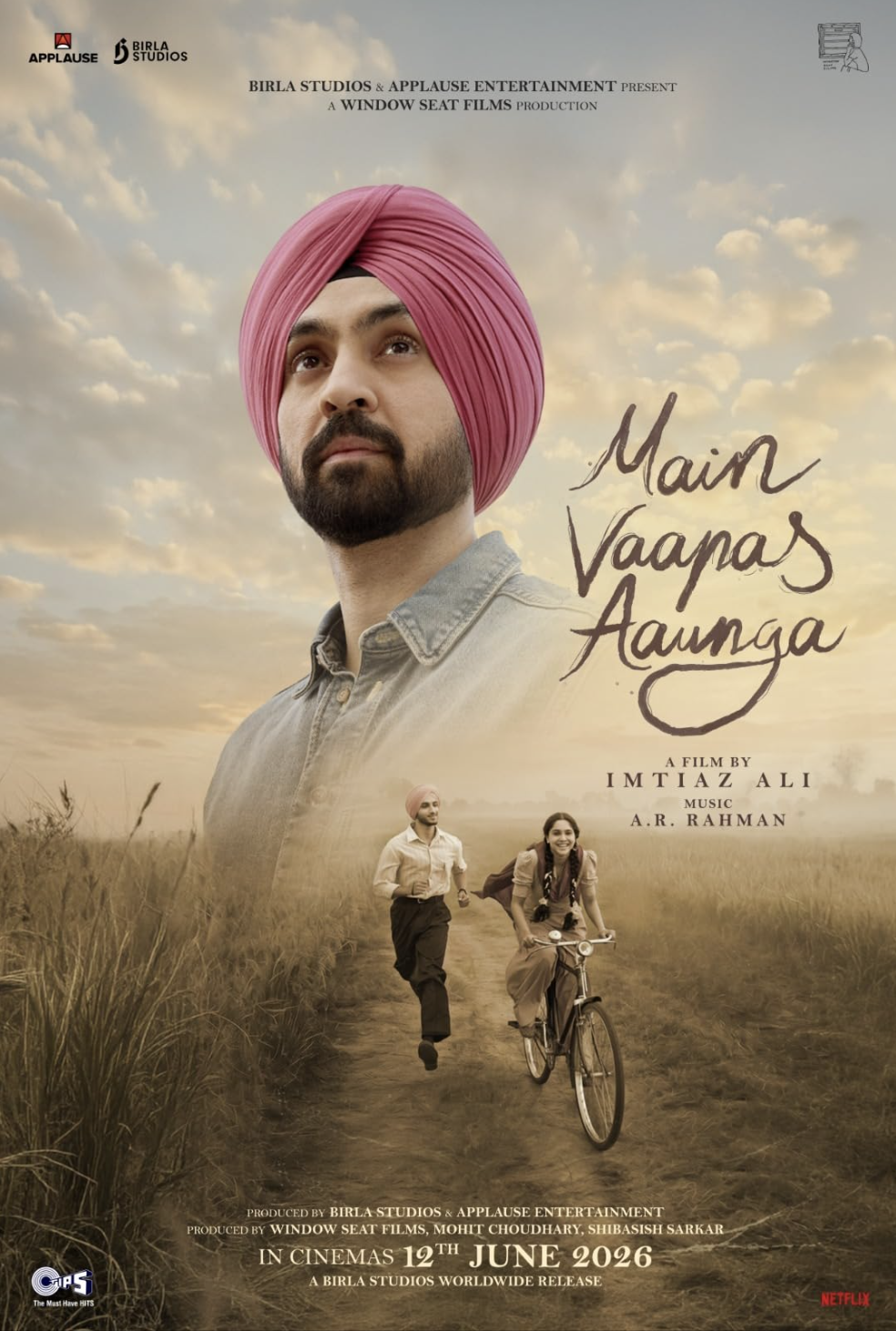
Birla Studios, Applause Entertainment and Window Seat Films' Main Vaapas Aaunga is a romantic drama set against the emotional backdrop of India's Partition. The film explores themes of eternal love, separation, promises, and redemption across generations. While its premise carries immense emotional potential and boasts a talented cast led by Naseeruddin Shah, Diljit Dosanjh, Vedang Raina, and Sharwari, the execution struggles to maintain the emotional impact required for such a poignant story.
Screenplay & Script Sense
Imtiaz Ali and Nayanika Mahtani present a story rooted in nostalgia, sacrifice, and unfinished love. The central premise of a grandson attempting to fulfil his dying grandfather's decades-old promise is emotionally appealing and has the ingredients of a memorable love story.
However, the screenplay becomes the film's biggest weakness.
The narrative unfolds at an extremely slow pace, often stretching scenes beyond their emotional value. Several supporting characters are insufficiently developed, making portions of the drama confusing rather than engaging. Despite dealing with the pain of Partition and lifelong separation, the screenplay rarely evokes the deep emotional response it seeks.
The climax is touching and offers a satisfying emotional payoff, while a handful of individual scenes stand out for their warmth and sincerity. The dialogues are well-written and often carry the emotional weight that the screenplay itself struggles to achieve.
Direction
Imtiaz Ali once again demonstrates his visual storytelling abilities, presenting several beautifully crafted scenes with elegance and sincerity. His understanding of romance and human emotions remains evident throughout.
However, despite technical finesse, the narrative lacks momentum. The slow pacing prevents the audience from fully investing in the emotional journey, resulting in a film that feels considerably longer than it actually is.
Acting
Naseeruddin Shah (Ishar Singh Grewal)
Naseeruddin Shah delivers a restrained and dignified performance as the ageing Ishar Singh Grewal. He effectively portrays the pain of an unfulfilled promise and leaves a lasting impression.
Diljit Dosanjh (Nirvair)
Diljit Dosanjh brings sincerity and warmth to the role of Nirvair. His understated performance provides the emotional anchor of the second half.
Vedang Raina (Young Keenu / Ishar Singh Grewal)
Vedang Raina performs confidently as the young lover, portraying innocence and heartbreak with conviction.
Sharwari (Jiya / Afsana)
Sharwari delivers a graceful and emotionally balanced performance. She shares convincing chemistry with Vedang Raina and lends authenticity to her character.
Banita Sandhu (Kaveri)
Banita Sandhu delivers a decent performance within the limited scope of her role.
Rajat Kapoor (Iqbal Grewal)
Rajat Kapoor performs with his trademark maturity and leaves a positive impression.
Jaipreet Singh (Angad Grewal)
Provides a satisfactory performance.
Anjana Sukhani (Meher Grewal)
Performs naturally and supports the narrative well.
Vinod Nagpal (Kirpal)
Leaves a noticeable impression despite limited screen time.
Sanjay Suri (Jasmer Grewal)
Sanjay Suri delivers an effective and composed performance.
Manish Chaudhari (Muzaffar Ahmedzai)
Very natural and believable in his role.
Danish Pandor (Afzal)
Makes his presence felt in the supporting role.
Dolly Ahluwalia
Leaves a pleasant impression despite limited screen time.
Supporting Cast
The supporting cast features several accomplished actors who perform sincerely. However, many characters lack sufficient development, limiting their emotional impact.
Cinematography
Sylvester Fonseca beautifully captures both the nostalgic landscapes and emotional moments. The visuals effectively recreate the period atmosphere and enhance the film's aesthetic appeal.
Music & Background Score
A.R. Rahman's music possesses emotional depth but lacks songs that leave a lasting impression or become instantly memorable. Irshad Kamil's lyrics complement the narrative well.
The background score, however, beautifully supports the emotional moments and enriches the film's atmosphere.
Editing
Aarti Bajaj's editing remains crisp considering the film's lengthy narrative. However, the sluggish pace stems primarily from the screenplay rather than the editing itself.
Final Verdict
Main Vaapas Aaunga is an emotionally ambitious love story with an appealing premise and several heartfelt performances. Unfortunately, its painfully slow screenplay and lack of sustained emotional engagement prevent it from reaching its full potential.
While fans of slow-burn romantic dramas may appreciate its sincerity, mainstream audiences are likely to find the narrative too stretched and emotionally underwhelming. Strong performances and beautiful visuals are ultimately overshadowed by a screenplay that struggles to maintain interest.
Verdict: A well-intentioned romantic drama elevated by fine performances but weighed down by an overlong and emotionally uneven screenplay.
On the Plus Side
Strong performances by Naseeruddin Shah and Diljit Dosanjh.
Vedang Raina and Sharwari share convincing chemistry.
Beautiful cinematography recreates the Partition era effectively.
Touching climax with emotional resonance.
Well-written dialogues.
A.R. Rahman's effective background score.
On the Minus Side
Slow and excessively stretched screenplay.
Emotional moments rarely achieve their intended impact.
Underdeveloped supporting characters create confusion.
Songs fail to leave a lasting impression.
Narrative loses momentum for long stretches, testing the audience's patience.
Film Review by Suyash Pachauri
Founder & Owner
Global Bollywood | Director's Daily Clapboard