Film Review by Suyash Pachauri
Founder & Owner
Global Bollywood | Director's Daily Clapboard
One Liner:
"A visually grand mythological adventure that dazzles the eyes but struggles to keep the heart and mind invested."
Introduction
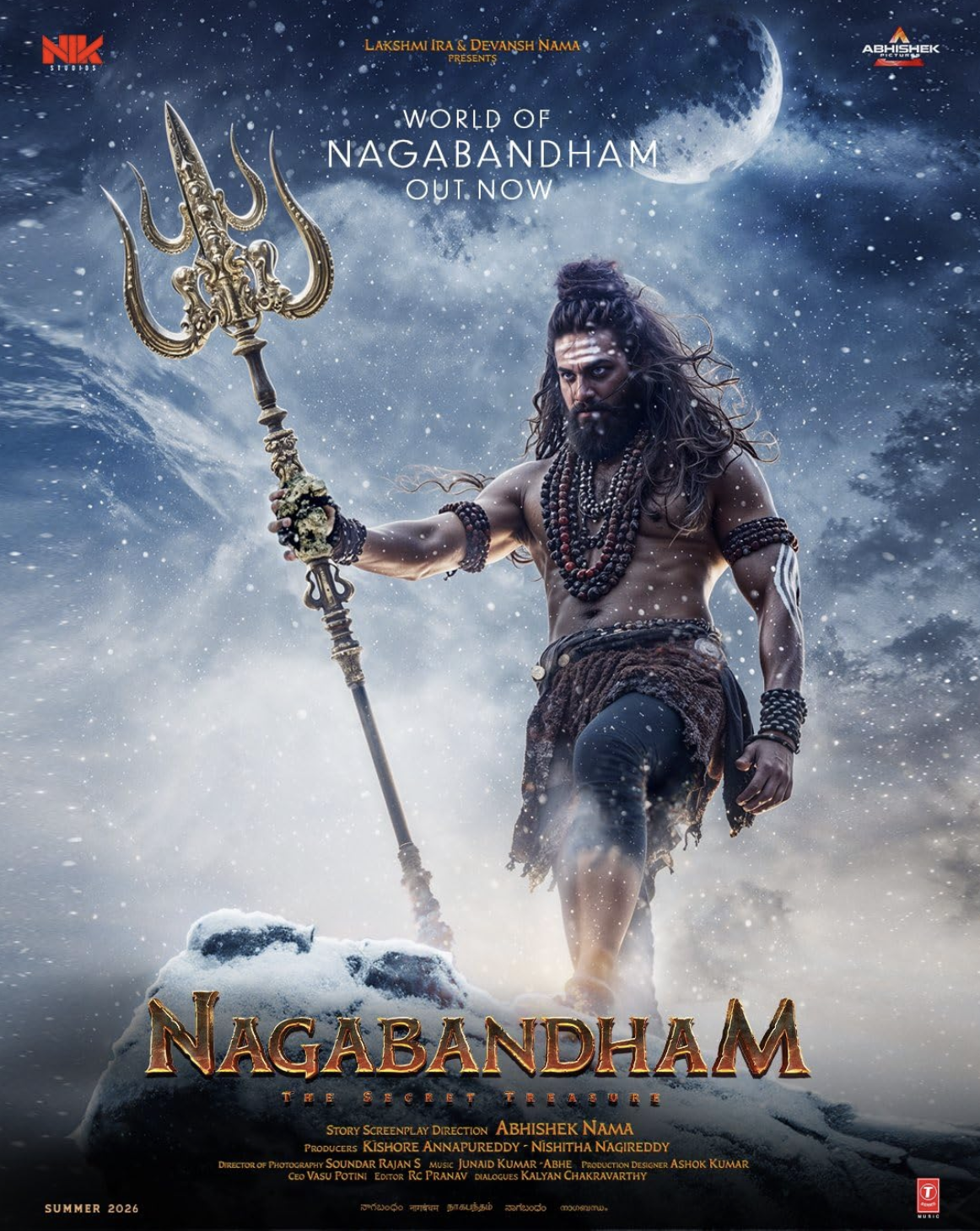
Indian cinema has increasingly embraced mythology and fantasy, combining ancient legends with large-scale visual effects and action-driven storytelling. Nagabandham, dubbed from Telugu, arrives with similar ambitions. Mounted on a lavish scale, the film promises an adventurous journey through hidden temples, sacred relics, mythical secrets and the timeless battle between good and evil.
The story revolves around the mysterious Nagabandham temple hidden in the Himalayas, where an unimaginable treasure lies protected by ancient forces. To unlock its secrets, the elusive Swaran Kamal and the sacred Nagabandham manuscript must be brought together. Standing between greed and destiny is Rudra, while the ruthless Abdali stops at nothing to obtain the treasure.
The premise carries all the ingredients of an engaging fantasy adventure. Unfortunately, while the production values consistently impress, the storytelling rarely reaches the same level. Nagabandham becomes a classic example of style outweighing substance. It is visually spectacular, but emotionally distant and dramatically inconsistent.
Screenplay & Script Sense
The screenplay is undoubtedly the film's weakest pillar. Although the central concept of a hidden mythical temple guarded by ancient secrets is fascinating, the writing struggles to convert that idea into a consistently engaging narrative.
The film introduces numerous characters, subplots and mythological references in quick succession, making it difficult for viewers to establish an emotional connection with anyone. Instead of allowing the mystery to unfold gradually, the screenplay frequently overwhelms the audience with excessive exposition and multiple narrative threads.
The pacing also becomes a major concern. At nearly every stage, the film feels longer than necessary. Several action sequences, despite being technically impressive, stretch beyond their purpose and eventually reduce the excitement rather than enhancing it.
The romantic portions involving Rudra and Parvathy appear forced and fail to contribute meaningfully to the larger story. Likewise, emotional moments lack the intensity needed to make the audience genuinely care about the characters' fate.
The dialogues, however, deserve appreciation. They effectively capture the mythological flavour of the narrative and occasionally provide impactful moments amidst the otherwise uneven screenplay.
Direction
Director Abhishek Nama clearly possesses an ambitious vision. Every frame reflects his desire to create a grand cinematic experience inspired by mythology and fantasy.
Unfortunately, visual ambition alone cannot compensate for weak storytelling. Despite the enormous scale, the narrative rarely generates genuine excitement or suspense. The film often mistakes spectacle for emotional engagement.
Nama deserves credit for attempting a genre that demands considerable imagination and technical precision. The large sets, elaborate costumes and expansive action sequences showcase his commitment to presenting a larger-than-life experience.
However, the screenplay never receives the same attention as the visuals. As a result, the audience admires the grandeur without becoming emotionally invested in the journey.
Acting
Virat Karrna
Virat Karrna delivers a sincere performance as Rudra. He possesses the physical presence required for an action-fantasy hero and performs the demanding action sequences confidently. While his emotional scenes occasionally lack depth, he remains a dependable protagonist throughout the film.
Nabha Naresh
Nabha Naresh brings grace and elegance to Parvathy. She looks convincing in the mythological setting and performs naturally. Unfortunately, her character is underwritten, preventing her from making a stronger impact.
Rishabh Sawhney
Rishabh Sawhney is one of the film's biggest assets. As Abdali, he projects menace and authority with ease. Although his performance occasionally becomes overly theatrical, he succeeds in making the antagonist memorable.
Jagapathi Babu
Jagapathi Babu once again demonstrates why he remains one of the industry's most reliable performers. His composed performance as Prabhakaran adds credibility and maturity to the narrative.
Ramachandra Raju
Ramachandra Raju leaves a solid impression as Bairagi. His commanding screen presence strengthens every sequence he appears in.
Murali Sharma
Murali Sharma performs his role with characteristic ease. Even with limited screen time, he lends authenticity to Achyutha Chary.
Saranya Ponvannan
Saranya Ponvannan performs adequately as Padmamma and adds emotional warmth whenever the screenplay allows.
Mahesh Manjrekar
Mahesh Manjrekar delivers an average but respectable performance as Suvarna Shastry. His character deserved greater depth.
Anasuya Bhardwaj & Daksha Nagarkar
Anasuya Bhardwaj and Daksha Nagarkar perform competently but remain restricted by limited character development.
Supporting Cast
The supporting ensemble performs according to the film's requirements but suffers from insufficient characterization. Because the screenplay constantly shifts between multiple characters, very few supporting roles receive enough attention to become memorable.
Nevertheless, the experienced cast collectively contributes to maintaining the film's mythological atmosphere.
Cinematography
Soundar Rajan S.'s cinematography is easily among the film's strongest achievements.
The Himalayan landscapes, elaborate temple interiors and fantasy-inspired visuals are captured beautifully. Every frame reflects grandeur and technical finesse. The cinematography consistently enhances the scale of the narrative and provides the immersive visual experience expected from a mythological adventure.
Music & Background Score
Junaid Kumar-Abhe's soundtrack is serviceable but largely forgettable. None of the songs possess the emotional or musical strength required to leave a lasting impression.
While the choreography is lavish and visually appealing, several songs interrupt the narrative flow instead of enriching it.
The background score supports the action adequately but misses opportunities to elevate the mystery and emotional drama.
Editing
R.C. Pranav's editing is another area where the film could have improved considerably.
The excessive runtime and prolonged action sequences affect the narrative rhythm. Tighter editing, especially during the second half, would have significantly increased the film's impact and prevented viewer fatigue.
Final Verdict
Nagabandham is a film that demonstrates tremendous ambition in terms of scale, production design and visual presentation. Every technical department contributes to creating a cinematic world that feels grand and immersive.
However, cinema ultimately depends on storytelling, and that is where the film falters. A confusing screenplay, uneven pacing, underdeveloped characters and limited emotional engagement prevent the narrative from reaching its full potential.
Virat Karrna performs confidently, Rishabh Sawhney delivers an effective antagonist, and the technical brilliance particularly the cinematography, production design and action choreography keeps the film visually engaging. Unfortunately, these strengths cannot completely overcome the shortcomings of the writing.
For audiences who enjoy visually mounted fantasy adventures, Nagabandham offers enough spectacle to justify a watch. But those expecting an emotionally gripping mythological epic may come away disappointed.
On the Plus Side
Grand production values and lavish set design.
Excellent cinematography.
Well-executed action choreography.
Effective performance by Rishabh Sawhney.
Strong visual appeal throughout.
On the Minus Side
Weak and confusing screenplay.
Slow pacing and excessive runtime.
Forced romantic track.
Limited emotional engagement.
Forgettable music and uneven background score.
One-Liner
"Despite unlocking the gates to visual grandeur, Nagabandham never truly unlocks the emotional treasure hidden within its story."
Film Review by Suyash Pachauri
Founder & Owner
Global Bollywood | Director's Daily Clapboard