Introduction
There are sci-fi films that impress you with scale, and then there are films that quietly surprise you with heart. Project Hail Mary manages to do both. Directed by the energetic duo Phil Lord and Christopher Miller, and adapted from Andy Weir’s bestselling novel, this film walks a tricky line between hard science fiction, emotional drama, survival thriller, and buddy comedy. Surprisingly, it succeeds more often than it stumbles.
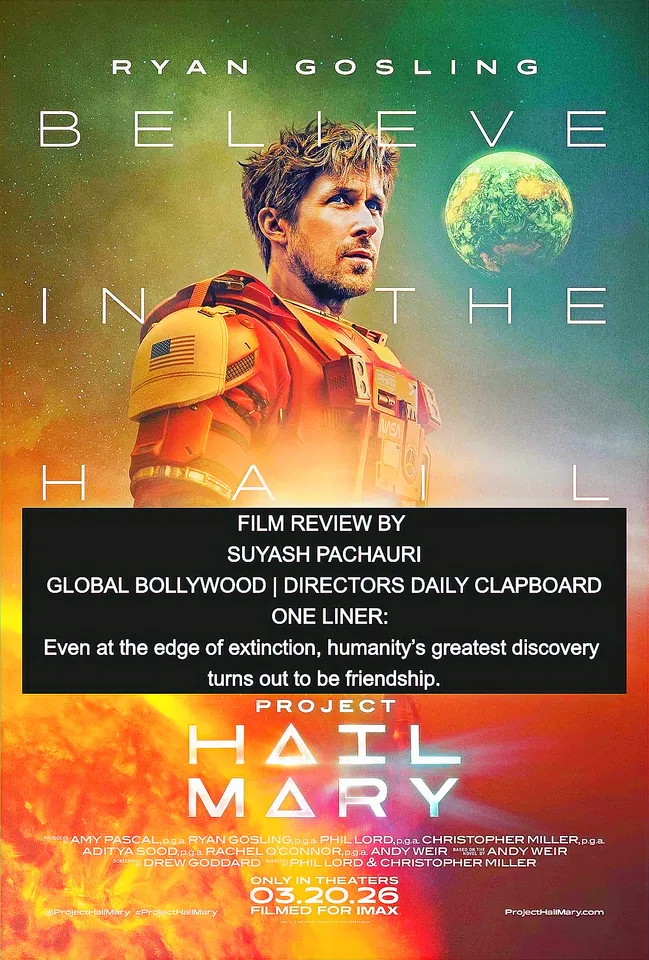
The film follows Ryland Grace, played by Ryan Gosling, a science teacher who wakes up alone aboard a spacecraft with no memory of who he is or why he’s there. As fragments of memory slowly return, he discovers he may be humanity’s last hope in preventing the sun from dying. The premise sounds massive, but the storytelling keeps things deeply personal.
Unlike many recent sci-fi spectacles that become obsessed with visual overload, Project Hail Mary stays emotionally grounded. It is clever without becoming cold, funny without ruining tension, and emotional without turning melodramatic. The film may not reinvent the genre completely, but it delivers one of the most satisfying large-scale sci-fi adventures in years.
Screenplay & Script Sense
The screenplay by Drew Goddard is arguably the film’s biggest strength. Adapting Andy Weir’s highly technical novel was never going to be easy because much of the book relies on scientific explanations and internal monologues. Yet the script smartly transforms those elements into engaging cinematic storytelling.
The film’s structure constantly jumps between present-day space survival and flashbacks from Earth. Usually, fragmented narratives risk damaging momentum, but here the mystery of Ryland’s memories becomes part of the entertainment. Every revelation adds emotional or narrative weight.
What works beautifully is how the science is treated seriously without alienating mainstream audiences. The film trusts viewers to follow scientific discussions instead of oversimplifying everything. There’s tension in problem-solving scenes because the screenplay understands that intelligence itself can be cinematic.
At the same time, the writing occasionally becomes too self-aware. Certain jokes arrive in moments where silence might have worked better. A few emotional scenes are interrupted by quips that slightly dilute the gravity of the situation. This tonal imbalance has divided audiences and critics alike.
Still, the emotional core involving friendship, loneliness, sacrifice, and survival remains powerful throughout. By the final act, the screenplay earns its emotional payoff honestly rather than forcing sentiment.
Direction
Phil Lord and Christopher Miller bring their signature energy into the film, but what surprises most is how restrained they are compared to their earlier work. Known for hyperactive humor and animated chaos, the duo show impressive maturity here.
The space sequences are visually immersive without becoming exhausting. The directors understand scale extremely well. The isolation inside the spacecraft feels suffocating, while the vastness of space feels genuinely intimidating.
Their biggest achievement, however, is making the relationship-driven moments feel natural. The film could have easily become a cold science lecture, but the directors never lose focus on emotional engagement.
The pacing does become uneven in the middle portions. At nearly 2 hours and 35 minutes, the film occasionally stretches scenes longer than necessary. Some Earth-based flashbacks feel repetitive. But whenever the narrative risks slowing down, the directors pull viewers back with either emotional stakes or visual spectacle.
The tonal balancing act between humor and existential dread isn’t always perfect, but it remains ambitious and refreshing.
Acting
Ryan Gosling
Ryan Gosling carries the entire film on his shoulders, and thankfully, he delivers one of his most likable performances in years. As Ryland Grace, he balances vulnerability, intelligence, sarcasm, fear, and emotional warmth with remarkable ease.
Gosling’s natural charisma makes even exposition-heavy scenes entertaining. More importantly, he convincingly portrays a man who never truly saw himself as a hero but is forced into impossible circumstances.
Some critics have argued that Gosling occasionally plays “Ryan Gosling in space” rather than disappearing into the character completely. There is some truth to that observation. However, his charm works heavily in the film’s favor. The emotional scenes land because Gosling never overacts them.
Sandra Hüller
Sandra Hüller is phenomenal as Eva Stratt. Her performance is controlled, sharp, and commanding. She brings authority without turning the character into a stereotype. Every scene involving her immediately gains intensity.
Hüller avoids unnecessary dramatics and instead delivers a performance built on cold realism. She becomes the perfect contrast to Gosling’s emotional uncertainty.
James Ortiz
James Ortiz deserves enormous praise for bringing Rocky to life. Despite being an alien character, Rocky becomes one of the most emotionally engaging personalities in the film. Through vocal performance, movement, and physical characterization, Ortiz creates genuine chemistry with Gosling.
Their evolving friendship becomes the soul of the movie.
Ken Leung delivers a grounded and sincere performance as Yao.Milana Vayntrub brings warmth and humanity to Olesya Ilyukhina.Lionel Boyce adds subtle emotional texture in supporting moments.Priya Kansara has limited screen time but leaves a pleasant impression.
The ensemble overall feels believable, which is crucial in a film dependent on scientific collaboration and emotional trust.
Supporting Cast
One of the underrated strengths of Project Hail Mary is how effectively even brief supporting roles contribute to the emotional atmosphere. The film never treats secondary characters as disposable exposition machines.
The Earth-based scenes feel alive because actors like Mia Soteriou and others bring realism to otherwise technical discussions. Every character appears motivated by fear, hope, or desperation instead of simply pushing the plot forward.
Even though the film is heavily centered around Ryland Grace, the supporting performances prevent it from feeling emotionally isolated.
Cinematography
The cinematography by Greig Fraser is stunning. Fraser once again proves why he is among the finest visual storytellers working today.
The spacecraft interiors feel tactile and claustrophobic, while the cosmic imagery delivers breathtaking scale. The lighting design especially deserves praise. Many scenes rely on subtle light contrasts that enhance loneliness and uncertainty.
Unlike some modern blockbusters that drown audiences in CGI excess, Project Hail Mary keeps its visuals surprisingly elegant. The imagery serves storytelling rather than existing only for spectacle.
Several sequences involving space travel, alien environments, and zero-gravity movement are visually mesmerizing without becoming overly flashy.
Music & Background Score
Daniel Pemberton provides a score that perfectly complements the film’s shifting tones.
The music blends emotional orchestration with atmospheric sci-fi textures. During tense scientific problem-solving scenes, the score quietly builds suspense without overwhelming dialogue. Emotional scenes are treated delicately rather than manipulated with loud dramatic cues.
The soundtrack understands restraint, which becomes one of its biggest strengths.
Some musical moments intentionally lean toward hopeful optimism rather than dark existential dread, giving the film a warmer emotional identity compared to many modern sci-fi dramas.
Editing
The editing by Joel Negron is mostly sharp, especially considering the film’s complex timeline structure. The transitions between memory flashbacks and present-day events feel smooth and purposeful.
However, pacing issues occasionally emerge in the second act. Certain explanatory scenes could have been trimmed for tighter momentum. The film’s long runtime becomes noticeable at points.
Still, the emotional rhythm remains effective, and the final act is edited exceptionally well. The climax builds tension naturally while maintaining emotional clarity.
Final Verdict
Project Hail Mary is one of those rare mainstream sci-fi films that manages to feel intelligent, emotional, funny, and visually grand all at once. It does not reach the philosophical depth of Interstellar, nor does it possess the grounded realism of The Martian, but it confidently creates its own identity.
The film’s greatest success lies in its humanity. Beneath all the science, visual spectacle, and cosmic danger, this is ultimately a story about connection, trust, and survival.
Yes, the humor occasionally undercuts tension. Yes, the runtime could have been shorter. But these flaws are easy to forgive because the film remains consistently engaging and emotionally rewarding.
Ryan Gosling delivers a highly charismatic lead performance, the direction is ambitious, the visuals are spectacular, and the emotional payoff genuinely works.
This is blockbuster science fiction made with sincerity instead of cynicism.
On the Plus Side
Ryan Gosling’s highly engaging lead performance
Strong emotional core beneath the sci-fi spectacle
Stunning cinematography by Greig Fraser
Intelligent screenplay that respects audience intelligence
Excellent chemistry between Ryland and Rocky
Daniel Pemberton’s emotionally effective score
Visually immersive space sequences
On the Minus Side
Tonal imbalance in certain scenes
Humor occasionally weakens emotional tension
Slightly overlong runtime
Some repetitive flashback portions
A few supporting characters deserved more depth
One Liner
“Even at the edge of extinction, humanity’s greatest discovery turns out to be friendship.”
PUBLISHED BY SUYASH PACHAURI, FOUNDER & OWNER, GLOBAL BOLLYWOOD | THE HOLLYWOOD SCOPE