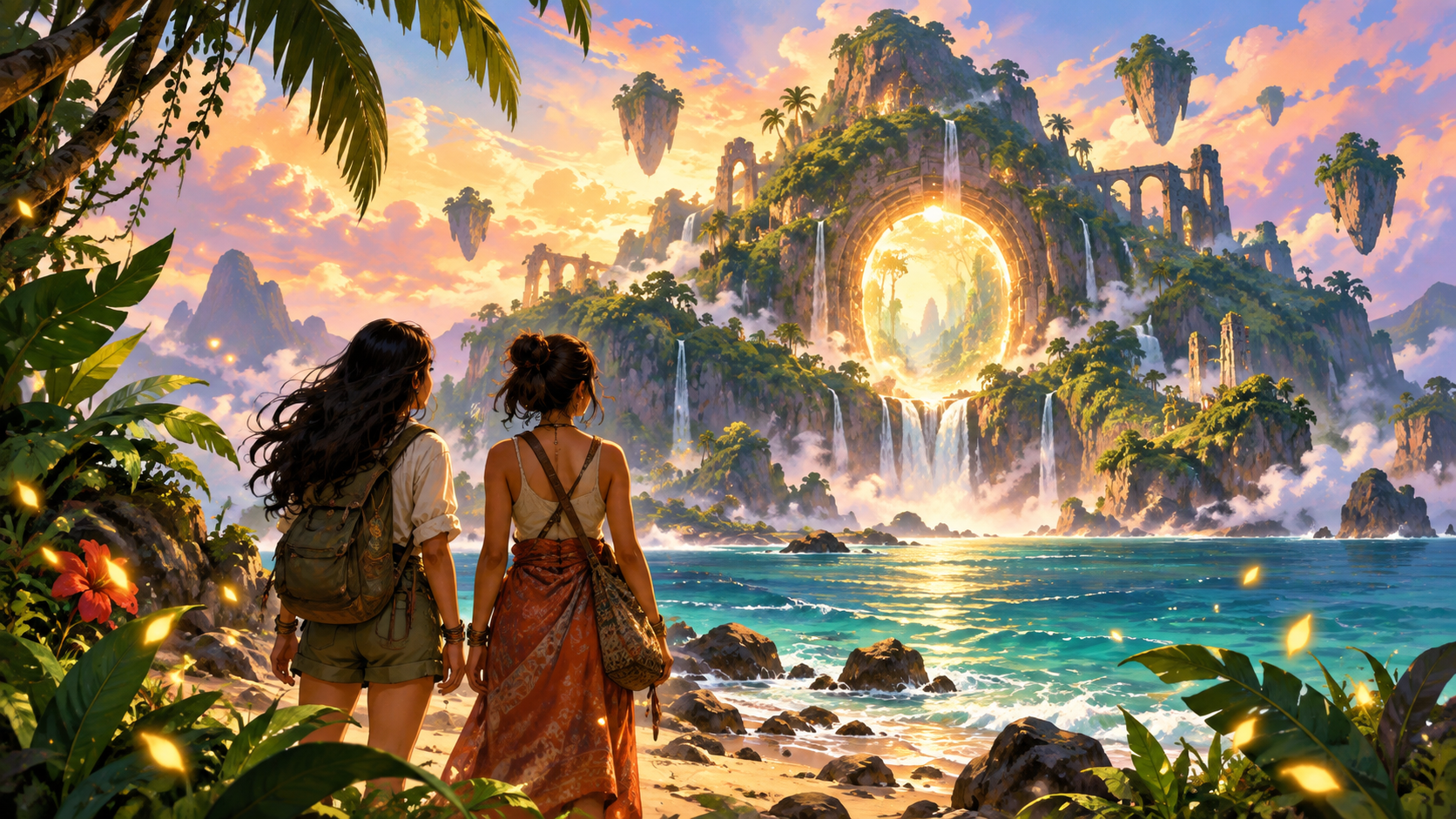
Forgotten Island gives DreamWorks Animation a culturally specific fantasy world and an emotionally universal problem: two lifelong friends can love each other deeply and still begin moving in different directions. Directors Joel Crawford and Januel Mercado place that tension inside a dazzling adventure inspired by Filipino folklore. The film is crowded, fast and occasionally exhausting, but its imagination and sincerity carry it through the busiest passages.
Set in the Philippines during the 1990s, the story follows Jo, voiced by H.E.R., and Raissa, voiced by Liza Soberano. Their friendship was formed in childhood, when Raissa defended Jo and embraced her stories about the mythical island of Nakali. As young adults they confront the possibility that ambition, opportunity and change may separate them. A celebration, an enchanted sand dollar and a missing stretch of memory lead them into the world Jo once described, where recovering the route home also means recovering what their bond has become.
Friendship Gives the Fantasy Its Emotional Centre
The screenplay works best when it lets Jo and Raissa disagree without turning either woman into a villain. Jo fears abandonment and clings to the history they share. Raissa wants growth and cannot remain inside a promise made by their younger selves. Both positions are understandable, which gives the adventure more complexity than a simple lesson about staying together forever. The film recognises that friendship is not preserved by freezing people in place. It survives through honesty, adaptation and the willingness to remember another person's needs.
H.E.R. and Soberano create a warm vocal rhythm that sells years of shared experience. Their banter feels comfortable until the unspoken conflict begins to show through it. The supporting voice cast, including Dave Franco, Manny Jacinto, Jenny Slate, Dolly de Leon, Jo Koy, Ronny Chieng and Lea Salonga, fills Nakali with comic friction and mythic personality. Lea Salonga's Manang, connected to the feared Manananggal tradition, gives the fantasy an especially memorable cultural charge.
Filipino Folklore Shapes the Visual World
The animation combines painterly environments, elastic character movement and bursts of graphic exaggeration. Filipino influences are not added as surface decoration. Food, family memory, language, creatures and community expectations shape the design and the emotional logic of the story. Nakali feels like a place assembled from legends remembered across generations. That specificity separates the movie from the many animated adventures built around interchangeable magical kingdoms.
Crawford and Mercado also bring the kinetic confidence associated with Puss in Boots: The Last Wish. Action scenes bend perspective and shift visual texture, allowing the animators to treat memory as a physical space. The most effective moments are not always the largest. A change in colour, a fragment of a childhood story or a photograph can carry as much emotional force as a chase through a realm of monsters.
When Energy Becomes Overload
The film's principal weakness is its determination to keep moving. Jokes, creatures, revelations and visual ideas sometimes arrive before the previous moment has settled. The crowded pace can flatten emotional transitions that deserve more silence. Younger audiences may enjoy the velocity, but viewers hoping to remain with Jo and Raissa during their most vulnerable exchanges may wish the movie would breathe.
Even that excess reflects an admirable creative appetite. Forgotten Island would rather risk too many ideas than offer a generic package. Its comedy does not always land, and certain plot turns rely on convenient rules, yet the film maintains a coherent emotional destination. The chaos is organised around a question that matters: what do friends owe the versions of themselves that first chose each other?
Forgotten Island Review Verdict
Forgotten Island is a vivid, culturally grounded animated fantasy with a strong heart. Its Filipino identity gives the film texture, humour and a mythology rarely presented at this scale in mainstream American animation. H.E.R. and Liza Soberano make the friendship believable, while the ensemble turns Nakali into a world full of surprises.
The movie's speed and density may overwhelm some viewers, but its emotional message survives the noise. Friendships change because people change, and remembering what brought two people together is not the same as refusing to let either of them grow. By placing that mature idea inside a colourful adventure, Forgotten Island becomes more than a visual showcase. It becomes a celebration of memory, culture and the difficult generosity required to move forward together.
Its most useful invitation to families is a conversation about change: how to support another person's ambitions while acknowledging the fear of being left behind. That question gives the adventure something to discuss after its spectacle has faded.
PUBLISHED BY SUYASH PACHAURI, FOUNDER & OWNER, GLOBAL BOLLYWOOD | THE HOLLYWOOD SCOPE