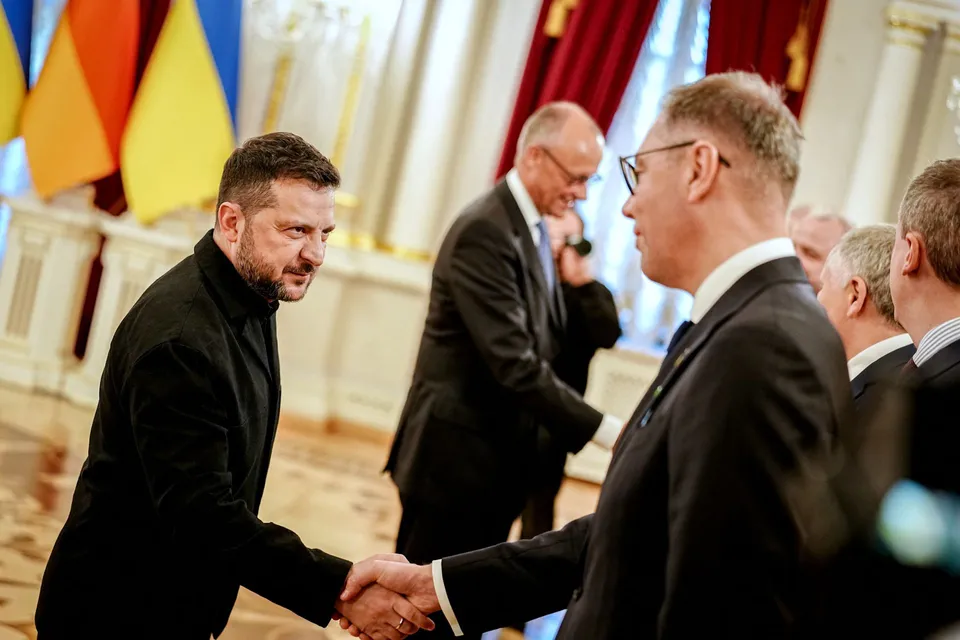
Germany Ukraine military aid will increase by another €1 billion after Chancellor Friedrich Merz used a visit to Kyiv to underline Berlin's long-term security commitment. The trip unfolded under repeated air-raid sirens and explosions as Russian drones targeted the capital. Merz also announced €350 million for energy-sector repairs and oversaw commercial agreements between German companies and Ukrainian partners. The package combines immediate defence needs, infrastructure recovery and industrial cooperation at a time when faster jet-powered drones are testing Ukraine's ability to protect cities.
What the New Germany Ukraine Military Aid Includes
The additional €1 billion is intended to strengthen military support, while the visit produced agreements for air-defence missiles, radar equipment and drone interceptors. Ukraine reached a supply arrangement with Diehl Defence for IRIS-T missiles, a radar deal with Hensoldt and an agreement involving Quantum Systems' jet-powered interceptor. These capabilities address different parts of the same defensive chain: detecting an incoming threat, tracking it accurately, assigning a response and destroying it before it reaches a city or military target.
Merz said Germany would not be intimidated into abandoning Ukraine and described support as a matter of European security. His message came while attacks struck transport and infrastructure around Kyiv. One blast damaged the roadway on the Northern Bridge across the Dnipro River, injured two people and disrupted a hot-water system. The setting gave the announcement a practical urgency. Military aid is not an abstract budget item when energy networks and bridges are being targeted during the diplomatic visit itself.
Sixteen Agreements Aim to Build a Wider Partnership
Executives traveling with the chancellor signed 16 agreements valued at roughly €6.5 billion. The package reaches beyond the direct transfer of equipment and points toward joint production, maintenance and technology development. Ukraine and Germany are also close to a broader defence arrangement that could cover drones, missiles and related software. Local production can shorten supply lines and make adaptation faster because Ukrainian forces can send battlefield feedback directly to designers and factories.
Jet-Drone Interceptors Address a New Air-Defence Gap
Russia has increased its use of high-speed jet-powered attack drones, which are more difficult to stop than slower propeller-driven systems. Ukraine often must use combat aircraft or expensive missiles against them, creating a cost and capacity problem. A smaller dedicated interceptor could provide a more sustainable response if it is reliable, easy to produce and integrated with radar. President Volodymyr Zelenskiy said the SPYS interceptor developed by Quantum Systems had shown promising results, but operational performance will determine whether it can be deployed at scale.
The €350 million allocated for energy repairs recognizes that civilian resilience is part of national defence. Repeated strikes on electricity, telecommunications and transport can weaken economic activity and force residents to leave cities even when front lines do not move. Repair funds must support transformers, grid components, protective works and rapid-response teams. Investment in decentralized generation and storage can also reduce the effect of losing one major facility.
Germany's Support Carries European Strategic Weight
Berlin's decisions influence the wider European debate because Germany has the region's largest economy and a significant industrial base. A commitment to missiles, radar and energy recovery can encourage other governments to make complementary contributions. It can also reveal bottlenecks in production. Air-defence demand now exceeds the pace at which some systems and interceptors can be manufactured, so multi-year orders and joint procurement are needed to expand capacity.
The partnership will still face scrutiny over delivery times, financing and accountability. Announced aid matters only when equipment reaches units, crews are trained and spare parts remain available. Commercial agreements also require clear ownership, export permissions and protection of sensitive technology. The most successful projects will combine rapid deployment with a plan for maintenance and domestic Ukrainian capability rather than creating long-term dependence on distant suppliers.
The latest Germany Ukraine military aid package signals that Berlin sees the conflict as a direct test of Europe's security order. Its value lies not only in the headline amount but in the combination of air defence, energy restoration and industrial cooperation. Parliamentary oversight and public reporting can help show how funds translate into delivered equipment and repaired infrastructure. Timely delivery remains essential. The visit under drone attack demonstrated the threat these programs are meant to address. Their real measure will be whether they reduce successful strikes, restore critical services and expand the production base needed for a prolonged defence.
PUBLISHED BY SUYASH PACHAURI, FOUNDER & OWNER, GLOBAL BOLLYWOOD | THE HOLLYWOOD SCOPE.