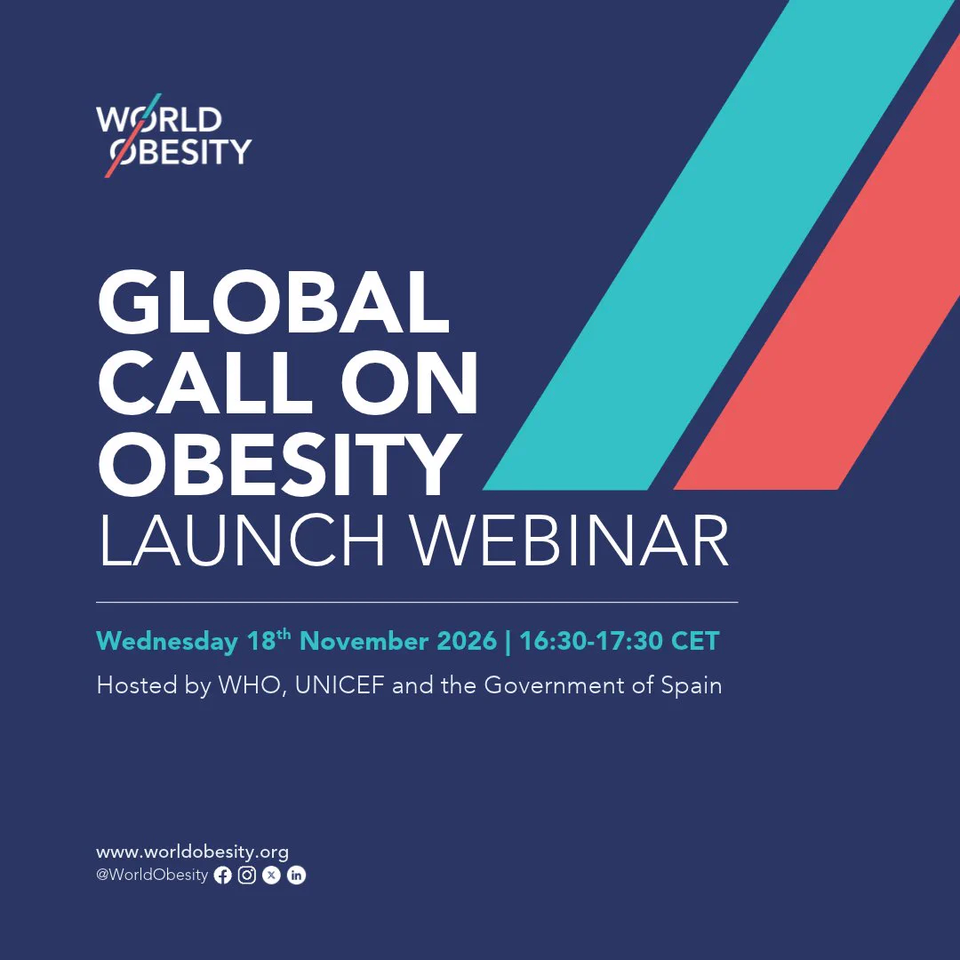
A coalition of 21 governments, working with the World Health Organization and UNICEF, set out a renewed international approach to obesity prevention and care on 17 November 2026. The commitment, called Bending the Curve by 2030, sets a measurable ambition to reduce national obesity prevalence by 5 percent by the end of the decade. The significance lies less in the launch ceremony than in what public institutions must now change: school environments, access to affordable treatment, health-system capacity and the way progress is measured.
Spain is participating alongside 20 countries from the existing acceleration initiative. Their announcement comes after the Madrid Global Obesity Summit in October and before a public launch event scheduled for 18 November. Those are distinct milestones, not three different policy agreements. The November commitment is worth examining beyond its launch week because its targets and implementation questions will remain active for several years.
Why the commitment matters in 2026
More than one billion people worldwide are living with obesity, equivalent to roughly one in seven people. The rise is not confined to a single income group or continent. Adult prevalence has more than doubled since 1990, while adolescent prevalence has increased roughly fourfold. These trends make obesity a public-health concern involving health services, food systems, urban planning and economic opportunity rather than a question that can be answered only by advising individuals to change their behaviour.
The participating institutions are also responding to a generational shift. In 2025, obesity became more common than underweight among children and adolescents aged five to nineteen, measured globally. That milestone does not mean undernutrition has disappeared, nor does it imply every country follows the same pattern. It shows why governments need policies capable of addressing multiple forms of malnutrition simultaneously, especially where households face high food prices and limited access to nutritious choices.
The three elements of the new approach
Preventing harm before illness develops
Population-level prevention is the first strand. Governments are encouraged to improve food environments through healthier school meals, reliable front-of-pack nutrition information and limits on aggressive marketing of unhealthy products to children. Taxes on sugar-sweetened drinks are another available policy instrument, although national implementation and effectiveness depend on design. Spaces that make everyday physical activity safer and more accessible are also part of the proposed response. No single measure is presented as sufficient on its own.
A credible prevention strategy must consider whose circumstances make healthy routines easier or harder. The distance to a food shop, the safety of a walking route, the price of fresh produce and the food served near schools can all affect choices. Policy therefore needs to work at neighbourhood level, not simply distribute information campaigns. Authorities also need to assess unintended burdens on low-income families and ensure that new standards produce genuinely healthier options rather than only new labels.
Finding risk earlier without stigma
The second strand focuses on earlier identification and support for people at increased risk. This means strengthening primary health care, making assessment accessible and connecting people to suitable counselling or other services before complications become harder to manage. A person's body size should not be treated as a complete description of their health. The policy approach recognises the value of validated clinical assessment and respectful communication, avoiding one-size-fits-all assumptions and judgemental language.
Earlier intervention also relies on trained clinicians and well-designed referral arrangements. Screening alone offers limited benefit when a patient has no realistic route to follow-up care. Governments will need to decide which services are available in community clinics, which require specialists and how continuity can be maintained across different ages. Young people require age-appropriate support, including transitions to adult care when relevant, rather than isolated advice delivered without family or community resources.
Making effective care affordable
The third strand addresses treatment for people already living with obesity and related health complications. Appropriate options can include behavioural support, long-term clinical follow-up, medication for eligible adults and surgery for selected patients. Such decisions require individual clinical assessment and national regulatory safeguards. The statement is not a recommendation that everyone should take medication or pursue a procedure. Its central proposition is that clinically appropriate care should not be reserved for people who can pay privately.
Affordability will be among the most difficult tests. Health systems need trained staff, reliable clinical guidance, appropriate financing and mechanisms for judging which interventions offer meaningful benefit. Countries also must consider how treatment fits alongside prevention, so that attention to new medicines does not eclipse school nutrition, supportive communities or broader health inequities. A sustainable programme should improve access while protecting patient choice and monitoring outcomes.
What the five percent target actually means
The governments have pledged to work toward reducing national obesity prevalence by 5 percent by 2030. This is a directional, time-bound commitment, not evidence that the decline has already occurred. Countries enter the period with different baseline rates, surveillance systems and health budgets. A headline target becomes meaningful only when each government publishes how it defines its baseline, which population groups it measures and how frequently it will report progress.
The objective also needs careful public explanation. A percentage reduction in prevalence is not the same as a promise that five percent of every affected individual will receive a particular treatment. Nor should the goal be confused with a projection of lives saved or medical costs avoided. Those outcomes would require separate research and follow-up data. Transparent reporting should allow readers to distinguish changes in prevalence from improvements in clinical access, nutrition and quality of life.
Participating countries and shared responsibility
Alongside Spain, participating countries include Bahrain, Barbados, Botswana, Brazil, Brunei Darussalam, Egypt, Eswatini, Ireland, Jordan, Malaysia, Mauritius, Mexico, Panama, the Philippines, Portugal, Seychelles, Slovenia, South Africa, Thailand and Uruguay. They represent different regions, population sizes and health systems. Their diversity is an opportunity for practical learning, but it also makes direct comparison difficult unless measurement methods and national starting conditions are made clear.
The collaboration is associated with a broader acceleration plan launched in 2022, which includes 34 frontrunner countries. The 21 governments participating in this specific November call should not be mistaken for the entire acceleration-plan membership. Wider support from United Nations organisations and national partners can help countries compare experience, but domestic authorities retain responsibility for health financing, school policy and legislation within their own jurisdictions.
The need for accountability and lived experience
An implementation framework should listen to people who live with obesity, including younger people and families facing economic barriers. Their involvement can identify where services are inaccessible, where public messages become stigmatizing and where policies fail to match daily circumstances. Participation should be part of programme design and evaluation, not a symbolic gesture at an international meeting. Respectful language matters because stigma can discourage people from seeking support.
The strongest sign of progress will come from comparable outcomes over time: reliable surveillance, healthier food environments, earlier access to support and treatment that people can actually afford. Governments may need to publish national action plans, service coverage and progress indicators before the scale of this agreement can be judged. The commitment does not settle debates over cost, drug access or responsibility, but it creates a public benchmark against which future decisions can be assessed.
The road to 2030
The next stage is administrative rather than ceremonial. Governments will have to choose the prevention measures they can implement, strengthen primary care, define indicators and make budgets consistent with their promises. As national programmes develop, international comparisons will be most informative when they account for different population characteristics and data quality. The long-term value of the November 17 commitment will be measured not by how many leaders supported its language but by whether fewer people face preventable illness and more receive dignified, effective care.
For readers, the practical distinction is clear: the November 2026 announcement is an agreed programme of action, not a completed public-health achievement. Its 2030 deadline gives citizens, clinicians and policymakers a reason to revisit the evidence in the years ahead. Keeping those commitments visible, while avoiding exaggerated claims about immediate results, is the most responsible way to evaluate the changing global response to obesity.
PUBLISHED BY SUYASH PACHAURI, FOUNDER & OWNER, GLOBAL BOLLYWOOD | THE HOLLYWOOD SCOPE.