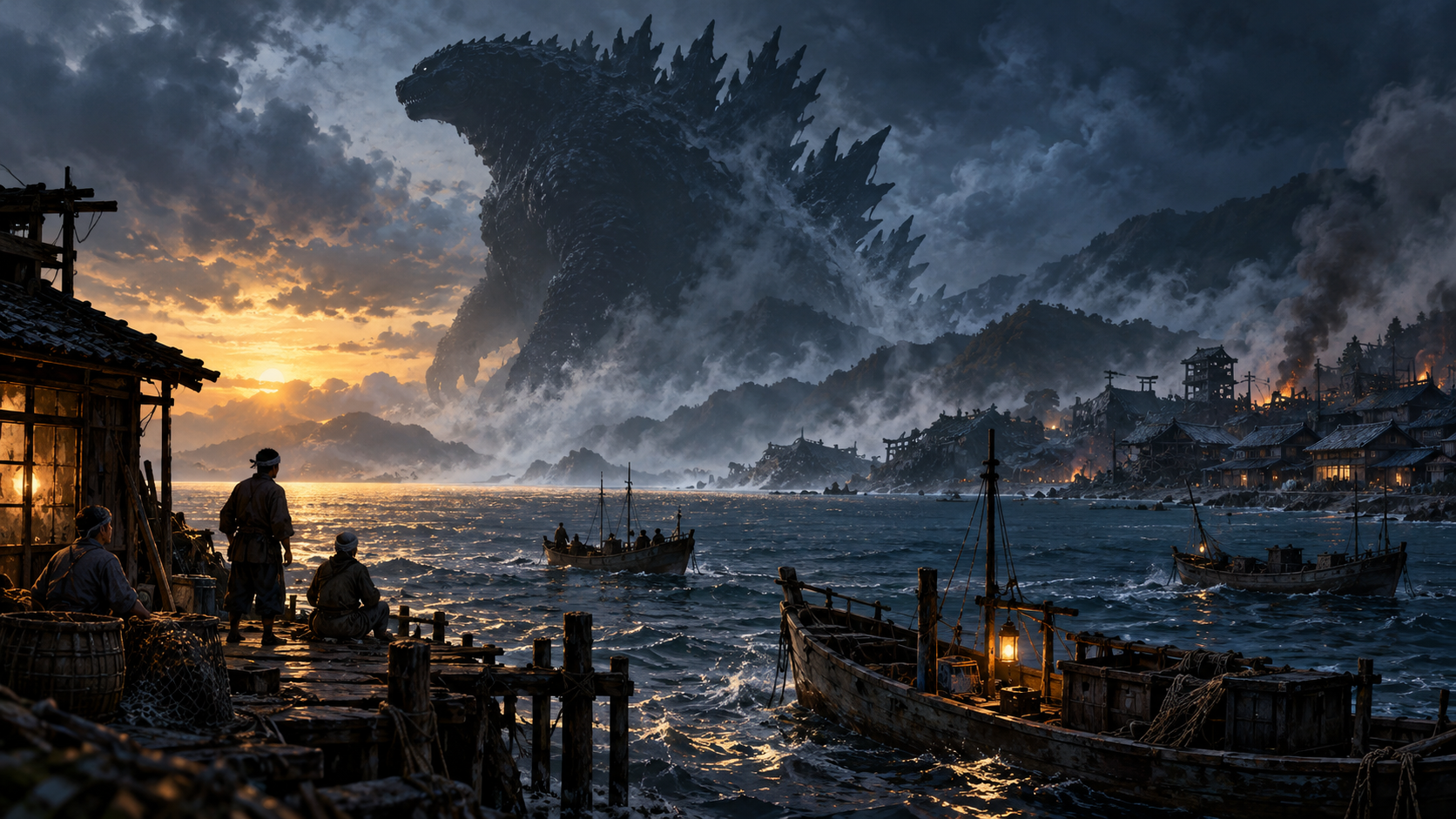
Godzilla Minus Zero arrives carrying the enormous burden created by Godzilla Minus One, yet writer, director and visual-effects lead Takashi Yamazaki understands that bigger spectacle alone would be the least interesting response. This sequel returns to a wounded postwar Japan and again treats the monster as a force that exposes private fear, public fragility and unfinished moral consequences. The result is an ambitious continuation that does not merely imitate the emotional architecture of its predecessor. It pushes the surviving characters into a harsher future and asks whether rebuilding a life is possible when catastrophe refuses to remain in the past.
A Godzilla Sequel Built Around Human Consequences
The film resumes the story in 1949, two years after the earlier crisis, with the Shikishima family trying to transform survival into something resembling ordinary life. That temporal jump matters. The characters are no longer reacting only to immediate destruction; they are living with memory, responsibility and the uneasy knowledge that stability can disappear without warning. Yamazaki uses this emotional foundation to give the new attack genuine weight. Buildings can be reconstructed, but trust and peace of mind take longer. Every sign of Godzilla therefore feels like a return of trauma as much as a physical threat.
This approach remains the franchise's strongest recent advantage. The people are not decorative figures waiting for the visual effects to begin. Their decisions determine the tension, and their emotional histories shape how the action is understood. The screenplay sometimes has to restate those stakes more directly than necessary, but the underlying dramatic idea is persuasive. The sequel treats courage not as the absence of fear but as the choice to act while fully aware of what loss can cost.
Takashi Yamazaki Expands the Kaiju Action
Yamazaki's visual strategy is precise and unusually tactile for a modern effects spectacle. Godzilla has mass, momentum and terrifying environmental presence. The creature is not simply placed in a frame to generate scale; landscapes, aircraft and crowds react in ways that make each movement consequential. A major aerial confrontation becomes the film's signature action passage, shifting the anxiety from the open water of the previous movie to the sky. The sequence is designed around geography and danger rather than visual noise, so the audience can understand where the threat is and why each manoeuvre matters.
The destruction is spectacular, but the film resists making suffering weightless. Shockwaves, collapsing structures and panicked evacuation routes are tied to specific human viewpoints. That choice prevents the set pieces from becoming a parade of digital landmarks. Yamazaki knows that Godzilla is most frightening when the audience can measure the monster against an individual body, a family home or a fragile machine. The best effects shots therefore work as dramatic punctuation, not as advertisements for technology.
A Darker Tone Without Losing Hope
Godzilla Minus Zero is notably severe, and its R-rated intensity gives several sequences a sharper edge. Even so, the film does not surrender to despair. Its central tension lies between fatalism and collective action. Characters carry guilt, anger and exhaustion, yet the story keeps returning to cooperation as the only meaningful answer to overwhelming force. This gives the film a hopeful current without softening its danger. Hope here is earned through preparation, sacrifice and the willingness to rely on other people.
The middle stretch can feel crowded as the film balances family drama, national recovery and the mechanics of a new defence plan. A few supporting figures receive less development than their functions deserve, and some emotional beats echo the earlier film closely. Those limitations are visible because the standard is so high. They do not erase the confidence of the direction or the seriousness with which the movie treats its characters.
Godzilla Minus Zero Review Verdict
Godzilla Minus Zero succeeds because it understands what audiences valued in Godzilla Minus One. The attraction was never only a famous monster rendered with award-winning skill. It was the combination of intimate pain, historical atmosphere and action staged with clarity. Yamazaki preserves that balance while introducing new visual ideas and a more unsettled portrait of survival. The sequel may not have the surprise of its predecessor, but it has purpose, craft and a genuine emotional pulse.
For viewers seeking a kaiju film with both scale and conscience, this is a gripping continuation. Godzilla remains an overwhelming cinematic presence, yet the human beings once again provide the reason to care. That is the franchise lesson Yamazaki has mastered, and Godzilla Minus Zero proves that the formula still has room to grow.
PUBLISHED BY SUYASH PACHAURI, FOUNDER & OWNER, GLOBAL BOLLYWOOD | THE HOLLYWOOD SCOPE