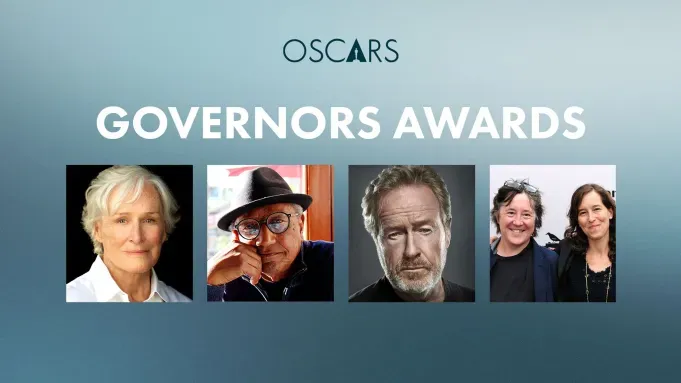
The 17th Governors Awards on 15 November 2026 marked an important moment for five figures whose work helped shape modern cinema. Glenn Close, Ridley Scott and Floyd Norman received Academy Honorary Awards, while independent producers Christine Vachon and Pamela Koffler were recognised with the Irving G. Thalberg Memorial Award. The ceremony in Los Angeles celebrated career-long contributions rather than the results of a competition for a particular film. Its significance reaches beyond the photographs and speeches because it draws attention to the different kinds of creative labour that sustain the film industry.
The honorees represented acting, directing, animation and producing, four disciplines that audiences often discuss separately even though each depends on the others. The selections also reflected different paths to influence. Some of these artists built international reputations through commercially prominent features; others supported distinctive stories or worked behind the scenes for decades. Looking at the recognition in retrospect offers a fuller account of the event than repeating the recipient list announced months earlier.
The Ceremony and Its Place in the Film Calendar
The Academy of Motion Picture Arts and Sciences held the event at the Ray Dolby Ballroom at Ovation Hollywood. The recipients had been announced on 10 June 2026, but their awards were presented at the gathering on 15 November. That distinction matters for an accurate historical timeline. A June announcement concerned who would eventually be honoured, while the November ceremony established that the recognition had actually taken place. Coverage written afterward should refer to the presentations as completed events, not forthcoming ones.
The Governors Awards serve a different purpose from the familiar televised Oscar competition. They allow the organisation to acknowledge sustained achievement and creative leadership without restricting recognition to a single release year. For film professionals, the occasion also foregrounds skills and careers that may not always fit neatly into conventional awards-season narratives. For readers, it provides an opportunity to consider who helped make influential films possible and how their impact can outlast initial box-office or critical reactions.
Glenn Close: A Career Finally Recognised with an Oscar Statuette
Glenn Close entered the ceremony with eight competitive Academy Award nominations and an unusually wide-ranging body of screen performances. Her work encompasses psychological drama, literary adaptation, dark comedy and mainstream family entertainment. Films including Fatal Attraction, Dangerous Liaisons, The Wife and The World According to Garp demonstrate her ability to reshape a character through small changes in expression and rhythm. The honorary Oscar celebrated that larger artistic record rather than a particular nominated performance.
John Malkovich, her colleague from Dangerous Liaisons, presented the award. The emotional response surrounding the presentation was understandable because the statuette represented recognition accumulated over decades, not a delayed verdict on one earlier contest. It would be misleading to describe the honorary award as a competitive win or to revise the results of previous races. Its importance lies elsewhere: the industry publicly acknowledged a performer whose filmography remains a reference point for complex, demanding roles.
Ridley Scott: The Director Behind Distinct Cinematic Worlds
Ridley Scott's honorary recognition reflected an unusually influential visual career. Alien fused science fiction with enclosed horror, Blade Runner helped define the look and philosophical mood of cinematic dystopia, and Gladiator joined large-scale spectacle to a character-driven historical story. His later work continued to move between genres, production scales and forms of commercial storytelling. Across those changes, a strong attention to atmosphere, production design and the physical geography of a scene remained central to his filmmaking.
Scott accepted the award through a recorded video rather than appearing onstage. He dedicated the honour to his late brother Tony Scott, acknowledging a creative relationship that began long before their international careers. The moment widened the perspective beyond a single director's personal achievements. Filmmaking frequently grows through families, collaborators, technicians and artists whose contribution is not always captured by one name above the title. The presentation brought that shared history into the celebration.
Floyd Norman: Animation History Beyond the Screen Credit
Floyd Norman's Academy Honorary Award recognised an animation career stretching across generations of American storytelling. His early work at Disney included productions such as Sleeping Beauty and The Jungle Book, and his broader career made him a significant figure in the history of studio animation. Norman also broke an important racial barrier as Disney's first Black animator. The achievement is historically meaningful, but it should not reduce an extensive artistic career to a single biographical fact.
Animation depends on thousands of decisions about movement, timing, expression and staging that viewers may experience without noticing the individuals responsible. Honouring Norman therefore makes visible a craft often overshadowed by voice stars, franchise brands and headline directors. For young artists considering a career in animation, his recognition demonstrates the enduring value of technical mastery and creative persistence. It also reminds institutions to preserve the stories of artists whose innovations are woven into familiar images.
Christine Vachon and Pamela Koffler: Independent Producers in the Spotlight
Christine Vachon and Pamela Koffler received the Irving G. Thalberg Memorial Award for their contribution to producing. As the figures behind Killer Films, the company they founded in 1995, the pair have supported stories that often resist conventional studio expectations. Its filmography includes Boys Don't Cry, Far from Heaven, Carol, May December and Past Lives. Those titles differ in genre and period, yet they share an interest in specific viewpoints, emotional ambiguity and filmmakers with distinct artistic identities.
The recognition was particularly notable because Vachon and Koffler became the first female producing team to receive this honour, as well as the first independent producers recognised in that form. Those milestones should not distract from the business and artistic substance of their work. Independent producers develop material, secure financing, identify collaborators and defend a project through a series of uncertain decisions. Even when a film is celebrated primarily for its cast or director, the producer's judgement often helped the project exist at all.
Why the Thalberg Distinction Matters
Unlike an award attached to one specific production, the Thalberg honour acknowledges a body of producing work characterised by sustained quality. That makes the award especially relevant to discussions of the film ecosystem. Producers can influence which stories receive funding, which emerging voices obtain meaningful opportunities and how creative ambitions survive practical limitations. For the independent sector, recognising Vachon and Koffler places the responsibility of building a film alongside the more visible work of performing in or directing it.
What an Honorary Oscar Does and Does Not Mean
An honorary Oscar is a genuine Academy Award, but it is not interchangeable with winning a competitive category. The distinction is important when describing Close's and Scott's careers, especially because both had received major nominations without winning the corresponding competitive statuettes. The November presentations do not change those historical results. Instead, they create a separate record of recognition for the breadth, longevity or exceptional influence of an artist's contribution to cinema.
The 2026 honorees also show why a narrowly numerical view of achievement can be incomplete. Nomination counts and awards won are useful milestones, but they cannot fully explain a performance's cultural life, a director's visual language, an animator's contribution to a medium or a producer's willingness to champion unconventional stories. An institution that honours artists from these different disciplines can broaden the conversation about success beyond a list of annual winners.
The Route from November to the 99th Academy Awards
The Governors Awards arrived ahead of the 99th Academy Awards ceremony scheduled for 14 March 2027. The Academy's published calendar places preliminary voting in December 2026, the shortlist announcement on 15 December and nominations on 21 January 2027. These later dates are separate developments. The November gathering may help frame awards-season discussion, but receiving an honorary award does not predict the outcome of competitive races for the films eligible in the 2026 season.
Readers following awards coverage should distinguish three timelines: the date the Governors Awards recipients were first announced, the date the honours were actually presented and the future milestones in the next Oscar competition. Mixing those events can make a historical report appear newer than it is or give the impression that a new selection was announced in November. Correct chronology provides a clearer account of why the honorees were in the spotlight and what remains ahead for the wider film industry.
A Wider Lesson for Emerging Filmmakers
For new directors, writers and producers, the range of careers honoured offers a practical lesson. Scott's achievement points to the value of a recognisable visual perspective. Close's long career illustrates the power of sustained performance craft. Norman's work speaks to patience, technical skill and artistic influence beyond the foreground. Vachon and Koffler demonstrate how careful development and conviction can protect a distinctive project. None of these examples supplies a formula for success, but together they show several legitimate ways to contribute to cinema.
Final Perspective
The 17th Governors Awards belong to 15 November 2026, yet their significance is not limited to that evening. By honouring Glenn Close, Ridley Scott, Floyd Norman, Christine Vachon and Pamela Koffler, the film community acknowledged work that spans screen performance, imaginative world-building, animation and independent production. The lasting value of the event is its reminder that cinematic achievement is collective and cumulative. Recognition becomes most meaningful when it helps audiences see the people and decisions behind the films they remember.
PUBLISHED BY SUYASH PACHAURI, FOUNDER & OWNER, GLOBAL BOLLYWOOD | THE HOLLYWOOD SCOPE.