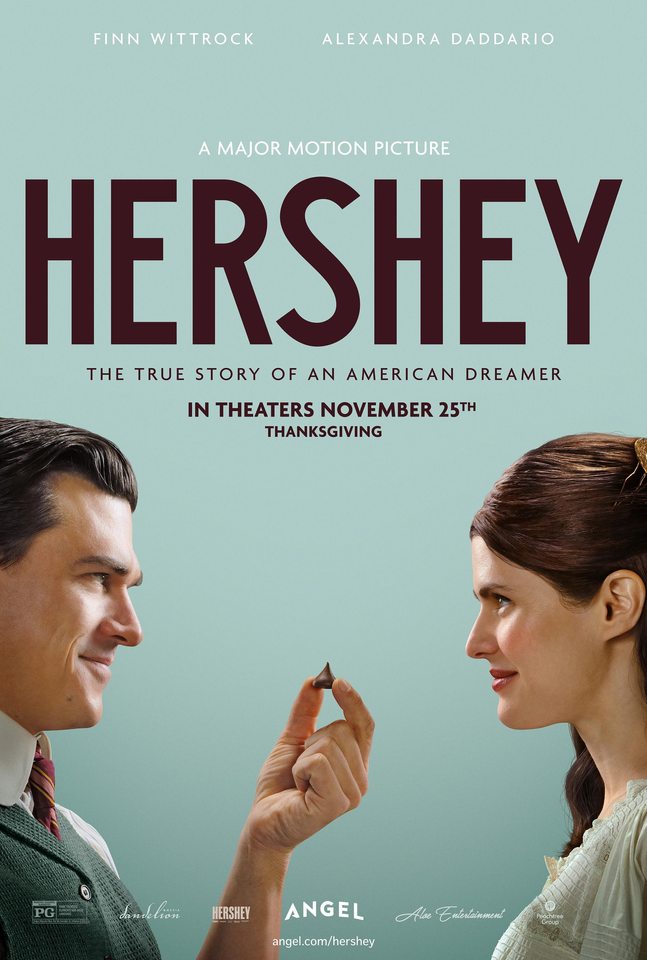
A Chocolate Empire Becomes an Inspirational Biopic
Hershey tells the story of Milton S. Hershey, the confectioner who survived repeated business failures, built an industrial empire and placed much of his fortune behind a school for children in need. Finn Wittrock plays Milton, while Alexandra Daddario portrays his wife, Kitty, whose relationship with him gives the film its romantic and philanthropic centre.
Directed by Mark Waters, the film arrives with an inherently cinematic subject. Milton's path moves through bankruptcy, experimentation, sudden success, personal loss and an extraordinary decision about wealth. Fresh critical coverage, however, suggests the production prefers a smooth inspirational line to the contradictions that could make his life dramatically complex.
This article combines confirmed film details with newly published criticism and does not claim firsthand viewing.
Finn Wittrock Plays Determination as a Defining Trait
The adult Milton is presented as an optimist who repeatedly rebuilds after failure. Wittrock has the charisma required to keep the audience invested through a succession of business attempts, from early candy ventures to caramel success and the eventual pursuit of affordable milk chocolate.
Persistence is essential to the historical story, but a biopic needs more than a sequence of setbacks followed by triumph. If every failure simply proves the hero's virtue, the narrative loses the uncertainty that makes risk meaningful. The early criticism indicates that Hershey too often treats its subject as an inspirational figure first and a complicated person second.
Alexandra Daddario Supplies the Emotional Counterweight
Kitty enters after much of Milton's professional foundation has been established. Daddario reportedly brings warmth and emotional movement to a film that can otherwise feel like an illustrated corporate history. Her illness and her influence on Milton's philanthropic vision provide the story with stakes that cannot be solved through business skill.
The relationship also raises a challenge for the screenplay. Kitty needs to exist as a person with desires and fears, not merely as the woman who teaches a famous man to care. The strength of Daddario's presence may partially resist that limitation, but the structure remains centred on Milton's transformation.
Mark Waters Chooses a Polished, Accessible Tone
Waters is best known for films that combine comedy with sharply observed social behaviour. Hershey appears to use a gentler mode, presenting its period settings, factories and domestic scenes with an emphasis on warmth and broad accessibility.
That tone suits a PG biographical drama intended for families. It also limits the room available for conflict. Industrial expansion, labour, wealth and the social conditions surrounding Hershey's rise offer difficult questions, yet the fresh critical response describes a film more comfortable celebrating the legacy than interrogating how it was built.
The School Gives the Story Genuine Moral Weight
Milton and Kitty's decision to establish a school and ultimately devote their fortune to its future is not a minor charitable detail. It is the part of the story that complicates a simple tale of capitalist success. The continuing institution provides evidence of an ambition larger than personal wealth.
The film reportedly closes by connecting that history to a recent graduating class, reinforcing the real-world endurance of the decision. Even viewers resistant to the movie's sentimental style may find that legacy moving.
Historical Drama Needs Friction as Well as Admiration
Biopics often struggle when their subjects are tied to a familiar brand. The production must tell a human story while avoiding the appearance of an extended corporate advertisement. Hershey's name is already associated with packaging, tourism and childhood memory, so the film needs to create distance from the brand's own mythology.
New reviews repeatedly identify the movie as too sweet, too safe or too simplified. Those descriptions point to a common problem: admiration without friction can make significant achievements feel less dramatic rather than more.
Runtime and Rating Require a Final Check
The film is rated PG, but public listings showed conflicting runtimes during research. One current review page listed 110 minutes, while another database displayed a longer duration. The final article should use the official theatrical listing available at publication and avoid treating an unverified number as settled.
That discrepancy does not affect the critical assessment, but it illustrates why release details should be checked against a current official page rather than copied across databases.
Final Verdict
Hershey appears to offer an earnest, visually polished account of perseverance and philanthropy. Wittrock can carry the optimism, and Daddario adds the emotional force the film needs. The underlying life has enough drama to sustain a compelling feature.
The limitation is the decision to sand away ambiguity. A story about failure, industry, love, illness and inherited wealth should contain bitterness beside sweetness. By favouring an uncomplicated inspirational flavour, the film may satisfy viewers seeking a reassuring historical drama while leaving others hungry for a more honest portrait of the man behind the wrapper.
Hershey celebrates generosity with sincere sweetness, but its polished surface leaves the life beneath it frustratingly smooth.
Hershey celebrates generosity with sincere sweetness, but its polished surface leaves the life beneath it frustratingly smooth.
PUBLISHED BY SUYASH PACHAURI, FOUNDER & OWNER, GLOBAL BOLLYWOOD | THE HOLLYWOOD SCOPE.