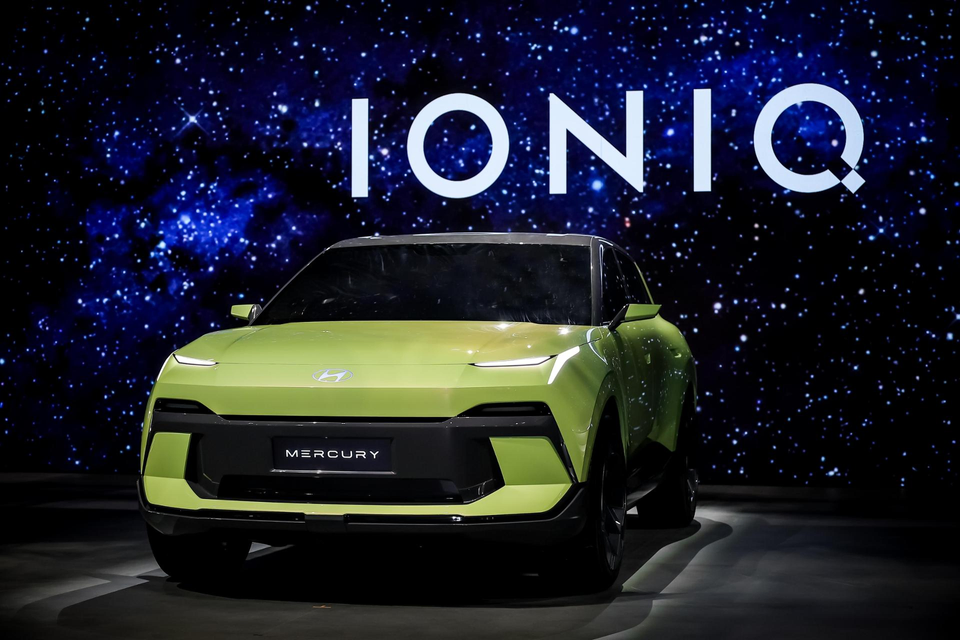
The smallest vehicle in Hyundai’s latest Chinese electric-car display raises an unusually large question for a city driver. If a battery can be exchanged as well as charged, what should the owner expect from the car and what should they expect from the network around it? Hyundai introduced the Mercury concept in Guangzhou on November 27 and said a battery-swap variant is planned with CATL. The vehicle on the stand is a design study. The production version of the compact electric SUV is on the company's China roadmap for 2027.
Mercury made its global design debut on the opening day of the Guangzhou International Automobile Exhibition. It occupies the entry position in the IONIQ range that Hyundai is developing for China. A display containing larger vehicles, a high-performance electric model and an extended-range car could easily have buried a small urban SUV. Instead, the most specific piece of news concerned the car intended for the least glamorous part of motoring: a journey made so regularly that the driver can name every awkward turn and every place to park.
An electric car designed locally
Hyundai credits its Chinese engineering and design team with the Mercury project. The concept combines a sharply raked windscreen, narrow lighting and a low front end in a bright yellow-green finish. Some of those features are meant to read from a distance on a show floor. Others answer a longer product question. If this is to be the most accessible member of the local IONIQ family, it has to look sufficiently related to larger cars while giving a buyer a reason to choose the smaller one on its own terms.
Local development extends into the cabin. Hyundai names Zhuoyu as its driver-assistance partner on the concept and says the cockpit incorporates ByteDance’s Doubao AI model. The technology labels identify the partners and the intended market. Buyers will have to wait for production specifications to find out which functions are standard, how the driver interacts with them and which versions of the vehicle receive them. A demonstration of a concept is an opportunity to see an interface; it is a limited basis for judging what a customer will live with every morning.
The practical question behind a swappable battery
On a car built for battery exchange, a driver can leave a depleted pack at a compatible station and continue with a charged one. This changes where the waiting takes place. A pack can spend time charging after its previous user has left. For someone living in a building without a conveniently located charger, the attraction is easy to understand. The economics still depend on a station being available in the right place, with a compatible pack, when that driver actually needs it.
Hyundai has identified CATL as its planned partner for the swap variant. Guangzhou provided the intent, without a consumer price, a network map or a date for the variant itself. These details matter just as much as the shape of the car. Two people driving the same daily distance can have very different experiences if one parks near a compatible station and the other has to make a special journey. The ordinary plug-in charging option and the planned exchange option therefore deserve separate scrutiny when the production offer arrives.
Three years of cars with different jobs
The wider China plan places Mercury beside an extended-range version of the IONIQ V in 2027. The locally developed IONIQ V had already reached the market in September. A production model derived from the larger Earth concept follows on the timetable for 2028. Two more new-energy models are planned for 2029. The dates describe Hyundai's intentions for China. They cannot yet be carried over to a launch calendar for India or another market.
There is a coherent purchasing question beneath that sequence. A compact battery-electric SUV asks a city buyer to organise routine travel around access to electricity. An extended-range vehicle offers a different answer to a buyer who regularly needs to cover longer journeys. Putting them side by side lets Hyundai make a case for more than one pattern of use. It also gives audiences a fairer way to assess the announcement than treating every car under a common electric brand as the same proposition.
The best test of Mercury will come some distance from the exhibition stand. A commuter will have to be able to find the purchase price, check what the cockpit actually does and judge a charging or exchange stop against their own route home. Guangzhou supplied a design, a named battery partner and a place on a production timetable. The next meaningful milestone will be a specification and a service that someone can price against an ordinary working week.
PUBLISHED BY SUYASH PACHAURI, FOUNDER & OWNER, GLOBAL BOLLYWOOD | THE HOLLYWOOD SCOPE.