A Documentary Festival with an Unusually Broad Canvas
Amsterdam's International Documentary Film Festival began its thirty-ninth edition on 12 November 2026, inviting audiences into eleven days of documentary cinema, interactive storytelling and conversations about the role of moving images. An opening-night presentation at Royal Theatre Carré placed emerging filmmakers alongside established voices. The festival continues through 22 November, making the opening developments relevant to visitors still choosing screenings and to professionals studying the direction of international nonfiction filmmaking.
The scale of the 2026 programme is notable. More than 250 films and new-media projects represent 80 countries, a range that makes the event more than a collection of premieres. The programme puts personal experience, difficult historical questions, artistic risk and new technology into dialogue. Rather than treating every documentary as interchangeable reportage, it offers several ways of understanding how filmmakers find evidence, build trust and shape experiences for audiences.
White Tiger Column Sets the Opening-Night Tone
The festival opened with the world premiere of White Tiger Column, directed by Robert Mentov, Dwight Jantzie and Bryan Dickie. Its focus is a generation of young people in Myanmar confronting repression and military rule. The film follows volunteers who take part in training with a resistance movement. By placing their choices and uncertainty at the centre of the story, the documentary provides a human perspective on political struggle without reducing those involved to distant headlines or simple symbols.
For viewers, the importance of this opening selection lies partly in the questions it asks. What compels someone to prepare for an extraordinary personal risk, and what might be lost even if the larger cause seems urgent? The film's premise invites attention to youth, community, sacrifice and the ethical burden of filming people under pressure. That approach gives the premiere a meaning beyond the ceremonial role usually assigned to an opening film.
Why the Premiere Matters
A festival's first screening can establish the expectations for the days ahead. Here, the choice of a documentary rooted in contemporary resistance signals a programme interested in people experiencing events rather than merely hearing them explained afterward. Viewers should still distinguish the film's own perspective from an exhaustive account of events in Myanmar. Documentary images are powerful, but responsible interpretation requires sensitivity to context, safety and the limitations of any single camera's viewpoint.
A €50,000 Stipend for Sabine Groenewegen
Opening night also included the presentation of the Cultuurfonds Documentaire Stipendium, worth €50,000, to filmmaker Sabine Groenewegen. The award was handed over by Lidija Zelovic, the previous recipient. Groenewegen's work examines history, identity and collective memory, with an interest in what is missing from familiar narratives. Her latest film, The Clearing, also features in the 2026 festival programme, offering audiences an opportunity to engage directly with her creative approach.
A grant of this size has a different function from the applause surrounding a finished film. It creates room for an artist to pursue research, development and experiments that might otherwise be difficult to finance. Groenewegen's recognition also reinforces a central question of documentary practice: who gets to construct the record, whose testimony becomes visible and which omissions remain hidden? That concern can travel across national histories without assuming that every country's experience is the same.
Recognition and Long-Term Creative Work
An award presented at a festival can attract attention for a day, but its more durable value is often the work it enables afterward. Filmmakers regularly face a tension between the time necessary for careful research and the economic demands of production. Dedicated development support can make patient investigation possible. Readers following the documentary sector should consider both the immediate recipient and the kind of independent, research-led filmmaking that such funding seeks to sustain.
Tatiana Huezo and the Value of a Curated Perspective
Filmmaker Tatiana Huezo is the 2026 Guest of Honour. Her participation extends beyond a ceremonial appearance through a retrospective and a personally curated Top 10 selection. Such a programme gives an audience more than a survey of career highlights. It allows viewers to explore artistic influences, compare approaches to nonfiction and understand how a filmmaker's choices can develop over time. A guest-curated selection can also introduce lesser-known titles to audiences who arrived for the headline premieres.
Huezo's guest talk was scheduled for 15 November with artistic director Isabel Arrate Fernandez. That date is already past as this historical article is prepared, so it should not be presented as an upcoming ticket opportunity. The retrospective and curated programme nevertheless remain useful points of reference for audiences examining the festival's artistic priorities. The distinction matters: an accurate historical recovery preserves what happened without advertising an event that has already taken place.
DocLab at Twenty: Participation as Documentary Language
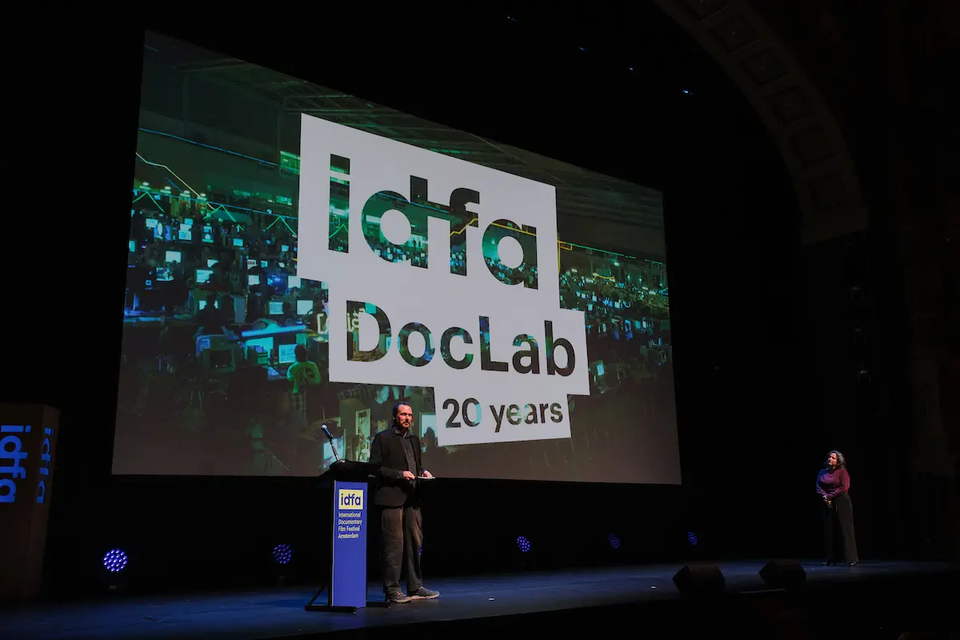
DocLab reaches its twentieth anniversary during the same edition. Its programme demonstrates how documentaries can move beyond a fixed screen into games, installations and collaborative experiences. At the opening event, DocLab head Caspar Sonnen introduced Hive Mind Pong, created by Lisa Mantel, Neander Giljam and Titouan Millet. The activity asks participants to coordinate their decisions rather than play as isolated individuals, turning cooperation into part of the experience itself.
The project highlights a wider issue in immersive storytelling. Interactive technology is sometimes described as a tool that separates individuals from a shared audience, yet it can also bring people into collective action. DocLab's anniversary invites a closer look at that contradiction. New tools do not automatically produce better documentary work; their value depends on whether the design helps participants consider other people, form a stronger connection with the subject and recognise the choices shaping the experience.
Why Interactive Formats Belong in the Conversation
A traditional screening gives each viewer the same sequence of images, while an interactive work may depend on decisions and relationships within the room. That difference changes how audiences interpret authorship, evidence and responsibility. At de Brakke Grond, the festival's interactive experiences allow visitors to test some of these ideas directly. The anniversary therefore functions as an opportunity to assess two decades of experimentation rather than merely a promotional milestone.
The Industry Programme and a Global Meeting Place
Beyond the public screenings, IDFA's industry activities ran from 14 to 18 November and were expected to welcome more than 2,500 film professionals. The schedule includes markets and meeting opportunities designed to connect directors, producers, funders and distributors. The Forum, Docs for Sale and related sessions help projects move between creative development, financing and eventual audience access. Those professional events have already concluded by 19 November, but their role remains relevant to an account of the festival.
For producers, an international festival provides a different kind of marketplace from ordinary theatrical release campaigns. Some projects are looking for completion finance, others for co-production partners, and others for distribution outside their country of origin. A programme spread across many nations can broaden the potential conversation, though participation alone does not guarantee investment or a sale. The long-term value depends on relationships built and opportunities pursued after the official meetings end.
The Dates That Still Matter
The main festival runs from 12 through 22 November 2026. Its professional programme was scheduled for 14 through 18 November, IDFAcademy for 12 through 15 November, and the Forum for 15 through 18 November. These distinctions prevent outdated industry-session dates from being mistaken for future appointments. Visitors seeking the remaining public screenings should consult current ticket availability rather than rely on an article's historical programme description.
What the Opening Reveals About Documentary Cinema
Taken together, the opening premiere, Groenewegen's stipend, Huezo's guest programme and DocLab's anniversary describe a field that is simultaneously concerned with urgent events and with the methods used to represent them. The film about Myanmar directs attention toward people navigating high-stakes choices. The stipend supports inquiry into the past. A retrospective helps reveal artistic lineage, while interactive experiments challenge familiar expectations of the viewing experience.
Those strands also explain why the festival remains relevant beyond a single news cycle. A screening may end after two hours, but the questions raised by its subject and its technique can influence subsequent creative work. For audiences, the strongest approach is to treat the programme as an invitation to compare perspectives and notice differences in form. For filmmakers, it is an opportunity to consider the responsibilities that accompany access, editing, financing and the presentation of another person's life.
Looking Beyond the Opening Night
As the 2026 edition approaches its 22 November conclusion, the opening events remain a useful record of the festival's priorities, not a substitute for its final awards or later developments. The ceremony took place on 12 November and the festival's written opening recap appeared on 13 November; these are distinct dates. Any subsequent winners, acquisitions or programming changes deserve independent verification before they are added to the historical record.
For readers following independent and international cinema, the central takeaway is the breadth of nonfiction filmmaking now on display. IDFA 2026 moves between political witness, patient historical research, the study of a filmmaker's body of work and participatory media. Whether encountered in an auditorium or an interactive installation, each form asks audiences to pay attention not only to the subject but also to how the story has been made and why that choice matters.
PUBLISHED BY SUYASH PACHAURI, FOUNDER & OWNER, GLOBAL BOLLYWOOD | THE HOLLYWOOD SCOPE.