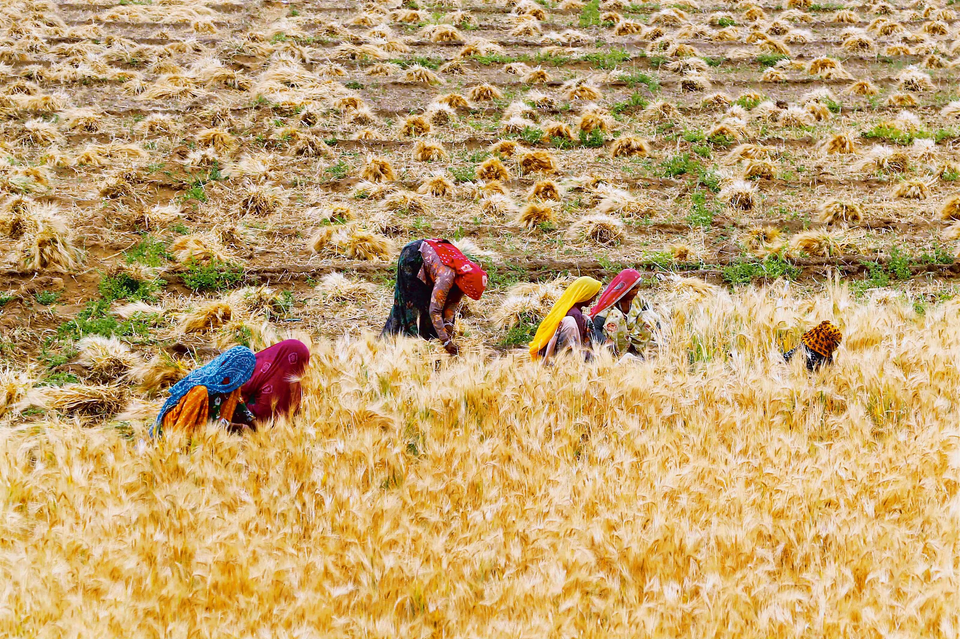
A Record Harvest Sets the Baseline
India has placed final foodgrain production for 2025-26 at a record 3,785.38 lakh tonnes, an increase of 208.06 lakh tonnes from the previous year's 3,577.32 lakh tonnes. The figures cover a broad agricultural year and show strong output across several major crops. They also create a high base against which the more difficult 2026-27 kharif season will be judged.
The headline total is significant for food availability, rural income, government procurement and export planning. Record production does not automatically guarantee higher earnings for every farmer because prices, input costs, storage and local weather vary widely. It does, however, indicate that national output remained strong enough to build substantial rice and wheat supplies while expanding attention toward crops in which India still depends on imports.
Rice and Wheat Reach New Highs
Rice production rose to 1,551.54 lakh tonnes from 1,501.84 lakh tonnes a year earlier, an increase of 49.70 lakh tonnes. Wheat output reached 1,220.64 lakh tonnes, up 41.19 lakh tonnes from 1,179.45 lakh tonnes. Together, the two staples account for a large share of national food security and public distribution, making their performance central to inflation and procurement decisions.
Other final estimates also showed maize at 550.25 lakh tonnes, sugarcane at 5,037.29 lakh tonnes and groundnut at 131.71 lakh tonnes. Total oilseed output reached 432.55 lakh tonnes. The data point to a broad harvest rather than a record created by one crop alone, although regional outcomes can differ sharply from the national picture.
The Next Kharif Season Faces Weather Pressure
The first advance estimate for kharif 2026-27 places foodgrain production at 1,671.43 lakh tonnes. That is 97.67 lakh tonnes above the average of the previous five years, but the season has been affected by the return of El Nino, a delayed June monsoon and rainfall reported at 35 to 40 percent below normal. Low soil moisture and drought-like conditions have affected important agricultural regions.
Maharashtra, Karnataka, Telangana and Andhra Pradesh were among the states identified as facing pressure, with sowing of paddy, maize, tur, soybean and cotton affected. Advance estimates can change as harvest data improve, so the figure should be treated as an early national assessment rather than a final result. The extent of local damage will depend on rainfall distribution, irrigation access and crop choices.
Pulses and Oilseeds Move to the Centre of Policy
With large rice and wheat stocks, policy attention is shifting toward pulses and oilseeds. Domestic demand for pulses and edible oils continues to rise, and imports expose consumers and farmers to global price swings. Crop diversification can reduce that dependence, but it requires more than production targets. Farmers need suitable seeds, assured procurement, market access, extension support and confidence that switching crops will not reduce income.
The first kharif estimates include 381.05 lakh tonnes of nutri-cereals and 239.47 lakh tonnes of oilseeds. Those categories matter for nutrition, climate resilience and import management. Millets and some pulses can perform better than water-intensive crops in dry regions, although every transition must reflect local soil, weather and market conditions.
Record Production Does Not Remove Structural Risks
A strong national harvest can coexist with stress at the farm level. Fertiliser and fuel costs, erratic rainfall, price volatility, post-harvest losses and uneven access to irrigation continue to affect profitability. Climate-resilient varieties and government programmes were credited with supporting output during difficult weather, but their reach and performance will need to be measured district by district.
The latest estimates present two realities at once. India finished 2025-26 with record foodgrain production, giving the country a stronger supply position. The next kharif season is already showing how quickly El Nino and weak monsoon conditions can test that strength. The priority now is to protect vulnerable farmers, improve water and storage systems and turn national production gains into stable incomes and affordable food.
Better Estimates Can Improve the Response to Weather Stress
National totals are useful for food-security planning, but decisions on seed, irrigation and crop insurance require district-level evidence. Satellite observations, rainfall records and field surveys can show where sowing was delayed or yields are likely to fall. Publishing revisions clearly will help markets distinguish an early estimate from the final harvest and reduce the risk that a single headline number produces unnecessary price volatility.
Policy must also respond before losses become irreversible. Water-saving irrigation, short-duration varieties and timely advisories can help farmers adjust when monsoon patterns weaken. Insurance claims and procurement should be processed quickly in areas where official assessments confirm damage. The contrast between record annual production and a difficult new kharif season is not a contradiction. It shows why India needs both strong national reserves and local systems capable of supporting farmers when climate conditions shift within a single planting cycle.
PUBLISHED BY SUYASH PACHAURI, FOUNDER & OWNER, GLOBAL BOLLYWOOD | THE HOLLYWOOD SCOPE.