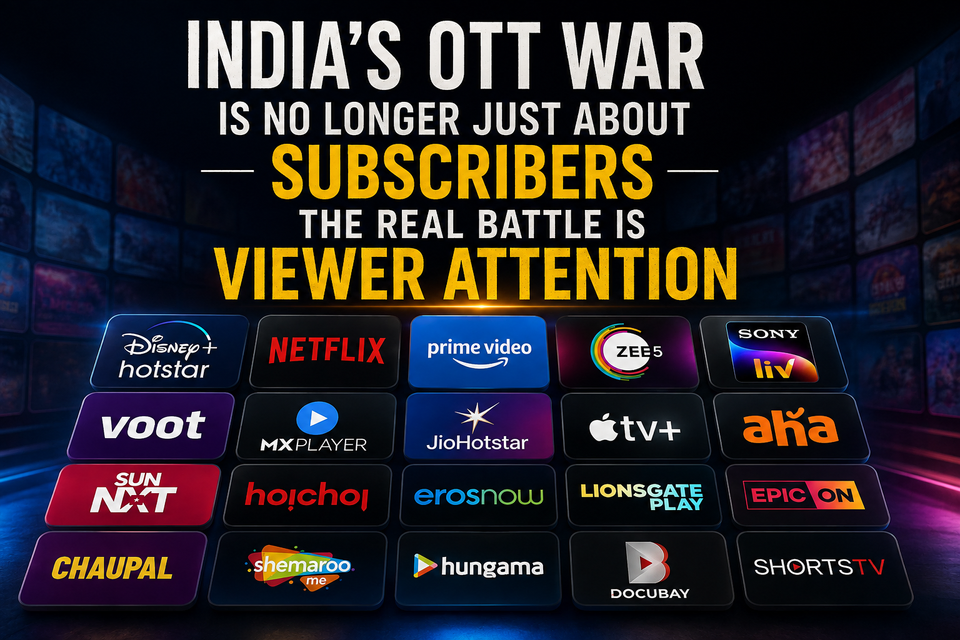
For the first phase of India's streaming revolution, success was largely measured by one number: subscribers. Platforms competed aggressively to acquire users, secure premium films, commission original series and establish themselves inside millions of Indian households. That phase is now evolving, and the next battle may not simply be about how many people subscribe, but how much time those subscribers actually spend watching.
A consumer can technically subscribe to several streaming platforms while regularly using only one or two. This creates a significant business challenge because acquiring a subscriber costs money, while retaining that subscriber requires a continuous flow of compelling content. The industry's focus is therefore increasingly moving toward engagement how frequently viewers open an application, how much content they watch, which programmes they complete and, most importantly, what makes them return tomorrow.
India makes this competition particularly complex because it is one of the world's most diverse entertainment markets. Multiple languages, regional preferences and audiences ranging from premium urban consumers to mass-market mobile viewers mean that no single programming strategy can satisfy everyone. Sports can generate enormous bursts of engagement, films can create immediate viewing spikes, long-running series can improve retention, and regional programming can build deeper loyalty within individual markets.
The competition for attention also extends far beyond conventional OTT rivals. Streaming services are simultaneously competing with YouTube, Instagram, gaming, television, cinemas and almost every other form of digital entertainment. Every consumer has limited leisure time, making attention perhaps the industry's most valuable currency. A service capable of owning two hours of a viewer's evening may ultimately have something more valuable than a platform that merely owns another subscription payment.
This shift could significantly influence future content strategies. Platforms may increasingly favour programming capable of encouraging repeat viewing, sustained conversation and long-term engagement. Franchises, reality programming, live events and regularly returning series could consequently become even more valuable. Personalised recommendations will also play an increasingly important role because having an enormous content library means relatively little if viewers cannot quickly discover something they actually want to watch.
India's streaming market is therefore entering a more mature and potentially more demanding phase. The early race was about getting consumers through the door; the next race is about convincing them to stay. Subscriber numbers will remain important, but attention, engagement and loyalty could ultimately determine which platforms build truly sustainable entertainment businesses in India.
For india longer just subscribers real battle viewer attention, the next stage of the story should be measured against the factual baseline already set out here rather than against assumptions created by the first reaction. The article's established details around suyash, pachauri, first, phase, india, streaming, revolution, success should remain the benchmark. New coverage becomes valuable when it introduces evidence that changes the scale, timing or practical meaning of the development. That gives the article a stronger long-term structure because future updates can be assessed against a clear, evidence-based starting point.
The significance of india longer just subscribers real battle viewer attention will become clearer as later verified developments are compared with the information already documented in this article. Using that standard helps preserve factual discipline while allowing the interpretation to evolve if the evidence itself changes.
A useful way to continue following india longer just subscribers real battle viewer attention is to distinguish what is already confirmed from what still depends on later decisions, implementation or measurable results. The result is a cleaner distinction between immediate attention and the later developments that determine lasting significance.
The broader context around india longer just subscribers real battle viewer attention is best understood by keeping attention on the facts already established in the article and on the way those facts develop over time.
A case-specific approach helps preserve the distinction between what is already known and what still depends on later evidence. For India’s OTT War Is No Longer Just About Subscribers - The Real Battle Is Viewer Attention, the article-specific reference points include suyash, pachauri, first, phase, india. The next useful milestone will be one that provides evidence strong enough to refine, qualify or change the current interpretation. This evidence-led structure helps preserve accuracy while leaving room for the conclusion to change.
The subject becomes clearer when attention stays on the sequence of verified information already documented here. For India’s OTT War Is No Longer Just About Subscribers - The Real Battle Is Viewer Attention, the article-specific reference points include streaming, revolution, success, largely, measured. Any new development becomes significant when it adds verifiable consequences rather than simply repeating the original attention around the story. The article can then evolve through substantive new information rather than repeated interpretation.
PUBLISHED BY SUYASH PACHAURI, FOUNDER & OWNER, GLOBAL BOLLYWOOD | THE HOLLYWOOD SCOPE