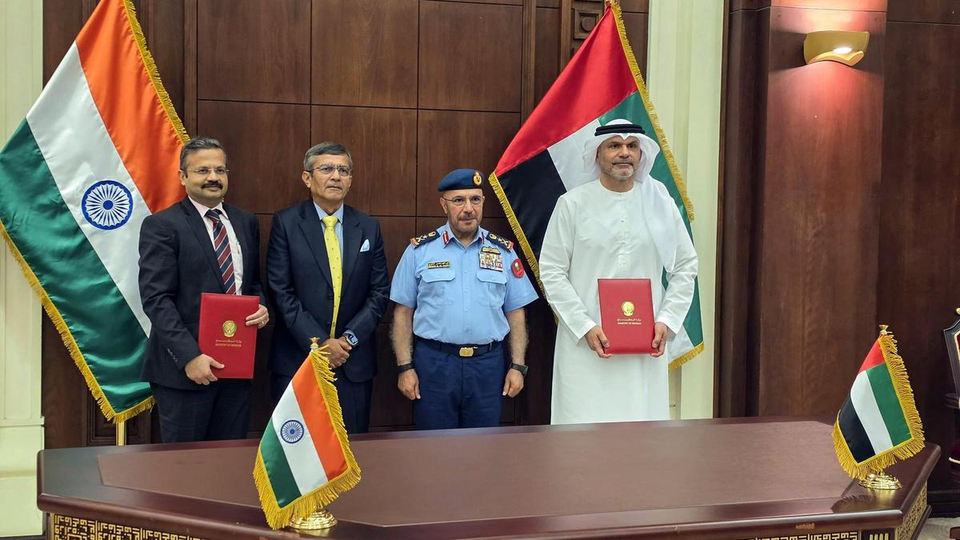
A Bilateral Framework Moves Toward Industrial Delivery
India and the United Arab Emirates have agreed to accelerate co-development and co-production partnerships for next-generation defence equipment. The commitment emerged from the 14th meeting of their Joint Defence Cooperation Committee in Abu Dhabi, where senior officials reviewed work under the Strategic Defence Partnership Framework signed in May 2026.
The language goes beyond a traditional buyer-seller relationship. Co-development implies shared design and technology work, while co-production points toward manufacturing responsibilities in both countries. The announcement does not identify a specific weapon system or contract, so it should be treated as an agreed direction rather than evidence that a named project has already entered production.
AI, Cyber and Maritime Safety Form a Wider Agenda
The two sides identified defence industry, innovation, advanced technology, artificial intelligence, cybersecurity, military training and maritime safety as priority areas. That breadth reflects the changing nature of security cooperation. Modern forces depend on software, sensors, secure networks and autonomous systems alongside aircraft, ships and land platforms.
Artificial intelligence can support surveillance, maintenance, logistics and decision assistance, while cyber cooperation can protect the networks that connect those capabilities. Maritime safety is particularly relevant because both countries depend on secure shipping routes and energy trade. Any technology programme will still need rules for data protection, export control, intellectual property and responsible military use.
Industry Meetings Aim to Create Practical Partnerships
An Indian industry delegation accompanied the official committee and held business-to-business discussions with UAE counterparts. The group visited Tawazun Industrial Park and met the Tawazun Economic Council to explore areas of cooperation. These meetings matter because government frameworks produce results only when companies can define viable products, investment and supply-chain roles.
Potential projects will need to balance each country's industrial goals. India seeks greater domestic design, manufacturing and export capability, while the UAE has invested heavily in building an advanced defence sector and attracting technology partnerships. A successful arrangement would create complementary work rather than simple assembly or dependence on a third-country supplier.
Regular Reviews Could Prevent Momentum From Fading
The committee leaders agreed to review progress at regular intervals before the next formal meeting. That is a useful mechanism because defence cooperation often slows between high-level announcements. Milestones can track feasibility studies, company agreements, technology approvals, training exchanges and movement toward production.
Regular review must also preserve security and financial discipline. Projects should be selected for clear operational need, realistic cost and the ability of both partners to sustain them. Public detail may remain limited for sensitive programmes, but broad information about investment, jobs and delivery can help distinguish substantive cooperation from repeated statements of intent.
Strategic Context Gives the Partnership Added Weight
Officials also discussed the geopolitical situation in the Gulf and West Asia. India has deep energy, trade and diaspora ties with the UAE, while regional conflict has increased attention on air defence, maritime routes and infrastructure security. A stronger defence partnership can support preparedness without requiring both countries to adopt identical positions on every international dispute.
The meeting gives the May framework a more concrete industrial focus. The next evidence to watch will be named projects, signed company agreements, defined technology-sharing arrangements and production schedules. Until then, the development is best understood as a meaningful political and institutional decision to accelerate joint work. If the partners convert it into transparent, deliverable programmes, it could become an important model for India's defence relationships in the Gulf.
Joint Production Requires More Than a Buyer-Seller Relationship
Co-production works only when each side contributes a capability that the other values. India offers a large defence market, manufacturing depth and growing experience with missiles, ships, electronics and unmanned systems. The UAE brings capital, commercial networks and an ambition to develop its own advanced industrial base. A durable partnership would identify components and platforms that can be built competitively, establish intellectual-property rules and agree how export approvals will be handled before factories are committed.
Testing and certification will be equally important. Equipment developed for desert, maritime and high-temperature conditions must meet the operational standards of both armed forces, while secure communications and software require careful protection. Common trials can reduce duplication, but they need clear responsibility when a design changes or a fault appears. Training, maintenance and spare-parts planning should be built into contracts from the start so a new platform remains usable throughout its service life rather than becoming a one-time procurement announcement. Shared exercises can then provide operational feedback, revealing whether jointly produced equipment works across different command systems and environments before either partner commits to a larger order. Clear export-control procedures would further reduce uncertainty for manufacturers seeking customers beyond the two home markets.
PUBLISHED BY SUYASH PACHAURI, FOUNDER & OWNER, GLOBAL BOLLYWOOD | THE HOLLYWOOD SCOPE.