Introduction
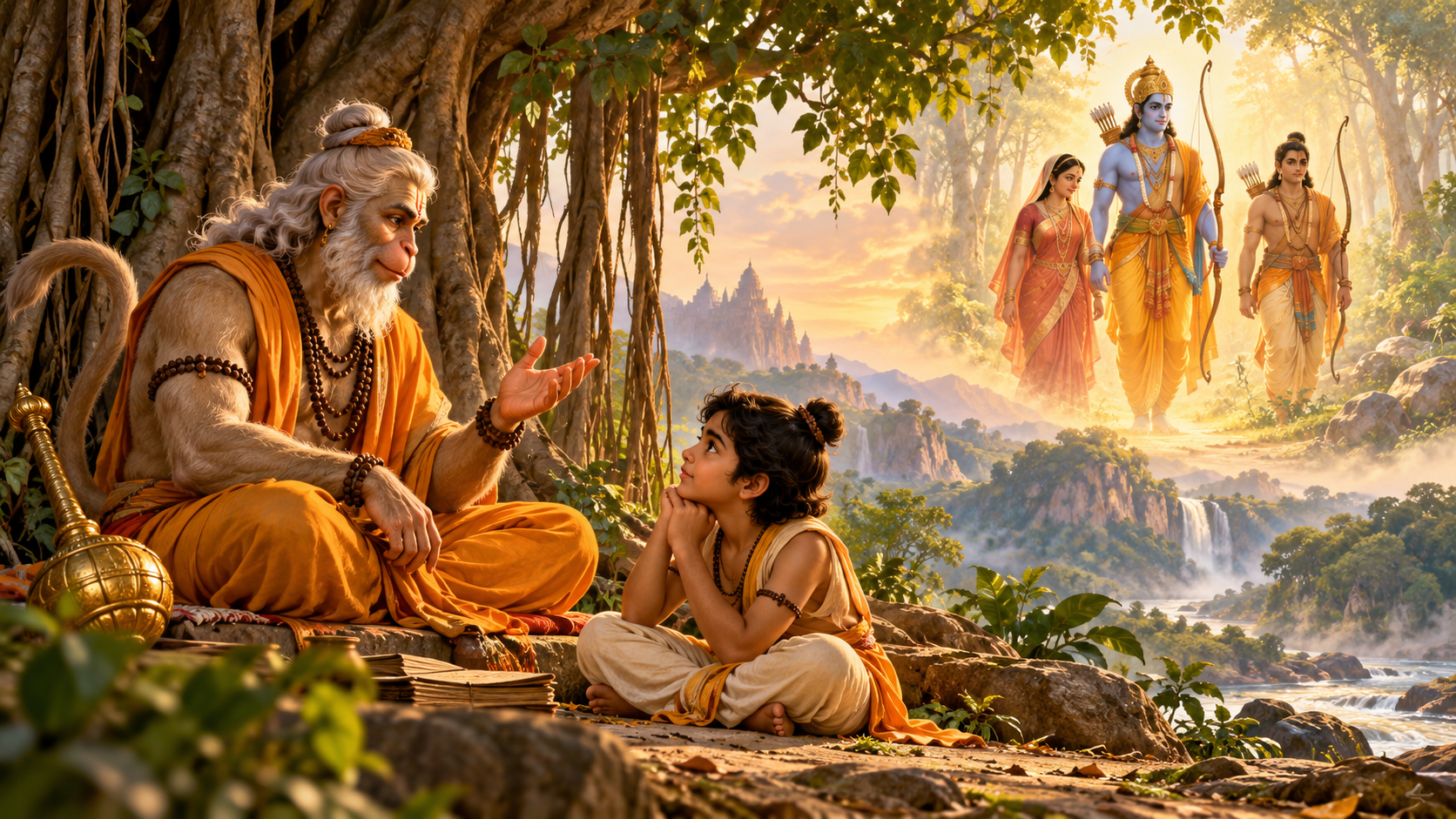
Retelling the Ramayana for cinema creates an unusual challenge because the audience often knows the story before the first frame. Mahakavya Shri Ramayan Katha tries to solve that problem through a framing device in which Lord Hanuman, appearing as a sage, guides a young boy named Shashwat through the life and journey of Shri Ram. Dev Sharma leads the principal mythological narrative, with Anjali Arora, Rajneesh Duggal, Sheel Verma and Nirbhay Wadhwa among the prominent cast. Director Abhishek Singh approaches the epic with reverence and a desire to introduce its moral structure to a new generation. Respect for the source is evident; the more difficult question is whether the film discovers a cinematic form strong enough to make a familiar story feel freshly experienced.
Screenplay & Script Sense
The framing idea is useful because it gives the retelling a listener and creates a bridge between ancient narrative and contemporary childhood. However, the screenplay often proceeds episodically, moving from one famous event to another with limited dramatic breathing room between them. That structure may help viewers who want a broad retelling, but it reduces the cumulative emotional build expected from a feature film. The best scenes are those that focus on the moral choices within the epic rather than simply reproducing well-known events. The writing becomes less effective when exposition takes priority over character conflict. A stronger screenplay would choose fewer episodes, explore them more deeply and allow Shashwat’s understanding to evolve in ways that meaningfully shape the frame story.
Direction
Abhishek Singh directs with sincerity and a traditional mythological sensibility. The performances, costumes, sets and staging are clearly designed to communicate respect rather than revisionism. That approach will appeal to viewers looking for a straightforward devotional retelling. Cinematically, however, many scenes are staged with a television-like directness, particularly when dialogue is delivered frontally and dramatic beats are resolved through exposition. The scale of the Ramayana invites visual imagination, but the direction does not always translate that scale into movement, depth or atmosphere. Singh is more successful in devotional moments where simplicity becomes an asset. The film needed a bolder visual grammar to distinguish itself from the long history of televised Ramayana adaptations.
Acting
Dev Sharma brings sincerity to the central portrayal of Shri Ram and understands that calmness is as important to the character as authority. His performance avoids excessive theatricality, which helps several emotional passages. Anjali Arora steps into a role carrying enormous cultural expectations and approaches it with restraint. Rajneesh Duggal, Sheel Verma and Nirbhay Wadhwa contribute to the broader mythological world, while the younger performer playing Shashwat gives the framing device its sense of curiosity. The cast is committed, although the dialogue style often encourages formal delivery rather than psychologically detailed performance. Greater conversational naturalism in the quieter scenes could have made the characters feel more immediate without reducing reverence.
Supporting Cast
The film includes a large ensemble representing the many figures of the Ramayana, including royal family members, sages, warriors and characters encountered across Shri Ram’s journey. With such a broad cast, individual supporting performers inevitably receive limited screen time. Several actors create clear impressions through costume, posture and vocal presence, but others function primarily as markers within the epic chronology. The ensemble would benefit from a screenplay that allows secondary relationships to develop before moving to the next major episode. The breadth is impressive, yet emotional memory often depends on depth rather than number.
Cinematography
Kunal V. Kadam and Ravi Parcha handle a production that moves between palaces, forests, devotional spaces and battle environments. The cinematography is clear and colourful, but the visual scale varies considerably. Some compositions have an appropriately ceremonial quality, while others feel flat because the staging and effects do not create enough depth. Mythological cinema depends heavily on the audience believing in a world larger than ordinary life, and that belief is strongest when practical detail, lighting and framing work together. The film reaches that level intermittently rather than consistently.
Music & Background Score
The music supports the devotional character of the film and gives several sequences the emotional lift expected from a Ramayana adaptation. The background score is often more effective than the songs because it can connect separate episodes and maintain spiritual continuity. There are moments where the score carries grandeur that the visuals do not fully achieve. At other times, heavy musical emphasis tells the audience what to feel instead of allowing performance and imagery to create emotion. The devotional soundscape will likely be one of the more accessible elements for audiences already connected to the epic.
Editing
Ajay Varma’s editing faces the structural challenge of compressing an enormous narrative into under three hours. The result is necessarily selective, yet the film still feels episodic because each major event arrives with limited transition. Some sequences could be shortened to create more room for character consequence, while others need additional space to achieve emotional weight. The pace is not uniformly slow, but the accumulation of familiar episodes can create fatigue. The frame story with Shashwat could have been used more actively as an editorial spine, giving the film clearer chapter progression and a stronger sense of discovery.
Final Verdict
Mahakavya Shri Ramayan Katha is a sincere and reverent attempt to bring the epic to a contemporary theatrical audience. Its devotion to the source and accessible framing device may connect with viewers seeking a traditional presentation. Dev Sharma leads with dignity, and the ensemble commits seriously to the material. The film’s limitation is cinematic freshness. Episodic writing, uneven visual scale and conventional staging frequently make the experience feel closer to a television mythological than a fully reimagined feature. The Ramayana does not need novelty for its own sake, but cinema requires a point of view about how the story should be seen, heard and emotionally rediscovered. This film respects the epic more consistently than it reinvents the experience of watching it.
On the Plus Side
Respectful treatment of the Ramayana, Dev Sharma’s sincere central performance, a clear framing device for younger viewers and a devotional musical atmosphere give the film its primary strengths. The production is earnest about preserving the moral and spiritual essence of the source.
On the Minus Side
Episodic storytelling, uneven visual effects, conventional staging and a television-like dramatic rhythm prevent the epic from achieving consistent cinematic grandeur. The large ensemble receives uneven development, and the film often recounts famous events instead of discovering a fresh emotional perspective on them.
Best Catchy One Liner
“Mahakavya Shri Ramayan Katha carries devotion on its shoulders, but cinema asks for more than reverence to make an immortal story feel newly alive.”
PUBLISHED BY SUYASH PACHAURI, FOUNDER & OWNER, GLOBAL BOLLYWOOD | THE HOLLYWOOD SCOPE