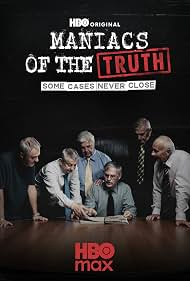
Hungary's documentary output gained a new international entry on 13 November 2026, when Maniacs of the Truth arrived on HBO Max. The two-part production, originally titled Az igazság mániákusai, places experienced investigators at the centre of its storytelling rather than constructing an entirely fictional police procedural. It was made in Hungary and is the platform's first Hungarian-produced true-crime documentary series. For viewers discovering it after the premiere, the attraction is a concentrated look at the relationship between memory, evidence and criminal investigation.
A Hungarian production with a wider audience
The series is a useful example of a local-language nonfiction project being presented to an international audience without abandoning its regional identity. The planned launch covered more than one hundred markets, including the United States and several European countries. That scale is particularly interesting because the material is rooted in Hungarian institutions, social history and public memory. International viewers need not already know the cases to appreciate the premise, although the experience may be richer when they understand the period in which the investigations took place.
The two investigations at the centre of the series
Episode one: the disappearance of Helga Farkas
The opening instalment revisits the case of Helga Farkas, whose disappearance has remained unresolved. Rather than presenting uncertainty as an inconvenience, the subject offers a reason to pay attention to the limits of recollection and the difference between a working theory and a demonstrated conclusion. Anyone approaching the documentary as an audience member should resist treating an unresolved question as an invitation to identify a culprit independently. The ethical responsibility of nonfiction is to leave space for what cannot be established.
Episode two: the investigation connected with Magda Marinko
The second instalment concerns the investigation associated with Magda Marinko, a case that attracted major attention in Hungary. Its inclusion gives the programme another setting in which to examine how experienced investigators interpret events. The two episodes therefore need not be approached simply as variations on a single narrative. Their different historical circumstances invite viewers to consider how evidence is organised, how an investigation develops and how later accounts can shape collective understanding of an earlier period.
The people behind the recollections
Retired investigator Ernő Tóth hosts the gatherings that provide the series with its organising structure. His former colleagues István Krispán, János Kőrösi, Lajos Kovács and Attila Petőfi appear alongside crime journalist László Illisz. They are participants in a documentary, not performers playing fictional detectives. This distinction matters because the perspective of a person involved in an investigation can be valuable without being comprehensive. A witness to institutional history may possess insight unavailable to an outsider while still bringing personal assumptions and selective memories to the conversation.
Adél Szajki-Vörös and Péter Szajki are the filmmakers behind the production. Their decision to organise the narrative around conversations between people who know one another creates a different editorial challenge from building a conventional interview sequence. The challenge is to maintain intelligibility when the participants share knowledge that the audience does not. Context must be made accessible without reducing the complexity of a real investigation to an easily digestible twist.
What the dinner-table format can contribute
A discussion among former colleagues can reveal the texture of a profession through the way people respond to one another. Pauses, qualifications and differences of emphasis may help an audience understand that investigation is a process rather than an effortless exercise in deduction. The format also raises questions about authority. An account does not become independently proven simply because several experienced people are discussing it. The viewer should distinguish the documentary's presentation of their memories from evidence establishing the facts of a case.
For students of documentary filmmaking, this is a useful structural model to examine. A recurring physical setting can give separate historical stories a common visual grammar. It can also make transitions between personal experience and public events feel less mechanical. The artistic question is not whether a dinner conversation resembles a formal interview, but whether the chosen environment allows meaningful information to emerge while maintaining the clarity and restraint that serious subject matter deserves.
Why the historical setting matters
The investigations belong to an era of considerable change in Hungary, stretching across the final years of state socialism and the transition that followed. That context is important even for an audience principally interested in crime documentaries. Institutions do not operate outside history, and expectations about policing, information and public accountability can develop differently across political systems. It would be reductive to treat the period merely as an atmospheric backdrop. The documentary offers an opportunity to consider the connection between professional experience and social change without equating individual recollections with a complete account of national history.
Where and how to watch
Both episodes were released on 13 November 2026. HBO Max is the confirmed streaming service in its supported launch territories. The original spoken language is Hungarian. Subtitle selections, dubbing, subscription arrangements and access in India should be checked within the viewer's own local catalogue rather than inferred from the international distribution announcement. The programme's title may also appear under its original Hungarian name, making that wording useful when searching a regional interface.
An international nonfiction perspective
Maniacs of the Truth is worth considering as a compact introduction to Hungarian investigative storytelling, particularly for audiences interested in how filmmakers adapt nationally specific subjects for international distribution. Its significance does not depend on sensationalising the events or promising definitive answers to unresolved matters. The two-episode format provides a manageable entry point into unfamiliar material and encourages attention to the documentary's methods as well as its subject. The appropriate expectation is a historical and professional perspective, not an independent determination of guilt or a substitute for judicial records. That distinction allows the programme to be discussed seriously even beyond its original November release.
PUBLISHED BY SUYASH PACHAURI, FOUNDER & OWNER, GLOBAL BOLLYWOOD | THE HOLLYWOOD SCOPE.