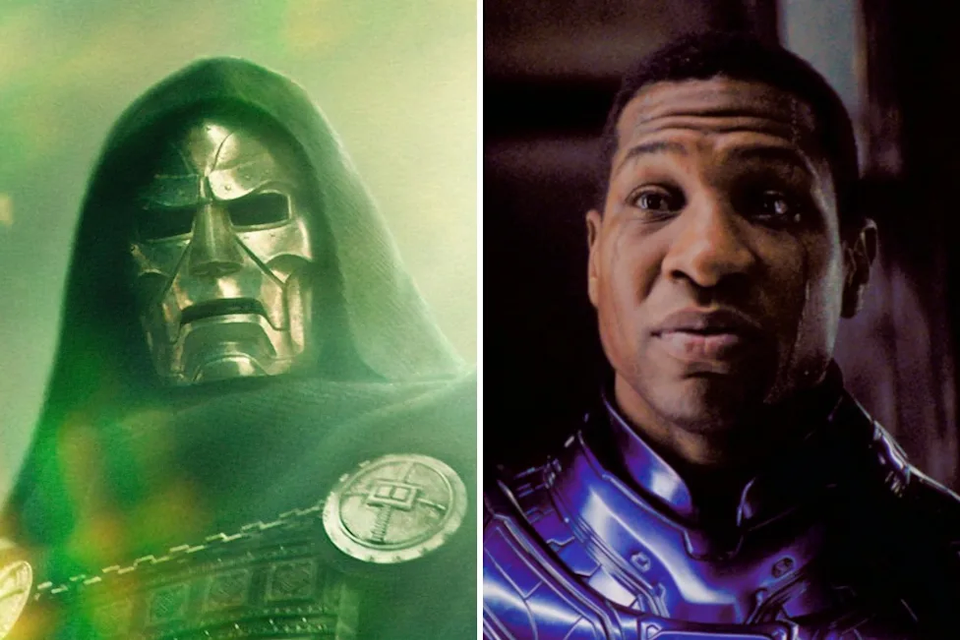
Marvel's Doctor Doom plan was already moving before the legal and professional crisis surrounding Jonathan Majors forced a visible change to the Avengers slate, according to Marvel Studios president Kevin Feige. The clarification alters the common assumption that Doom entered the story only after plans for Kang collapsed. Feige says the studio had begun discussing a larger role for the Fantastic Four villain and had contacted Robert Downey Jr's representative around the February 2023 premiere of Ant-Man and the Wasp: Quantumania.
The original fifth Avengers film was announced as The Kang Dynasty, with Kang positioned as a central threat across the multiverse storyline. Feige now describes a version that could have retained that title while revealing Doom as the more important long-term antagonist. Majors' legal problems accelerated the transition, but the creative rethink had already started because the studio was reassessing the response to Quantumania and the direction of the saga.
Doctor Doom Was Being Positioned Behind Kang
Feige's account suggests that The Kang Dynasty was once conceived as a strategic handoff rather than a final confrontation centered only on Kang. Doom could have appeared partway through the film and emerged as the true power driving the next phase. That structure would have allowed Marvel to preserve the public title while gradually changing the hierarchy of its villains.
The idea fits Doctor Doom's comic-book history. Victor von Doom is not simply a physically imposing opponent. He combines scientific intelligence, political authority, magic and personal grievance, making him capable of threatening heroes on several levels at once. In a multiverse story, that range gives writers more options than a villain defined primarily by alternate versions of himself.
Robert Downey Jr Entered the Conversation Early
The timing of Marvel's approach to Robert Downey Jr is the most revealing part of the new account. Feige says the studio contacted the actor's representative with the message that it had an idea and believed the time was right. That outreach occurred around the Quantumania premiere, weeks before Majors was arrested in New York.
Downey's return carries unusual narrative and commercial weight because Tony Stark's death concluded Avengers: Endgame. Casting the same performer as Doom creates an immediate emotional connection for characters and audiences, even if the villain is not literally a transformed version of Stark. The decision can turn a familiar face into a source of uncertainty, but it also creates a demanding storytelling problem: the film must establish Doom as a complete character rather than relying on memories of Iron Man.
Quantumania Changed the Creative Calculation
Feige acknowledged that Quantumania was not received as Marvel had hoped, even while defending elements of the production and Majors' performance. The response mattered because the film was intended to elevate Kang from a television and variant-based concept into a credible theatrical threat. When audiences and critics reacted unevenly, the studio had reason to reconsider how much of the next Avengers cycle should depend on that character.
Franchise planning is rarely fixed as far in advance as public roadmaps make it appear. Release dates, actor availability, audience response and script development all reshape the path. Marvel's public announcements created the impression of a linear plan, but Feige's comments reveal overlapping contingencies. Doom was not merely an emergency replacement. He was part of a developing alternative that became more important as the existing approach weakened.
The Legal Crisis Accelerated an Existing Pivot
Majors' arrest and subsequent legal proceedings created a separate employment issue that Marvel could not treat as a simple creative note. Feige described the situation as delicate and said the studio did not want to make a rushed employment decision. His distinction between acceleration and original cause is important. It recognizes that the studio's story concerns and its response to an actor's legal situation were related in timing but not identical in origin.
Once Marvel ended its association with Majors, keeping Kang as the dominant face of the saga would have required either a recast or a substantial rewrite. The existing Doom discussions provided a route that was already creatively active. Avengers: Doomsday eventually replaced The Kang Dynasty on the public schedule, making the internal pivot visible to audiences.
Avengers: Doomsday Must Make the New Plan Feel Intentional
Knowing that Doom was considered earlier may reassure viewers who worried that the next Avengers film was assembled as a reaction to crisis. It does not remove the burden on the finished movie. The story still has to explain Doom's objectives, establish his power and make Downey's casting meaningful without reducing the villain to a surprise cameo.
The most effective version would use the audience's familiarity with Downey as dramatic tension while allowing Victor von Doom to possess his own history and worldview. Marvel also needs to connect the new antagonist to the many characters introduced since Endgame. A villain of Doom's scale can unify those threads, but only if the screenplay gives relationships and consequences as much attention as spectacle.
Feige's timeline therefore functions as more than behind-the-scenes trivia. It shows how Marvel responds when a long-range plan stops working and how a studio can keep several creative paths open at once. Avengers: Doomsday will reveal whether that flexibility produces a coherent new chapter or leaves visible seams from the story it replaced.
PUBLISHED BY SUYASH PACHAURI, FOUNDER & OWNER, GLOBAL BOLLYWOOD | THE HOLLYWOOD SCOPE.