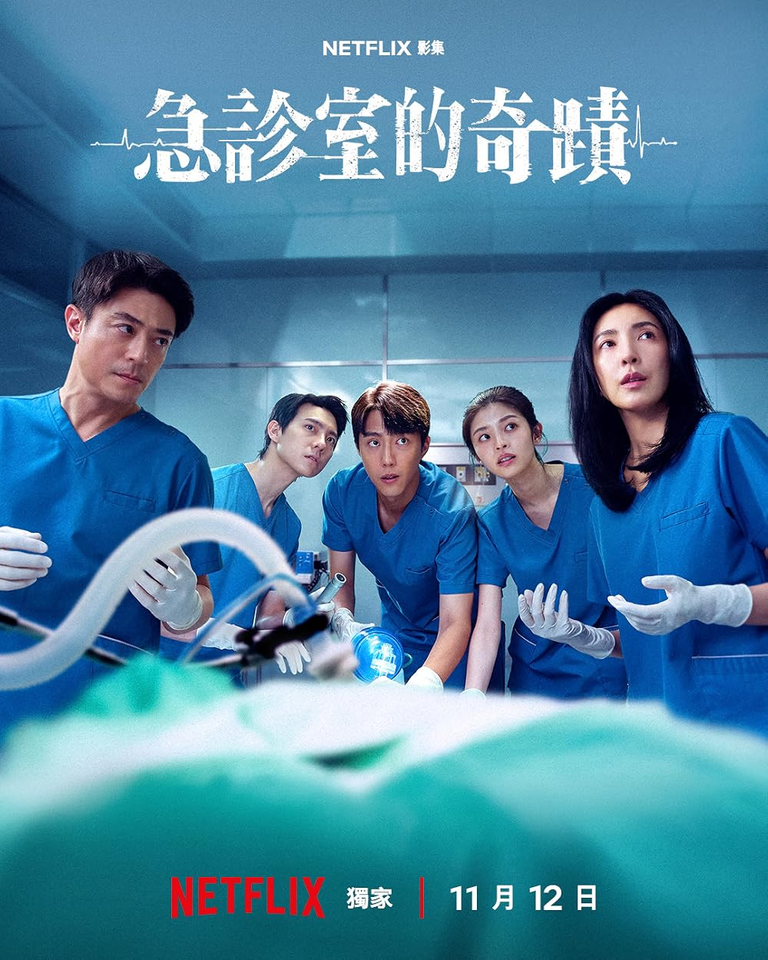
Miracles of the ER Arrived on November 12
Miracles of the ER entered the Netflix catalogue on November 12, 2026, giving international audiences access to an eight-episode Taiwanese hospital drama built around an unusually demanding workplace. Rather than treating its release as a fresh announcement weeks later, this guide looks at what viewers can watch now and why the series deserves attention in the broader conversation about Asian television. The setting is Yang-Da University Hospital, where senior emergency doctors work alongside newcomers who must learn quickly while facing patients whose needs cannot be postponed. The material combines medical emergencies with a much more recognisable question: how can an inexperienced person remain thoughtful and humane when mistakes carry consequences for other people?
The series is presented as a workplace ensemble, not a documentary or a medical instruction programme. Its procedures and professional conflicts belong to a scripted story. That distinction matters because its dramatic value comes from relationships, choices and institutional pressure rather than any promise to teach viewers how to handle emergencies. Readers deciding whether to watch can approach it as character-led television with an urgent setting.
The Story at Yang-Da University Hospital
A central narrative decision gives a less conventional medical graduate a place among talented new residents. Lin Geng-ming did not arrive with the strongest academic record, but associate director Chou Cheng-chun believes he deserves an opportunity. That act of professional trust creates the framework for a season about proving oneself through effort rather than credentials alone. Lin joins Tang Hsi and Chiang Tung-yen, colleagues whose strengths and personal motivations complicate easy assumptions about who is naturally suited to emergency medicine. Their work unfolds under supervisors who must protect patients while deciding how much responsibility the younger doctors are ready to carry.
The hospital is not simply a backdrop for spectacular incidents. Patients bring families, histories and competing expectations into examination rooms. A doctor must weigh urgent facts while navigating people who are frightened, angry or reluctant to speak openly. The dramatic possibility lies in the gap between an ideal course of action and the limited time, imperfect knowledge and complex human relationships available in practice.
Cast and Character Guide
Wallace Huo and Cheryl Yang Lead the Senior Team
Wallace Huo plays Chou Cheng-chun, an experienced emergency physician whose decision to back an unlikely newcomer sets the story in motion. The role places him at the intersection of supervision, clinical judgment and institutional responsibility. Cheryl Yang portrays He Yu-hua, a senior attending doctor whose professional confidence exists alongside vulnerabilities created by past conflicts. Their characters offer two different ways of understanding leadership: the willingness to take a chance on a trainee, and the discipline to keep working even while carrying unresolved personal strain. The distinction prevents the senior staff from becoming interchangeable authority figures.
Kent Tsai, Chan Tzu-hsuan and Payne Peng as the Residents
Kent Tsai plays Lin Geng-ming, the recruit whose eagerness initially outpaces his experience. Chan Tzu-hsuan appears as Tang Hsi, a capable graduate whose expectations of the profession face difficult tests. Payne Peng plays Chiang Tung-yen, a highly accomplished but emotionally guarded colleague. This combination creates a useful dramatic triangle: practical uncertainty, conscientious ambition and guarded excellence. Viewers can follow how each trainee responds when technical skill alone is insufficient. Their distinct temperaments also make the ensemble more accessible to audiences who are unfamiliar with Taiwanese television or emergency-room terminology.
Why the Eight-Episode Format Matters
The confirmed season contains eight episodes, a relatively concentrated length for a drama attempting to balance numerous cases with ongoing character development. That format gives viewers a clear commitment before starting. It also means the series must connect short-term workplace situations to longer arcs without relying entirely on case-of-the-week storytelling. An emergency may create immediate tension, but the consequences for a trainee's confidence or a senior doctor's trust can continue after the patient leaves the room. A concise season can make those echoes especially important, provided the writing gives them sufficient space.
A viewer looking for a straightforward action series should expect a different rhythm here. Medical decisions often involve deliberation, teamwork and conversation. The intensity comes from uncertainty and responsibility as much as from movement. For people who enjoy dramas about apprenticeships and professional ethics, this structure supplies an obvious point of entry.
Creative Team and the Taiwanese Television Context
The production reunites director Isaac Li, writer-director Huang Ching-tsu and producer Jade Lee, artists associated with Tears on Fire. That connection helps position the project within Taiwanese storytelling interested in public-service work and the people who perform it. Their choice to locate the plot in an emergency department opens several intersecting subjects: access to care, institutional conflict, generational learning and the emotional effects of repeated exposure to crisis. None needs to be treated as an abstract lecture when a character's immediate task can dramatise it.
The creators also drew on observations and conversations involving frontline medical workers. For fiction, such research is most useful when it lends texture to interactions, workplace hierarchy and the ordinary decisions between headline moments. Realism in a series does not require every scene to resemble a training video. It can instead emerge through credible uncertainty, imperfect communication and the knowledge that even committed professionals sometimes disagree.
What Makes This Different from a Routine Hospital Drama
Many hospital programmes concentrate on exceptional physicians whose brilliance resolves dilemmas. Miracles of the ER begins with someone who must establish whether he belongs there at all. That perspective changes the emotional centre of the story. A beginner may lack the confidence to challenge a decision, while an expert may underestimate how much a novice notices. The resulting friction offers possibilities beyond a contest between competence and incompetence. It asks how professional cultures transfer knowledge without humiliating the people expected to learn.
The ensemble also leaves room for patients and relatives to have agency in the narrative. An injury or diagnosis does not erase the social circumstances of the person receiving treatment. Family disagreements, silence and mistrust may shape what medical staff can learn. These elements can make the drama relevant even to viewers who have little interest in hospital technology.
Workplace Pressure, Ethics and Human Vulnerability
Medical fiction often uses the idea of a race against the clock, but speed is not the only meaningful pressure. Senior staff have to judge whether to intervene or let a resident grow through supervised responsibility. Younger staff must decide when to ask for help and when to trust their preparation. Personal convictions can collide with institutional rules, while a family's expectations may differ from what a physician believes is appropriate. The series uses these situations to explore how a workplace's culture influences its treatment of vulnerable people.
A careful viewer can distinguish the drama's themes from its clinical details. It is possible to appreciate the representation of exhaustion, doubt and compassion without assuming any episode is a reliable guide to medical practice. The story's interest is moral and interpersonal: how people continue showing up for difficult work, how they treat colleagues after mistakes and whether their ideals survive daily pressure.
Viewing Guide: Language, Genre and Expectations
The programme is a Taiwanese drama available through Netflix, with the platform listing eight episodes and describing a young graduate struggling to earn a place among elite peers. Exact audio and subtitle choices depend on a viewer's account and territory, so availability should be checked in the playback menu rather than assumed from an international listing. The series may appeal to fans of workplace stories, Asian ensemble dramas and television that mixes professional conflict with personal growth. Those expecting an exclusively romantic plot or a procedural built only around unusual cases may find a broader character-driven approach.
The official cast and episode listing are useful places to start without spoiling later developments. Promotional material establishes the central relationships and broad premise, but it does not require an audience to know the outcomes of the hospital's most difficult decisions. For a first viewing, it is reasonable to discover those conflicts in episode order rather than relying on circulating scene summaries.
A Useful Release-Date Distinction
The November 12 global launch is the event that belongs in this historical backfill. Earlier publicity on September 29 established the release date and introduced the characters; a later October trailer expanded the promotional picture. Neither earlier announcement should be redescribed as if it first happened on November 12. The actual availability of the episodes is the relevant new condition on that date. As of November 23, the show remains a current viewing option, so an evergreen cast, story and production guide still has practical reader value.
Likewise, the presence of eight episodes should not be stretched into an invented season-renewal claim or a projection about audience performance. No fresh ratings or additional-series order is established by the launch information cited for this article. The guide therefore separates confirmed release facts from commentary about the format and storytelling possibilities.
Final Perspective
Miracles of the ER offers an accessible entry point into contemporary Taiwanese drama through a setting that people across cultures recognise: a team trying to do consequential work under pressure. Its premise places the uncertainty of an inexperienced doctor beside the burden carried by senior colleagues. That balance makes the series more than a succession of hospital emergencies. The strongest reason to explore it is the opportunity to follow how professional skill, empathy and trust develop together, rather than treating one quality as a substitute for the others.
This is a spoiler-conscious viewing guide based on confirmed release and production information, not a claim to have personally reviewed every episode. Its lasting value is to help readers identify the cast, understand the central premise, assess the eight-episode commitment and recognise the film and television crafts involved in creating the hospital world.
PUBLISHED BY SUYASH PACHAURI, FOUNDER & OWNER, GLOBAL BOLLYWOOD | THE HOLLYWOOD SCOPE.