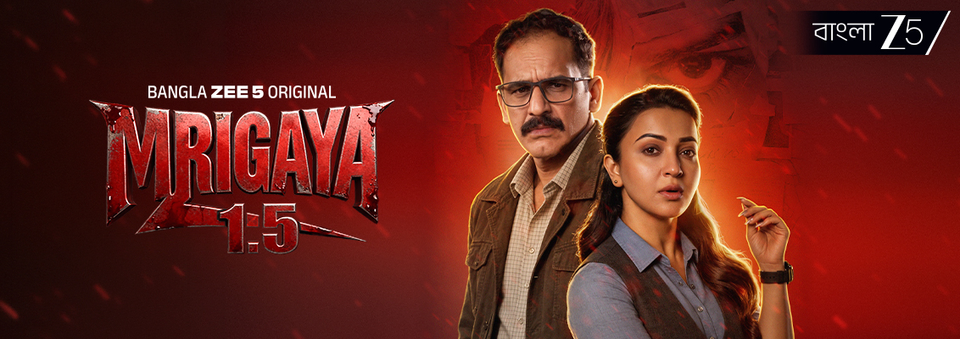
Mrigaya 1.5: The Hunt Continues is now available to Bengali-language film viewers on ZEE5, with its platform catalogue recording 13 November 2026 as the release date. Directed by Abhirup Ghosh, the crime thriller places officer Debanjan Dutta at the centre of another difficult investigation. Its distinguishing feature is not simply the return of an established protagonist but the expansion of his policing world into a story concerned with modern forms of criminal organisation.
Ritwick Chakraborty reprises Debanjan, joined by Koushani Mukherjee, Arpan Ghoshal, Mir Afsar Ali and Ananya Bhattacharya. For someone discovering the film after its November debut, the useful questions concern the cast, the connection with the earlier Mrigaya film, the tone of its storyline and where it can be watched. This is a viewing guide based on confirmed production and availability details, not a claim to have independently reviewed every performance or plot twist.
Where to watch and what the November date means
The film's official streaming listing identifies 13 November 2026 as its release date and carries it as a Bengali crime thriller. It remains a relevant catalogue discovery rather than a newly announced premiere. Viewers should check their local subscription and playback options because availability, subtitles and purchase requirements can vary by territory. The catalogue lists an approximate running time of one hour and fifty-four minutes, making this a feature-length production rather than a multi-episode series.
The distinction between an announcement and actual viewing access matters in historical film coverage. A promotional teaser may circulate well before a streaming date, and subsequent articles may repeat that information. Here, the usable development is the film's availability in the November catalogue. This guide keeps earlier publicity in the background so readers are not led to believe that a release already completed is still approaching.
How the film connects to Mrigaya: The Hunt
Mrigaya 1.5 continues a crime-fiction setting introduced in Mrigaya: The Hunt, with Debanjan Dutta serving as the narrative bridge. The unusual decimal numbering signals an intermediate chapter or spin-off rather than an attempt to erase the earlier story. Familiarity with the previous film may add texture to Debanjan's past, but the new investigation provides an accessible central conflict for viewers encountering this world for the first time.
That approach is especially useful for regional cinema seeking to develop recurring characters without asking every viewer to start with an entire franchise. A recognisable officer can provide continuity while new crimes, colleagues and locations carry a different story. Whether the larger universe eventually grows is a separate future question; the verified November release establishes this individual chapter, not an unannounced sequel or streaming season.
The premise and its sensitive subject
The official synopsis begins with a serious sexual offence involving a minor that shocks Kolkata and draws Debanjan into the investigation. As officers pursue those responsible, the case points towards a dangerous network whose methods are not limited to traditional street crime. This is sensitive material, and the central offence should be described without graphic detail or exploitation. Families choosing what to watch may reasonably consider the subject before pressing play.
The film's publicly described tension comes from a race to identify perpetrators while the investigation faces pressure from the surrounding city. Police procedure, public scrutiny and the emotional consequences of the crime all form part of that premise. A responsible viewing guide can explain those stakes without treating the victim's experience as a promotional hook or presenting speculative case details as facts.
Ritwick Chakraborty returns as Debanjan Dutta
Ritwick Chakraborty plays the officer-in-charge whose determination supplies continuity between the original film and this follow-up. Debanjan is not introduced as a detached detective solving a puzzle in isolation. His responsibilities operate within a wider police team, where decisions involve colleagues, institutional expectations and information that must be tested. The returning character gives audiences a point of familiarity while allowing the circumstances of the case to change.
The importance of Debanjan's return is structural as much as commercial. A crime series built around a continuing officer can examine what experience teaches a person and which new threats invalidate familiar methods. Here the stated technological dimension complicates the investigation, allowing a veteran character to confront questions that cannot be answered by professional instinct alone. That conflict gives the film an identity beyond its numerical title.
Meet the investigators and supporting cast
The officers working alongside Debanjan
Koushani Mukherjee plays SI Joyita Sen, while Arpan Ghoshal appears as SI Paritosh Saha. Mir Afsar Ali portrays ACP Agnishwar Chatterjee, a senior figure connected with the team. These named roles establish a hierarchy within the investigation, where junior officers, experienced personnel and leadership can approach evidence differently. Their inclusion also helps distinguish the follow-up from a story constructed exclusively around its returning lead.
Ananya Bhattacharya, Aritra Dutta Banik and Sohini Guha Roy are additionally associated with the ensemble. Not every character's eventual importance should be predicted from a cast list, and the identity of the criminal operation should not be disclosed without evidence. The more practical point for prospective viewers is that this is an ensemble-driven police narrative with multiple professional and personal perspectives rather than a solo-hero chase.
The filmmaker behind the continuation
Abhirup Ghosh directs the film, extending the crime setting associated with the original Mrigaya. His challenge in a connected story is to keep what returning audiences recognise while giving the new plot a different organising problem. In this case, the move towards cyber-enabled crime offers such a problem. The film is described as a blend of suspense, police procedure and contemporary investigative methods rather than a purely nostalgic return.
A useful way to assess this kind of project is to separate the claim of a shared universe from the substance of an individual story. Recurring names and references may help sell continuity, but the dramatic test lies in whether each investigation presents intelligible stakes and credible decisions. That is a question for a full review after viewing, not a verdict a release guide should manufacture in advance.
Why the cybercrime angle matters
The film's public story description connects the police investigation with offenders who use technology and with the challenge of following evidence beyond conventional leads. Cybercrime can alter the pace of a procedural because information moves quickly, identities may be obscured and digital material requires careful interpretation. The premise therefore has space for two kinds of tension: physical danger in the city and uncertainty within the evidence trail.
That theme is timely without requiring a fabricated claim that the screenplay reproduces a specific real police case. Viewers should distinguish the fictional investigation from actual law-enforcement procedure. The synopsis provides a genre framework, not a textbook on digital forensics, and it would be inappropriate to infer precise investigative tactics or legal outcomes that have not been independently established.
Kolkata as more than a backdrop
The city setting matters because public anxiety, local geography and police accountability can shape the atmosphere of a Bengali crime drama. Kolkata is identified in the film's official premise as the place disrupted by the offence. Beyond that grounded location, unverified claims about individual streets, real incidents or shooting locations are unnecessary. The contrast between familiar urban spaces and an expanding network of suspects is already enough to explain the intended sense of pressure.
Regional-language crime films also make room for local speech patterns, professional relationships and social expectations that can feel different from generic pan-Indian thrillers. An attentive guide should not reduce those details to novelty. The audience can approach the film both as a mystery and as a Bengali production using its own acting ensemble and city context to shape the investigation.
What to expect from the genre
Prospective viewers should expect a serious investigative premise, an escalating hunt and a group of officers trying to understand a dangerous criminal operation. They should not expect this article to reveal the resolution, assign a numerical rating or promise that every scene is suitable for younger audiences. The crime at the story's centre is distressing, so content sensitivity deserves greater weight than simplistic labels such as action entertainment.
A connected-cop thriller typically faces a balancing act between clues, character development and urgency. Too much procedural explanation can slow the story, while too little may weaken the logic of the case. Mrigaya 1.5 presents the ingredients for that balance in its official synopsis. How successfully the released film handles them is a critical judgement requiring direct viewing rather than inference from promotional material.
How this release fits the broader OTT landscape
A feature-length Bengali thriller reaching an established streaming catalogue can remain discoverable beyond the initial weekend of publicity. For regional cinema, that extended shelf life matters: viewers may encounter a film through search, word of mouth or a recommendation weeks after the original launch. A detailed guide with a date, cast and clear premise can therefore retain practical value long after a social-media teaser has stopped circulating.
The release also illustrates the usefulness of tracking individual regional films rather than relying exclusively on national headline lists. A title may be significant to its audience even without a widely publicised opening-week figure. No streaming view count, ranking or commercial success is asserted here because none is needed to establish the fact of availability or the identities of the principal creative team.
Viewing details at a glance
The title is Mrigaya 1.5: The Hunt Continues. It is a Bengali-language feature directed by Abhirup Ghosh and led by Ritwick Chakraborty, Koushani Mukherjee, Arpan Ghoshal, Mir Afsar Ali and Ananya Bhattacharya. The platform catalogue identifies the release date as 13 November 2026 and the genre as crime and thriller. The running time is approximately one hour and fifty-four minutes. Streaming access remains subject to a viewer's country and account.
Questions readers may have
Is it a television series? No, the catalogue presents it as a film. Is it linked to a previous title? Yes, Debanjan Dutta returns from Mrigaya: The Hunt, but this chapter follows a new investigation. Does the plot involve cybercrime? The published premise describes a technologically sophisticated criminal threat. Can viewers start with this film? Its distinct case provides a usable entry point, although earlier familiarity can add character background.
The most relevant takeaway on 23 November is that a November 13 Bengali release is available for viewers to explore, with an established cast and an investigation shaped by both ordinary police work and contemporary criminal methods. Its sensitive storyline calls for careful choice rather than hype. That makes Mrigaya 1.5 a useful title to identify in the regional streaming catalogue without pretending its premiere is still breaking news.
PUBLISHED BY SUYASH PACHAURI, FOUNDER & OWNER, GLOBAL BOLLYWOOD | THE HOLLYWOOD SCOPE.