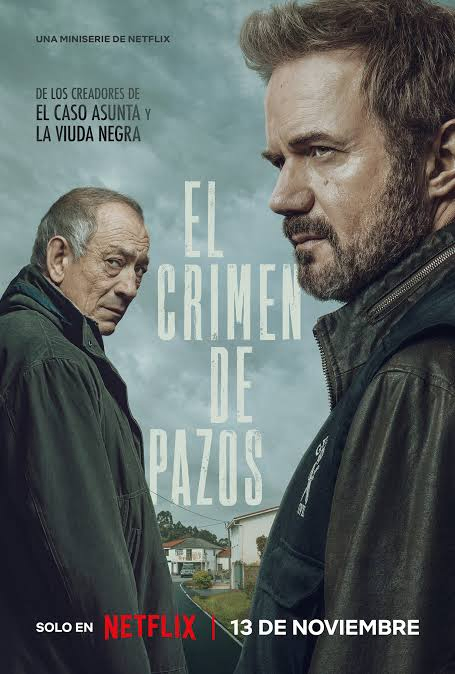
Released on 13 November 2026, Murder in Galicia is a three-part Spanish crime drama that asks an unsettling question about how a threatened woman can remain vulnerable even after investigators recognise the danger around her. This guide examines the completed limited series, the filmmakers and cast, its relationship to an earlier documentary and the important distinction between dramatized storytelling and the historical case. It is a retrospective viewing guide, not a new-release alert.
At approximately forty-three to forty-four minutes per episode, the complete story can be viewed in one extended sitting. Yet the compact format should not disguise its difficult subject matter. The plot concerns an assault, a suspected perpetrator and the institutional decisions that may affect a victim's safety. The series is currently presented as a complete limited series rather than an ongoing show with an announced second season.
The 13 November premiere and what the series offers
The show's 13 November premiere followed an October publicity announcement. The older announcement is useful for establishing the production history, but it should not be mistaken for fresh November news. Readers encountering the series now have a more practical concern: whether this is a fictional thriller, a factual documentary or an adaptation inspired by real events. The clearest description is a dramatized limited series based on a real Spanish case.
The premise centres on Irene, a woman attacked in her home during what initially appears to have been a robbery. A Civil Guard sergeant becomes suspicious of the explanation offered by her husband, Aniceto, and fears that a wider failure to respond could leave her exposed to further harm. The narrative develops less as a conventional chase than as a tense struggle to make warnings count.
Three episodes and the structure of the investigation
The limited series comprises three episodes titled Before Dawn, Night and Morning. Their approximate runtimes are 43, 44 and 43 minutes. In the opening instalment, the investigator challenges inconsistencies in the account of the nighttime attack. The second focuses on the couple's history and the urgency surrounding Irene's transfer from intensive care. The final episode follows the public consequences of the case and questions surrounding the handling of information.
These episode descriptions establish the broad movement of the story without pretending to offer a scene-by-scene account. The short format gives the production little room for unrelated subplots. Instead, the main dramatic pressure comes from limited time, incomplete information and the contrast between an investigator's concern and the decisions made around him.
Cast and the characters at the centre
Tristán Ulloa leads the cast as the Civil Guard investigator, identified in the fictional narrative as Elías Lago. Miguel Borines plays Aniceto, the husband whose version of events draws scrutiny. Carlos Blanco and Fer Fraga are part of the principal ensemble, while Luisa Merelas, Tatán and Isabel Garrido also appear. Special appearances include Verónica Sánchez and Eduardo Soto.
The character configuration matters more than a long list of famous names. It positions an investigator, a vulnerable woman, her family and people around the inquiry within the same moral dilemma. Viewers should distinguish the performers' dramatic roles from actual individuals associated with the historical case. An actor's depiction is not testimony, and a scripted dialogue cannot be treated as a primary historical record.
The real case that inspired the story
The series is inspired by the death of Isabel Fuentes in Galicia in 2015. She was attacked at home in the Pazos area of Verín and survived the initial violence. Thirty-seven days later, she was killed in the hospital where she had been receiving treatment. The circumstances raised deeply serious questions about the protection offered to a person believed to be at risk.
The central concern is not simply identifying the person responsible for the attack. It is also the sequence of warnings, responses and opportunities for intervention before the later killing. That broader concern gives the dramatization a social dimension beyond its thriller structure. Details of criminal responsibility and official decisions should be assessed through reliable records rather than inferred solely from a fictional scene.
A separate documentary is not the same production
One week earlier, on 6 November 2026, a documentary film titled Unprotected: Murder in Galicia premiered on the same streaming service. This is a separate nonfiction work about the Isabel Fuentes case, rather than episode one of the scripted series. The documentary is directed and written by Jorge Laplace and features accounts from investigators, doctors, relatives, neighbours and journalists.
Watching both can help viewers understand the difference between a dramatized interpretation and an investigation constructed from firsthand interviews and research. The documentary seeks to reconstruct the real timeline; the series uses characters, scenes and dramatic concentration to examine the same themes. Neither format should be mistaken for an exact transcript of the other.
How the fictional names shape the adaptation
The drama gives the endangered woman the name Irene and places the investigation around a sergeant played by Ulloa. The narrative includes Aniceto as the husband and uses a suspense structure to develop competing explanations for the initial attack. These creative choices make the events legible for television audiences but also mark the work as an adaptation.
That distinction should remain visible in any discussion of the programme. What a character thinks, hears or says can serve the script's dramatic design without proving that an identical exchange happened in real life. A responsible viewing guide describes the real events separately and does not use dramatized exchanges to expand the historical record.
The creative team and production background
Carlos Sedes directs the limited series. Ramón Campos serves as executive producer, with scripts credited to Campos, David Orea Arribas, Curro Serrano and Gema R. Neira. Carlos Garcés is credited as director of photography. The production company, Bambú Producciones, has extensive experience in Spanish television drama, including crime stories and internationally distributed series.
The decision to tell this story through three tightly connected chapters is a meaningful production choice. It can keep attention on a single chain of circumstances rather than developing a sprawling mystery universe. Any fuller judgment on the cinematography, editing or performances would require independent viewing; production credits alone cannot establish artistic quality.
Why the subject is larger than a crime mystery
The story invites questions about institutional responsibility, domestic violence and whether warnings about danger receive adequate consideration. Its fictional investigator is written as a figure trying to make others recognise a threat. That approach shifts some attention away from sensational questions about the crime and toward the protective decisions surrounding a victim.
A dramatic adaptation cannot settle every question about an actual investigation. But it can encourage viewers to ask how institutions communicate, what measures are taken after a serious attack and why delays may carry consequences. Those themes remain relevant after the original November release date, which is the principal reason this story merits a lasting explanatory article.
Content sensitivity and responsible viewing
Because the subject involves violent assault and the murder of a woman, the series may be distressing for some viewers. Its thriller packaging should not reduce the real victim to a puzzle or convert the story into entertainment without context. A careful introduction can acknowledge the violence while avoiding graphic descriptions that add no useful understanding.
The presence of fictional characters also deserves care when discussing historical responsibility. The article deliberately separates facts about the 2015 case from the scripted narrative and avoids presenting invented motives as confirmed truth. Readers seeking greater factual background may choose the companion documentary, while remembering that all screen accounts require thoughtful scrutiny.
Where to watch and available language options
Murder in Galicia is available as a limited series on Netflix. Its official listing identifies the original language as Spanish from Spain and lists English-language subtitles among its options. Language tracks and ratings can vary by country and device, so the choices shown in a viewer's own account are the most reliable guide to availability.
The complete three-part structure makes the series relatively easy to approach without making it lightweight viewing. Those expecting an action-heavy procedural should instead anticipate a serious investigative drama concerned with the consequences of institutional and personal decisions. Those interested in nonfiction may want to distinguish this title carefully from the documentary released on 6 November.
Final perspective: a story that remains worth examining
As of 23 November 2026, the most useful angle is no longer an announcement about a forthcoming premiere. The series has already arrived, and readers can evaluate whether its short format, Spanish-language production and difficult real-world subject are appropriate for them. The real case gives the fictional narrative an enduring relevance that exceeds a brief publicity cycle.
Murder in Galicia belongs in a broader conversation about how film and television adapt real tragedies. It presents viewers with an investigative narrative, but the more substantial question concerns the safeguards available to people in danger. Separating screen fiction from historical evidence is essential to discussing that question with fairness and care.
PUBLISHED BY SUYASH PACHAURI, FOUNDER & OWNER, GLOBAL BOLLYWOOD | THE HOLLYWOOD SCOPE.