India’s perfect start gives way to a long recovery
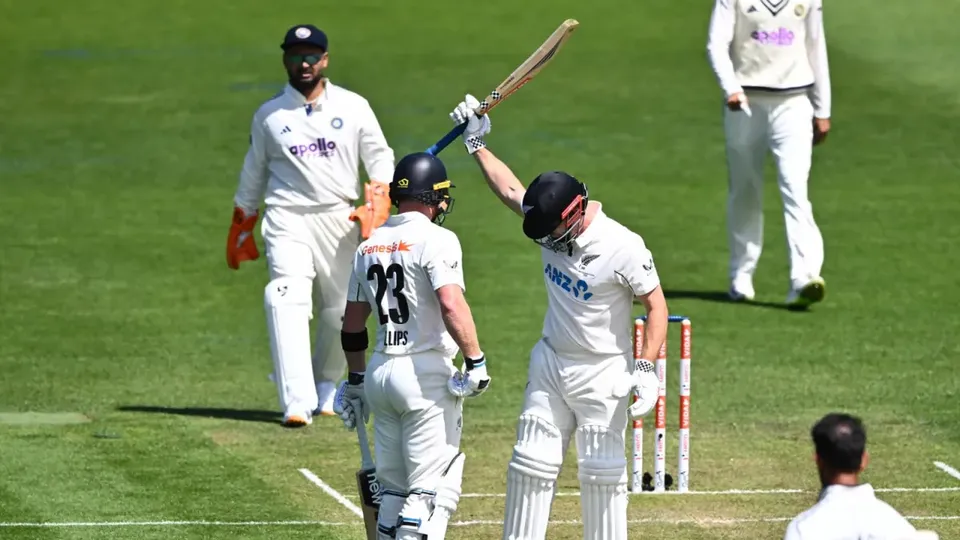
New Zealand reached 243 for 5 at stumps on the opening day of the first Test against India at the Basin Reserve in Wellington after recovering from 70 for 5. Henry Nicholls finished unbeaten on 113 from 221 balls and Glenn Phillips remained 94 not out from 182, their unbroken 173-run sixth-wicket partnership completely changing the shape of a day India had controlled through the first session.
India won the toss and chose to field, a decision that looked immediately justified when Jasprit Bumrah dismissed captain Tom Latham for a two-ball duck. Devon Conway fell for four, Rachin Ravindra made 15 and Daryl Mitchell scored one as the home side slipped to 52 for 4. Tom Blundell’s dismissal for five left New Zealand in danger of being bowled out cheaply.
Bumrah’s return produces early damage
Bumrah led India’s attack with 3 for 52 from 17 overs, including five maidens. His control and movement troubled the top order, while Anshul Kamboj removed Conway and Akash Deep accounted for Ravindra. At lunch, New Zealand were 60 for 4, and India had the chance to turn favourable bowling conditions into a decisive advantage.
The early wickets reflected disciplined lengths and sharp catching. Rishabh Pant took catches behind the stumps, while Yashasvi Jaiswal and Shubman Gill contributed in the field. Yet the attack could not maintain the same pressure after the fifth wicket. Prasidh Krishna and Washington Sundar went wicketless, and six no-balls added to the difficulty of sustaining control.
Nicholls builds the innings around patience
Nicholls responded to the collapse with a Test innings shaped by judgement rather than urgency. His 113 included 14 fours, but the defining quality was his willingness to leave, defend and wait for scoring opportunities. Reaching a 12th Test century, he filled the critical number-three role and prevented India from repeatedly exposing the lower order.
The innings became more valuable as the day progressed. Nicholls absorbed the second spell from the fast bowlers, managed the changing wind and surface, and refused to let the scoreboard pressure force an error. By surviving 221 deliveries, he gave Phillips the time to settle and gradually shift the momentum.
Phillips turns survival into counter-pressure
Phillips supplied the more aggressive half of the partnership without abandoning discipline. His unbeaten 94 contained 13 fours and came at a strike rate just above 51. Once the ball softened and India’s early intensity faded, he found boundaries square of the wicket and through the off side, moving New Zealand from rescue mode toward a competitive first-innings platform.
The pair batted through the entire final session, adding 103 runs without losing a wicket. That passage was the day’s clearest reversal. India had reduced New Zealand to a position from which 150 looked possible, but the bowlers finished 82 overs facing two set batters and a second new ball only two overs old.
Day two begins with the match finely balanced
India will still believe early wickets can keep New Zealand near 300 because four lower-order batters remain. The second new ball gives Bumrah and his partners a fresh opportunity before Nicholls and Phillips extend the partnership. New Zealand, by contrast, can aim for 350 if Phillips completes his century and the tail supports the two established batters.
New Zealand vs India first Test day one belonged to both the visitors’ opening burst and the hosts’ extraordinary recovery. India’s decision at the toss was validated, but its advantage was not converted. Nicholls and Phillips ensured the match enters the second morning with no clear owner, turning a threatened collapse into a demanding examination of India’s endurance and execution.
What comes next
Weather and the Basin Reserve surface will continue to shape the match. Morning movement could make the first hour decisive, while a drying pitch may become better for batting later. India must avoid assuming the new ball alone will break the partnership; consistent lengths and catching discipline remain essential.
New Zealand’s lower order has enough batting ability to extend the innings if Nicholls or Phillips stays at the crease. Conversely, two early wickets could expose the final pair and return the advantage to India. The scoreboard reflects a recovery, not a settled result, which is why the opening session of Day 2 carries unusual weight. India’s first innings will then test whether the surface continues to reward patience once the early movement fades.
PUBLISHED BY SUYASH PACHAURI, FOUNDER & OWNER, GLOBAL BOLLYWOOD | THE HOLLYWOOD SCOPE.