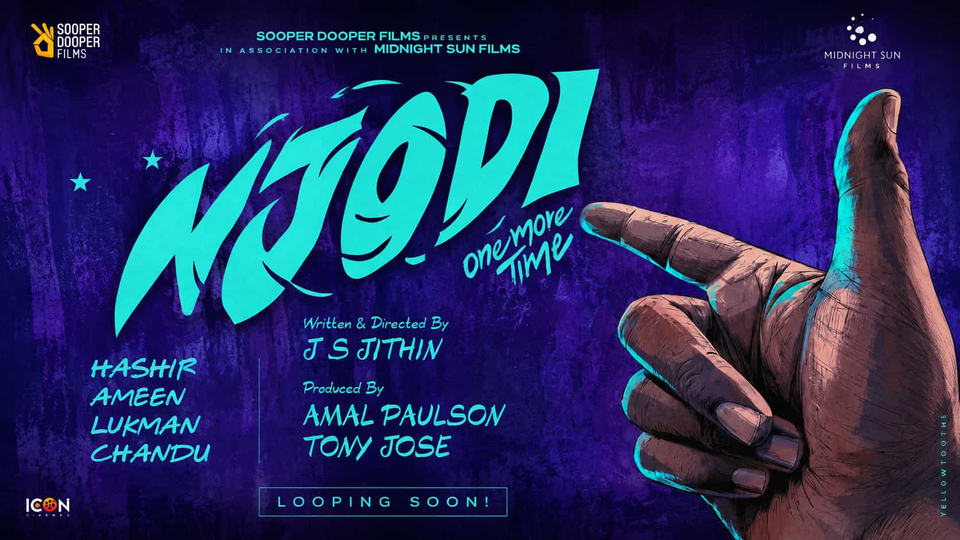
Njodi: One More Time has completed principal photography after a 72-day shoot, giving the Malayalam film a major production milestone as it moves toward post-production. The makers announced the wrap on November 18. The project stars Hashir in his second lead role and reunites him with Ameen, while Lukman Avaran and Chandu Salimkumar also hold important parts in the ensemble.
Written and directed by debutant JS Jithin, Njodi has been described as a time-loop film, although the team has kept detailed plot information private. That combination of a young cast and a high-concept structure makes the project distinct from a conventional campus or friendship comedy. The completed shoot now shifts attention to editing, sound, visual treatment and the eventual campaign that will explain how the repeated-time idea drives the characters' choices.
What the Njodi shoot wrap confirms
The wrap confirms that the film has finished its planned principal shoot after 72 days. That is a meaningful stretch for a project involving a time-loop narrative, where continuity and repeated events may require multiple variations of the same setting or action. The announcement does not provide a release date, so the remaining post-production schedule is still open. It does, however, indicate that the team has captured the primary material needed to assemble the film.
The cast brings together performers whose recent work has connected strongly with younger audiences. Hashir became widely recognised as a social media creator before moving into a leading screen role. Ameen follows a similar path, while Lukman Avaran has worked across varied Malayalam projects and can add dramatic weight to an ensemble. Chandu Salimkumar contributes another recognisable young presence. Their combination gives the film room to balance comic energy with the tension that a looping timeline can create.
Hashir's second lead role after Vaazha II
Njodi is Hashir's second outing as a lead actor following Vaazha II: Biopic of a Billion Bros. That earlier film expanded a coming-of-age franchise and introduced several digital creators to a wider theatrical audience. Njodi now offers Hashir a different test because a time-loop story often depends on precise reactions, evolving awareness and the ability to make repeated situations feel newly meaningful.
The role also represents a step beyond the novelty of a creator entering cinema. A second lead project begins to establish whether a performer can carry different genres and sustain a character across a full narrative. The presence of Ameen and other ensemble actors may retain the camaraderie that audiences associate with the group, but the new concept provides an opportunity to develop a separate screen identity.
How a time-loop premise can shape the film
Time-loop stories usually rely on a recurring event or period that forces characters to confront the consequences of their decisions. Njodi's title, which suggests a moment or instant, fits that broad idea, but the makers have not confirmed the exact rules. It is therefore too early to say whether the film will emphasise comedy, romance, suspense or personal growth. The genre description only establishes a framework.
For the concept to work, the edit must clearly distinguish repetition from progression. Each return needs to change what the audience understands, even when locations or actions appear familiar. Cinematographer Viswajith Odukkathil and editor Nidhin Raj Arol will be central to that process. Art director Vinod Raveendran also has an important role because repeated environments must remain consistent while supporting small visual changes that may signal a different stage in the loop.
The production and distribution team
Amal Paulson and Tony Jose are producing Njodi under the Sooper Dooper Films and Midnight Sun Films banners. Icon Cinemas will handle distribution. Having a distributor attached at this stage gives the project a clearer path toward release, though the makers have not announced whether they are targeting a particular season or festival period.
The film also marks JS Jithin's directorial debut. A high-concept first feature can be demanding because the screenplay must communicate its rules without slowing the story. The 72-day production suggests the team devoted substantial time to the shoot. Post-production will now determine how effectively the concept translates into pace, clarity and emotional payoff.
What comes after the Njodi wrap
The most useful next update would be a teaser or synopsis that identifies the central conflict without revealing the loop's solution. Character information could also clarify whether the story follows a single person trapped in repetition or a group gradually recognising the same problem. Music, release strategy and runtime remain undisclosed.
Njodi: One More Time now enters the stage where its ambitious structure must become a coherent finished film. The cast offers familiarity, while the time-loop idea provides novelty. Completing principal photography is not a verdict on the final result, but it is a concrete step that places the project closer to audiences. If the screenplay and edit use repetition to deepen rather than delay the story, the film could give its young ensemble a distinctive Malayalam genre vehicle.
PUBLISHED BY SUYASH PACHAURI, FOUNDER & OWNER, GLOBAL BOLLYWOOD | THE HOLLYWOOD SCOPE.