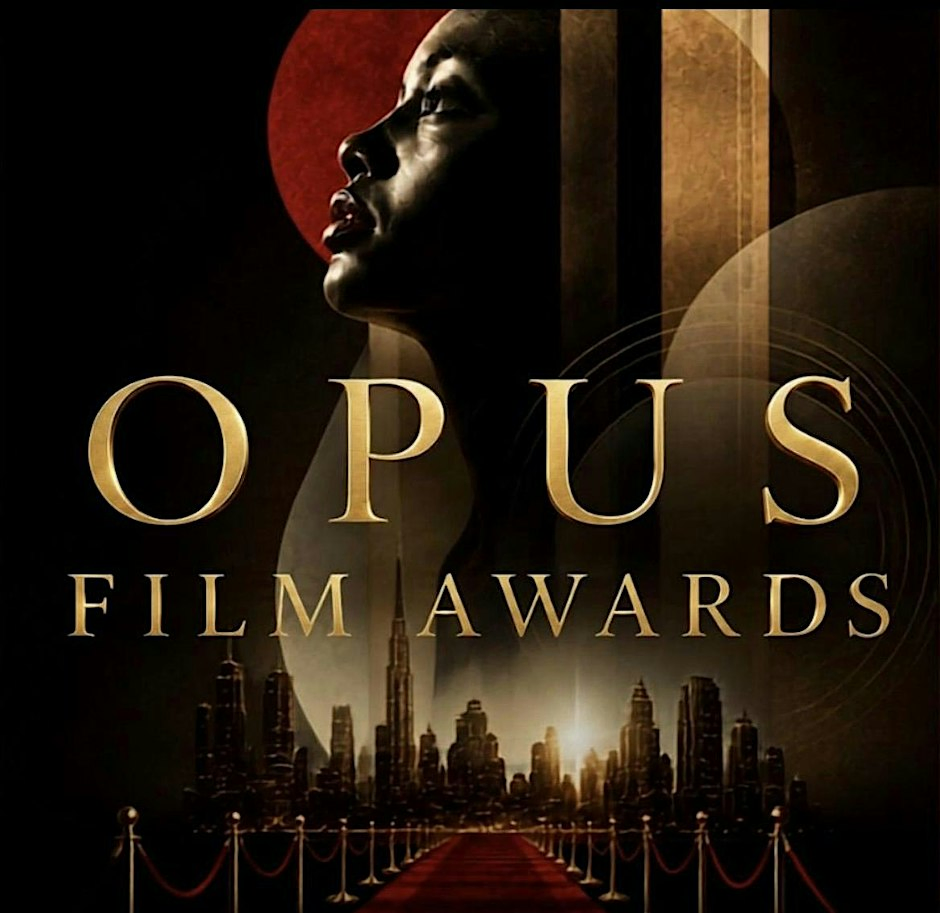
The inaugural OPUS Film Awards held their ceremony at London Film School on 14 November 2026, presenting an unusually broad picture of how artificial intelligence is being used in contemporary moving-image production. The night's overall Grand Prix went to PRAY TO GACHA, credited to ICO. Beyond the top prize, the ceremony recognised work in short films, features, documentary, animation, anime, music video, advertising and trailers. Its final record is valuable not because one evening settled the debate over AI cinema, but because it identifies the creators and productions that received recognition at a formative event for this filmmaking community.
The award results were published after the ceremony and concern an event already completed. They should therefore be read as a dated record rather than as an announcement unfolding today. Organisers said the first edition selected 54 official nominees from 307 submissions. That figure describes the organisers' submission process; it is not a measure of audience reach, box-office performance or independent artistic consensus. The winners provide a practical snapshot of emerging approaches to visual storytelling while leaving open the larger questions of creative control, authorship, consent and the place of human craft.
Grand Prix: PRAY TO GACHA Leads the First Edition
PRAY TO GACHA, credited to ICO, took the Grand Prix, the ceremony's highest overall distinction. Unlike the prizes restricted to individual formats, the Grand Prix was selected across categories. Its placement at the top of the results positions the work as the jury's preferred entry in a field that included narrative films, animated projects, promotional work and documentary storytelling. That breadth matters when evaluating the recognition: an overall prize and a category prize are different accomplishments and should not be conflated.
The result also offers a reminder that a title associated with artificial intelligence is still judged in the context of storytelling. Strong visual technology may make a project immediately noticeable, yet the interest of any screen work depends on the choices that connect images, sound, rhythm and dramatic purpose. The prize does not disclose which tools were used, how much of the work was generated, or the extent of each collaborator's contribution. Those questions require project-level production documentation rather than assumptions based on an award label.
The Short Film and Feature Categories
The Walkers, credited to DJ Marcelll, won Best AI Short Film. The award recognises a specific work in the short-form competition, where creators must establish a visual world and a convincing idea within limited running time. Short films often serve as testing grounds for new pipelines and techniques, but an award alone does not demonstrate that a particular workflow is commercially scalable or technically superior. It confirms the festival's category result, and no more should be inferred.
Best AI Feature Film went to Candy by Jiaze Li. The title of the prize is the festival's own category designation, not independent verification that the winning production satisfies a particular theatrical feature-length standard. That distinction is important because festivals can define categories differently. The significant reported fact is that Candy received the prize in this category. Readers interested in duration, distribution or production method should seek the film's own specifications before making wider claims.
Why Format Labels Need Careful Reading
Placing short-form and feature-labelled projects side by side can give the impression that they are directly comparable. In practice, each category may involve different submission rules, production ambitions and expectations. A festival honours an entrant within the terms of its programme. A responsible account keeps the organiser's terminology intact while avoiding claims about runtime, theatrical release, commercial financing or awards eligibility elsewhere unless those facts have been independently established.
Animation, Anime and Documentary Recognition
THE SIESTA JOB by Tamara Llorens won Best AI Animation, while Oni-Slaying Maiden by Ce Jiang received Best AI Anime Film. Keeping those results separate respects the festival's decision to distinguish animation in general from an anime category. It also avoids assuming a single stylistic method across both films. Moving-image artists can combine illustration, character design, compositing, editing and digital assistance in many ways, and neither category name supplies a complete production history.
The award for Best AI Documentary went to When You Run From Your Mom by Edmond Yang. Its inclusion illustrates the range of genres being tested in AI-related film competitions. Documentary is an especially demanding field for discussions of authenticity. Audiences need to understand whether an image is captured, reconstructed, illustrated or generated whenever that distinction affects their understanding of real events. The award records the selection of Yang's work, but does not by itself establish its factual method, editorial disclosures or the provenance of any particular scene.
A Documentary Question Beyond the Trophy
Documentary practice depends on trust between the filmmaker, subjects and viewers. New image-making methods can help communicate memory, uncertainty or experiences that are difficult to film directly. They can also blur the boundary between evidence and representation. The industry's task is to develop clear disclosures and sound consent practices while preserving artistic freedom. This is an editorial consideration prompted by the category, not a claim that the winning film did or failed to follow a particular ethical standard.
Music Video, Commercial and Trailer Winners
Checkmate by Selina Schneider was named Best AI Music Video. Music videos are a natural laboratory for unusual transitions, stylised imagery and rapid changes in visual language. Their success, however, still depends on coherence between sound and screen. The recognition identifies Schneider as the credited creator of the winning entry, while any assessment of the finished video's artistic quality would require a separate viewing and critical review.
Chicken Rider by Nick Tasker received Best AI Commercial, and The Wind Before the Name by Mark Wachholz won Best AI Movie Trailer. These are distinct categories with different storytelling requirements. Commercial films usually seek to express a brand or proposition efficiently, while trailers aim to suggest the tone and stakes of a larger screen narrative. The festival results show that its programme included applied creative production as well as stand-alone stories. They should not be misread as statements about the advertising success of a campaign or the release status of a feature.
Luminary Award and the Audience's Choice
Department of Good Memories by Caroline Kiessling received the Luminary Award, presented by She Builds with AI. The prize was framed as a distinct recognition rather than as another conventional genre category. Its place in the ceremony also signals an interest in participation and visibility within a quickly evolving area of filmmaking. It is reasonable to note the platform's decision to include the award, without claiming that this one result proves broad industry change.
Kakehashi (The Bridge) by Luke Mazey won the OPUS People's Choice Award. This outcome is separate from the jury-selected Grand Prix. The distinction preserves the difference between recognition arising from the public voting process and a jury decision. Neither represents all filmgoers, and organisers' voting totals were not independently established in the material reviewed. Still, the inclusion of both types of prizes allowed the event to acknowledge artistic assessment and audience engagement in different ways.
The Importance of Naming Every Recipient
An awards roundup can easily compress a long list into the highest-profile title, leaving filmmakers from smaller categories invisible. Recording the credited artists alongside their respective works is therefore a central part of this report. It allows later readers, researchers and film professionals to trace a specific award without confusing a nomination, a genre win or an overall trophy. Exact category names are particularly necessary in a field where the terminology and judging frameworks are still developing.
What the London Ceremony Means for Independent Filmmakers
The London event brought together filmmakers, jury members and creative professionals at a time when generative systems are altering the cost and organisation of some production tasks. The programme's variety is its most immediate significance: it demonstrates that entrants were working across narrative, non-fiction, music-led and commissioned forms rather than in a single uniform format. The awards do not establish whether any one method will become the dominant workflow. They establish that a community has begun developing shared spaces in which the work can be screened and debated.
For independent filmmakers, the relevant questions are practical as well as artistic. Who has the rights to the material used to make an image? What permissions apply to a person's likeness or voice? Can the same character be maintained across shots? How should filmmakers credit collaborators and disclose synthetic elements? How much revision remains possible when an image is generated rather than photographed? A festival can help put these questions in public view, but it cannot answer them simply by selecting winners.
There is also a difference between receiving festival recognition and building a sustainable career. Distribution, financing, creative ownership and audiences do not follow automatically from a trophy. The organisers mentioned a potential showcase partnership for winning films, but that should not be mistaken for a guaranteed distribution contract or a confirmed commercial release for every entry. Each project's next step needs its own evidence.
Final Perspective: A Useful Record, Not a Verdict on Cinema
The first edition left a concrete historical record. PRAY TO GACHA won the Grand Prix; The Walkers and Candy received the short and feature-labelled awards; THE SIESTA JOB, Oni-Slaying Maiden and When You Run From Your Mom led the animation, anime and documentary results. Checkmate, Chicken Rider and The Wind Before the Name were recognised in music video, commercial and trailer categories, with Department of Good Memories and Kakehashi (The Bridge) receiving the two special distinctions.
Those outcomes deserve careful reporting because they preserve the names of the people making the work. They also belong within their date, location and programme rather than being repackaged as breaking developments after the event. Whether AI-driven filmmaking expands into an enduring artistic movement will be determined by many later works, creators, audiences and legal choices. The November 2026 London winners represent one chapter in that larger story, not its final answer.
PUBLISHED BY SUYASH PACHAURI, FOUNDER & OWNER, GLOBAL BOLLYWOOD | THE HOLLYWOOD SCOPE.