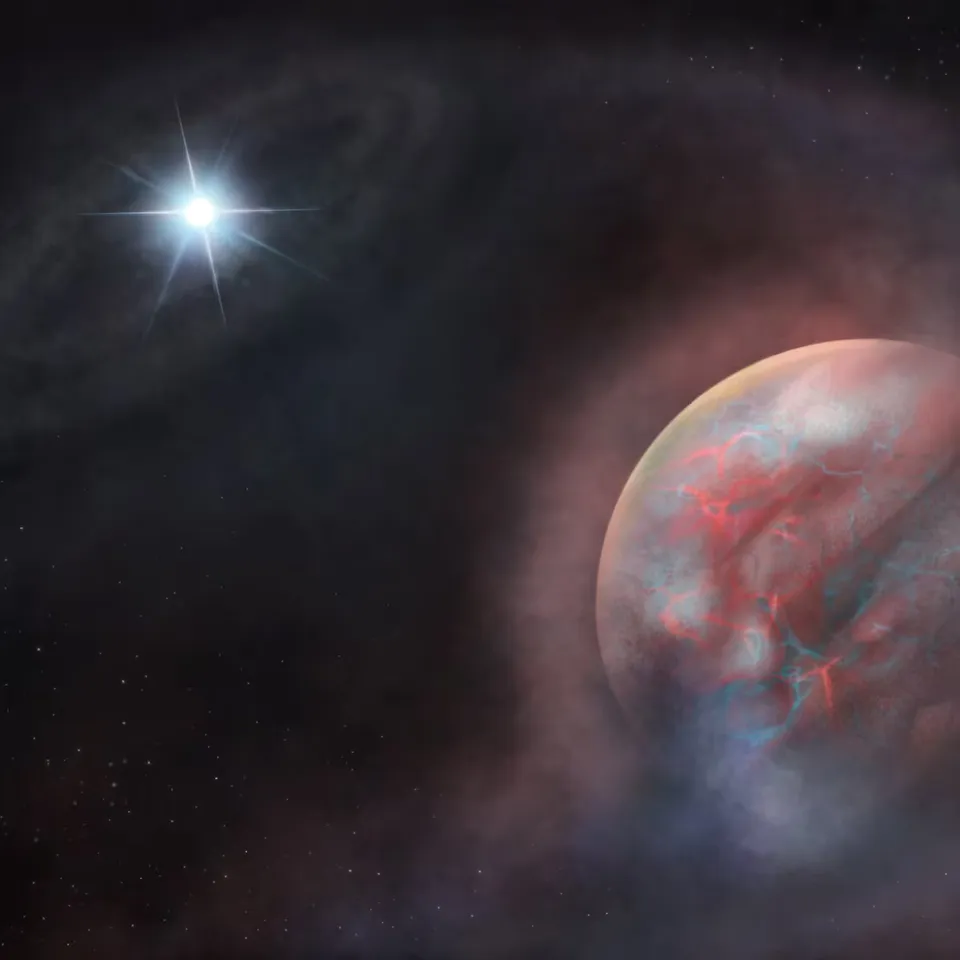
Astronomers have identified a remarkable exoplanet that appears to have formed from material expelled during the death of its host star. The world, described as a phoenix planet, now circles the white dwarf left behind by that stellar collapse. It is the first confirmed example of a planet forming around a white dwarf rather than surviving from the star's original system. The discovery shows that planetary birth may continue after stellar death, creating a second generation of worlds from chemical material scattered during a star's final transformations.
What Makes the Phoenix Planet Unique
Most planets form within disks of gas and dust surrounding young stars. This object followed a different path. Its host was once slightly larger than the Sun, then exhausted its nuclear fuel, expanded and shed its outer layers. The remaining core became a white dwarf. Researchers conclude that the planet assembled from the ejected material after that process, making it genuinely younger than the stellar remnant it orbits. That origin distinguishes it from planets that formed early and later endured their star's violent evolution.
The gas giant lies about 250 light-years away in the constellation Cetus. It completes an orbit every 4.4 days and sits at only about 4% of the distance between Earth and the Sun. Such proximity exposes its atmosphere to intense ultraviolet radiation. Material is evaporating from the planet and falling toward the white dwarf, creating chemical fingerprints that astronomers can measure. Those fingerprints include elements such as niobium, copper and zinc, which support the idea that the world formed from enriched stellar debris.
How Scientists Reconstructed Its Origin
The team combined observations from the Hubble Space Telescope, the Transiting Exoplanet Survey Satellite and archival ultraviolet measurements. Transit data reveal the planet when it passes in front of the star, while spectroscopy identifies elements in the escaping atmosphere and surrounding material. No single observation proves a second-generation origin. The conclusion emerges from the planet's composition, its tight orbit and models showing how matter expelled by the dying star could settle into a new disk and assemble into a giant world.
Future observations with the James Webb Space Telescope could test the atmospheric composition in greater detail. Webb's infrared instruments can examine molecules and temperature structure that are difficult to detect at other wavelengths. Researchers will want to know how quickly the planet is losing mass and whether its current orbit has changed over time. Those measurements could reveal how long second-generation worlds survive in the harsh environment around compact stars.
The Discovery Expands the Planet-Formation Timeline
The finding changes a basic assumption about when planetary systems can appear. Stellar death was once viewed mainly as an ending, capable of engulfing, ejecting or destroying existing worlds. The phoenix planet shows that the same event can supply raw material for a new system. Heavy elements manufactured inside the star are returned to space, where gravity can organize them again. In principle, cooling white dwarfs may host disks that produce several planets, moons or smaller rocky bodies.
Could Second-Generation Worlds Become Habitable?
This particular gas giant is too close and too irradiated to resemble Earth. The broader concept is still intriguing. White dwarfs cool slowly and can remain stable for billions of years. A rocky planet at the right distance might eventually experience temperatures compatible with liquid water. Formation conditions, radiation and orbital stability would all present challenges. Scientists first need to learn how common these systems are and whether they can build small worlds, not just gas giants. The discovery makes that question testable rather than purely theoretical.
Finding more examples will require several techniques. Transit surveys favor planets with edge-on orbits, while direct imaging is difficult because compact systems are faint and close together. Changes in the timing of a white dwarf's pulses can reveal unseen companions, and metal-rich atmospheres can point to disrupted rocky material. Combining those clues will help astronomers estimate whether the phoenix planet is a rare exception or the first member of a substantial hidden population.
A New Chapter in the Search for Worlds
The phoenix planet is a reminder that nature produces planetary systems through more routes than standard models once allowed. It links the chemistry of stellar death with the mechanics of new planet formation and gives astronomers a laboratory for studying both. Surveys may now revisit white dwarfs that show unusual metal pollution or infrared dust, looking for signs of hidden companions. If more second-generation planets are found, the life cycle of a solar system will look less like a straight line and more like a process capable of renewal.
PUBLISHED
BY
SUYASH PACHAURI,
FOUNDER & OWNER,
GLOBAL BOLLYWOOD | THE HOLLYWOOD SCOPE