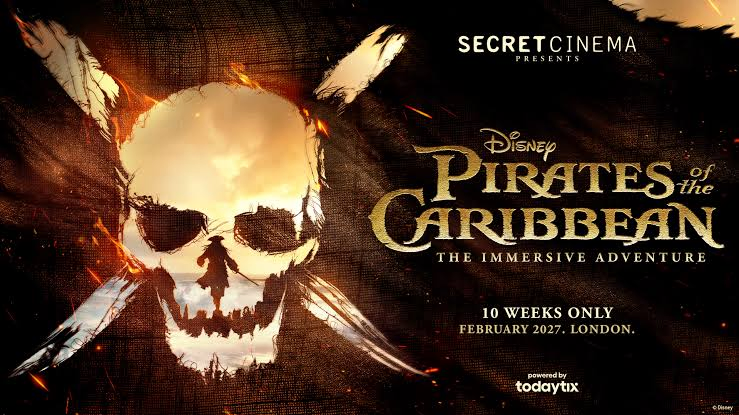
Rehearsals Bring the Pirate World Into Physical Motion
Secret Cinema has released behind-the-scenes rehearsal footage for Disney's Pirates of the Caribbean: The Immersive Adventure. The material shows cast members practising sword fights, aerial work and rig climbing ahead of the production's 2027 London run.
The show begins previews on February 16 at a new Greenwich Peninsula venue, with an official opening scheduled for March 10. Its extended run is planned through June 6. Rather than screening The Curse of the Black Pearl in full, the production will weave selected film clips through live theatrical storytelling.
The Cast Steps Into Familiar Roles
George Maguire plays Captain Jack Sparrow, with Phil Daniels as Captain Barbossa. Lily Blunsom appears as Elizabeth Swann, Harrison Wilde as Will Turner and Gleanne Purcell-Brown as Anamaria.
The casting creates an immediate challenge. These characters are closely associated with screen performances, but a live immersive production cannot succeed through imitation alone. Each actor must preserve the role's recognisable outline while adjusting voice, timing and movement for audiences who may be standing nearby rather than watching through edited close-ups.
Sword Fighting Must Work From Every Angle
Alex Payne serves as fight director. The rehearsal footage places emphasis on blade work and aerial movement, two elements that require precise safety systems even when the final effect appears spontaneous.
In conventional theatre, choreography is designed for a fixed audience direction. Immersive staging complicates that task because viewers may encounter action from several positions. Performers must protect one another, control distance and keep the story readable without relying on film editing.
A New Venue Raises the Scale
The production will launch Secret Cinema's flagship home at Greenwich Peninsula. A permanent venue can give the company greater control over rigging, sound, crowd movement and environmental design than a temporary conversion.
That infrastructure matters for a pirate world requiring ships, docks, taverns, hidden routes and effects. It also gives the audience freedom to explore while creating the need for clear accessibility and safety information.
The Experience Blends Film and Theatre
Curated clips from The Curse of the Black Pearl will appear within the live production instead of functioning as a complete screening. This choice moves the project closer to adaptation than an enhanced cinema event.
The creative team must decide when the screen should carry narrative information and when live actors should take control. Too much film could reduce performers to decoration. Too little could weaken the connection audiences expect from the licensed property.
The Creative Team Behind the Adventure
Olivier Award winner Matt Costain directs. Kait Kerrigan is the theatrical adaptor, Jason Sherwood leads production design, Alan Williams supervises music, Susan Kulkarni designs costumes, and Helen Keane oversees hair, wigs and makeup.
Those departments must build a unified world that can survive close inspection. A costume seen from a few feet away needs different detail from one photographed for a distant camera. Scenic surfaces, props and makeup also have to remain convincing as audiences move through the environment.
Music presents another adaptation problem. The film's score and themes are central to its identity, but live sound must respond to action that can unfold at different distances and along more than one audience route. A fixed soundtrack cannot simply dictate every beat when visitors control part of their own pace. The production will need musical cues that preserve recognition while helping performers coordinate entrances, combat and shifts in attention. That work is less visible than a ship set or sword fight, but it can determine whether separate spaces feel like parts of one continuous adventure.
Immersion Is Optional but the World Must Still Guide Viewers
The production allows visitors to choose how actively they participate. General admission is standing, while seated ticket holders can leave and return to an assigned place. The full experience lasts about two hours and fifteen minutes, with free-roam sections rather than a conventional interval.
That flexibility can welcome different personalities, but it requires careful guidance. Highly interactive guests should not overwhelm those who prefer observation, and essential plot points must remain accessible regardless of the path someone takes.
Why the Rehearsal Footage Matters
The project was announced earlier, so the genuinely new development is the visual evidence of how the live action is being built. Rehearsals turn marketing promises about stunts and scale into specific physical work.
They also give ticket buyers a clearer sense of the athletic demands placed on the performers before the venue opens to the public.
They also reveal the production's central wager. Pirates of the Caribbean became famous through cinematic movement, music and effects. The immersive version must translate that energy into a room where performers and audience share risk, distance and time.
If the balance works, the show can offer more than a themed recreation. It can allow viewers to feel how choreography, design and collective attention make a familiar story immediate again.
PUBLISHED BY SUYASH PACHAURI, FOUNDER & OWNER, GLOBAL BOLLYWOOD | THE HOLLYWOOD SCOPE.