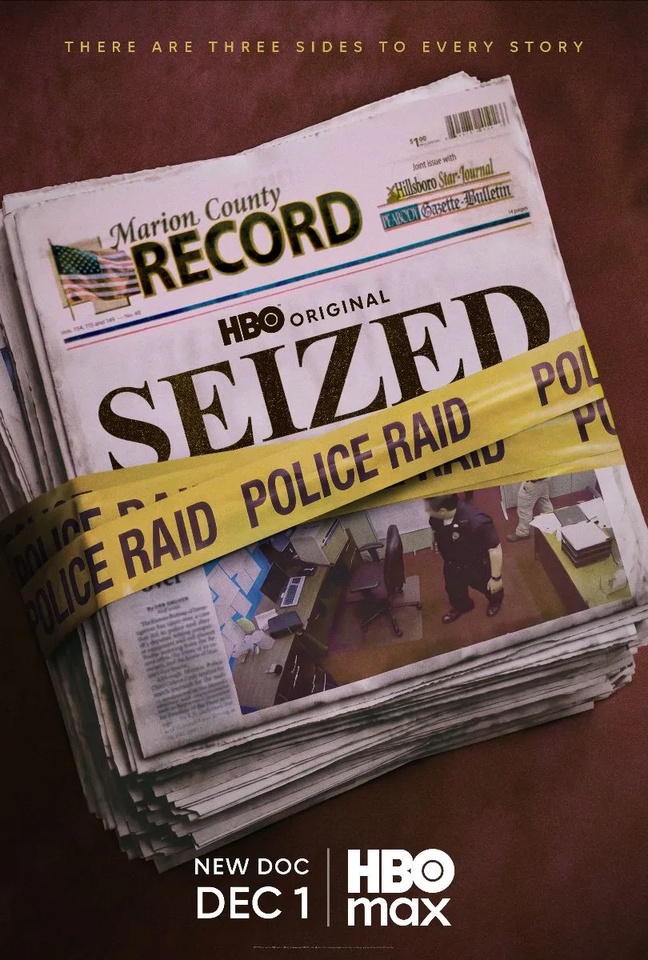
A story about one small American newspaper is moving from the festival circuit to a wider television audience. The documentary Seized, directed and produced by Sharon Liese, is scheduled to debut on HBO on December 1, 2026, with streaming availability on HBO Max. The specific premiere plan was announced on November 17, making it a useful development for viewers who could not attend its earlier screenings. Rather than treating a 2023 police raid as an isolated spectacle, the film examines a community in which ordinary reporting, local relationships and the power of public officials collided. This is a release preview, not a review based on viewing the completed documentary.
A December premiere with an established festival history
The announced United States television window is Tuesday, December 1, at 9 p.m. Eastern and Pacific time. The broadcast is scheduled for approximately ninety-four minutes, and the same film will be available through HBO Max. Availability outside the United States may differ by territory, so readers should not assume the American broadcast time applies to every market. This release is notable because Seized has already been exhibited to festival audiences, including its world premiere in the U.S. Documentary Competition at Sundance in January 2026. The new element is broader home access, not the first-ever public screening of the film.
Release notices often blur important distinctions between a film being acquired, being shown at a festival and being available for the general public to stream. Seized provides a clear example of why those stages should be separated. Its festival recognition and earlier limited engagements belong to the film's completed exhibition history. The December date concerns a forthcoming television and streaming rollout. No audience figures, awards outcome for the December premiere or new theatrical expansion should be inferred from that programming announcement. A careful preview can explain the project and its makers without inventing reception that has not occurred.
The 2023 raid at the centre of the film
On August 11, 2023, law enforcement searched the offices of the Marion County Record in Marion, Kansas, as well as private residences connected with the newspaper. Computers, phones and reporting equipment were taken. The searches brought national attention to a local dispute and prompted questions about the legal protections afforded to journalists, the circumstances under which officials may obtain newsroom material and the obligations of a newspaper serving a small community. The documentary focuses not simply on the day of the searches, but also on the relationships and institutional decisions that placed the newspaper at the centre of a controversy far larger than the town itself.
Editor and publisher Eric Meyer is among the film's principal participants. Local reporting can create unusually intimate tensions: the people whose conduct is investigated may also be neighbours, advertisers, acquaintances or elected representatives familiar to the newsroom. In a larger city, public accountability is often discussed in abstract language. Here, the consequences are personal and visible. That proximity makes the case valuable for a documentary because it allows the audience to consider both the necessity of scrutiny and the social cost of asking uncomfortable questions. Neither friendliness nor hostility toward an editor determines whether lawful scrutiny is warranted.
The human consequences behind the headlines
Joan Meyer, the newspaper's 98-year-old co-owner and Eric Meyer's mother, died the day after the searches. Her death forms part of the documentary's emotional background. It is important to distinguish the chronology, which is established, from any sweeping medical or legal conclusion about causation, which a film preview cannot independently determine. The raids also affected a small staff charged with keeping an issue of the paper moving toward publication despite the loss of essential equipment. What might appear to an outsider as a battle over files or devices was also a disruption to livelihoods, routines and a longstanding local institution.
Sharon Liese and a documentary built around people
Sharon Liese directs and produces Seized, continuing a filmmaking practice concerned with lived experience and complex social relationships. The project is produced with Sasha Alpert and Paul Matyasovsky. Jackson Montemayor is credited as director of photography and Derek Boonstra as editor. The film uses security-camera material and police body-camera footage alongside interviews and observation. Such footage can establish what was visible at specific moments, but the challenge for a feature-length documentary is to place it within an intelligible human narrative. The audience needs to understand why the records mattered and what happened to the community after the cameras stopped recording.
Liese's chosen approach is not limited to an adversarial interview between journalists and officials. The portrait also includes people who disagree with the paper or question the editor's manner. That range is significant: documentaries about constitutional rights can lose the texture of local life if every person becomes a symbol of a position. Making room for disagreement does not require excusing an unlawful act. It offers a fuller picture of the environment in which power is exercised and challenged. The resulting story can be considered as a work of nonfiction filmmaking as well as a case study in the relationship between a news organisation and its community.
A younger reporter offers another viewpoint
Finn Hartnett, a young reporter who joined the newspaper from New York City, provides a fresh perspective on the newsroom and the town. The film also features reporter Phyllis Zorn, investigative reporter Jessica McMaster and civic figures including Marion mayor Mike Powers and former vice mayor Ruth Herbel. Their inclusion expands the human geography of the story beyond a single office. An outsider arriving after a crisis can notice routines that longer-term residents take for granted, while veteran staff can supply context that the newcomer lacks. That contrast gives the documentary a useful narrative route through events with complicated local history.
How the material becomes cinema
A police raid is dramatic by definition, but dramatic events do not automatically make coherent films. Seized must connect documents, surveillance images, public actions and spoken recollections while keeping its chronology clear. The project also finds moments of everyday humour in Marion, a tonal choice that can prevent a serious story from becoming one uninterrupted argument. Its structure asks viewers to think about credibility from several directions: what cameras show, what witnesses remember, what legal processes establish and what a community believes. Those forms of evidence are related without being interchangeable, and responsible storytelling should make their differences apparent.
The technical credits also point to an important distinction between the event and the film made about it. Documentary cinematography is not just the recording of newsworthy occurrences. Images of a workplace, a street or a meeting can locate the story in a physical and social world. Editing, in turn, determines how a viewer moves between the original raid, later consequences and interviews conducted after the event. This description concerns the film's announced method and its available production information, not a personal assessment of its shot composition, score or editing quality. Those judgments belong in a review after a complete viewing.
An argument about rights without a simple hero
The film's central questions touch both the First Amendment, which protects freedom of the press, and the Fourth Amendment, which places limits on unreasonable searches and seizures. But constitutional language does not by itself explain every local motive or every contested decision. Viewers should be able to separate the legal issues from the individual personalities involved. It is possible for an editor to be divisive while still possessing legal rights; it is also possible for members of a community to dislike coverage without justifying official retaliation. A documentary that preserves these distinctions encourages examination rather than reflexive allegiance.
Why the January festival premiere still matters
Seized had its world premiere on January 25, 2026, at Sundance, where it was included in the U.S. Documentary Competition. That earlier appearance matters because it establishes the film as a completed documentary with a public exhibition record, rather than an announced project still awaiting production. Its festival journey also provided a setting for discussions with participants about the complicated responsibility of portraying real people whose lives are still affected by events on screen. The November television announcement should therefore be read as a distribution milestone within an ongoing life for the film, not as the discovery of a previously unknown subject.
An important feature of the documentary's reception has been attention to the tension between the importance of its subject and the difficulties of putting that subject into a film. A filmmaker can be deeply concerned about press freedom without treating every narrative choice as beyond debate. Festival discussion has highlighted the portrait of Eric Meyer as an imperfect central figure rather than a convenient emblem of virtue. That nuance may help the film reach viewers who would resist a simpler message. It also offers aspiring nonfiction directors a practical lesson: access and sympathy need not eliminate difficult questions about one's central character.
A wider conversation about independent local journalism
Small-town newspapers occupy a fragile space in modern media. They may have limited staff, equipment and finances, yet their reporting is often the most sustained record of school boards, local councils, businesses and police activity. When that work is interrupted, the information gap is felt by people who may not agree with the newspaper's editorial choices. Seized places a particular Kansas episode inside this larger question of whether an independent publication can challenge authority while remaining rooted in its community. That subject has resonance beyond the American town because locally produced reporting faces different forms of pressure across many countries.
For filmmakers and producers, the project also illustrates the value of concentrating broad public issues within a manageable human setting. Its conflicts involve a recognisable group of journalists, residents and officials, while the themes extend to rights, ethics and institutional power. The source material is already compelling, but the documentary form must earn attention through character, detail and an intelligible progression of events. For viewers, the practical invitation is to watch a story about people operating under pressure and then consider what a functioning local press should be allowed, expected and equipped to do.
What audiences can verify before watching
As of the November 17 announcement, the confirmed upcoming release is a December 1 HBO debut with HBO Max streaming availability. The documentary is directed by Sharon Liese and its festival premiere has already taken place. There is no basis here to claim new December audience totals, future award wins or worldwide simultaneous availability. Readers should check regional programme listings closer to the date, particularly if watching outside the United States. Likewise, this preview does not present a verdict on the completed film's artistic success. Its purpose is to explain the documented production, the real events and the significance of an approaching release.
Seized arrives at an intersection of documentary cinema and public accountability. Its unusual setting may attract viewers through the drama of a police search, while the longer-lasting appeal lies in the unresolved challenge of how a community lives with scrutiny. The November news is therefore worth retaining even after the original announcement cycle has passed: the film's scheduled wider release remains ahead, and the questions it raises have not expired with a news headline. That is the appropriate frame for this historical update, with confirmed dates distinguished from interpretation and with space left for an eventual full critical review.
PUBLISHED BY SUYASH PACHAURI, FOUNDER & OWNER, GLOBAL BOLLYWOOD | THE HOLLYWOOD SCOPE.