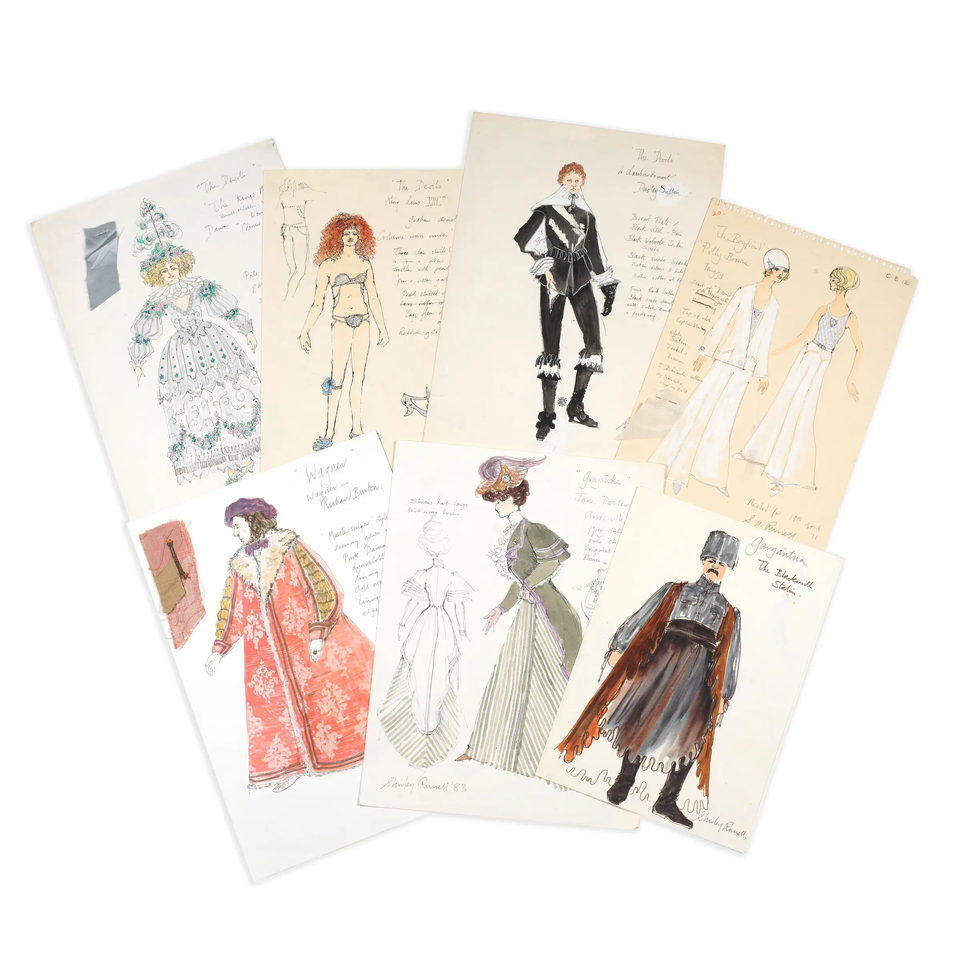
Why the November 17 archival feature matters
The renewed attention to Shirley Russell's surviving costume sketches offers an unusually precise way to study a film that is often discussed chiefly for its confrontational subject. A 17 November 2026 archival presentation brought the drawings into focus as working evidence of how characters and social power were designed for the screen. Their significance does not expire with the original announcement. The film is returning to viewers through a new restoration and a planned home edition, making its visual craftsmanship an immediate subject for reassessment.
Costume sketches allow audiences to investigate choices that can disappear when a film is reduced to a plot summary or a debate about censorship. The designer's lines, handwritten instructions and fabric samples show how an actor's public identity was built before cameras began recording. This is not a new production or a recently discovered movie. It is a fresh opportunity to look closely at materials connected to a 1971 work.
The film and its historical world
Directed by Ken Russell, The Devils is a historical drama inspired by the case of Urbain Grandier, a seventeenth-century French priest accused amid claims of demonic possession. Oliver Reed plays Grandier, while Vanessa Redgrave portrays Sister Jeanne. Political and religious authority intersect throughout the film, and the visual world repeatedly asks viewers to distinguish genuine conviction from institutional performance. Its images make that conflict visible even when a character has not yet spoken.
Russell's expressive staging depends upon collaboration among departments rather than a single striking design. Derek Jarman's monumental settings create an austere architectural frame, while costumes differentiate clerical discipline, royal pageantry and theatrical manipulation. The contrast between a severe surrounding environment and extravagant garments is one of the film's most revealing design decisions. The clothes do not merely reconstruct a century; they interpret how the film imagines belief and control.
Shirley Russell's path into screen costume design
Shirley Russell studied fashion at Walthamstow College of Art, where she met Ken Russell, who became her husband and a frequent creative collaborator. Her work extended across roughly four decades. She contributed costumes to his early short film and television projects and received a costume designer credit on Women in Love in 1969. Her career was not confined to a single director or visual style, although their collaborations remain central to the way audiences encounter her designs.
Later credits demonstrate the breadth of her work. She won a BAFTA for Yanks, released in 1979, and her filmography also includes Hope and Glory from 1987 and Gulliver's Travels from 1996. Those productions required different ways of understanding era, character and texture. In The Devils, her approach is especially forceful because the garments carry an unusually direct argumentative burden. Every chosen surface or decorative flourish can become a clue to character.
Grandier and the discipline of clothing
One preserved drawing presents Grandier in dark clerical clothing. The restrained silhouette is an important counterpoint to the more theatrical outfits worn elsewhere in the film. Such economy invites a viewer to examine posture, gesture and the actor's presence rather than assume that all historical costume should announce itself through ornament. The drawing also shows how tailoring and material notes can turn a conceptual image into practical instructions for a wardrobe department.
Grandier's clothing is part of a contested social position. He belongs to a religious institution but also stands within a wider struggle involving officials, public belief and private conduct. A sober costume can therefore signal both authority and vulnerability, depending on the circumstances of a scene. The point is not that a garment dictates a single interpretation. Rather, its formal restraint leaves room for performance and staging to alter its meaning.
Why the paper designs matter
The drawings survive as evidence of process rather than simply decorative artworks. Notes about fabrics and construction connect an artist's intention with the practical work of cutters, makers and dressers. Their preservation makes it possible to ask more exact questions about what was planned and what eventually appeared on screen. Anyone studying filmmaking can trace the distance between an idea on paper and the physical texture visible in a completed shot.
Louis XIII and the theatre of monarchy
The film introduces King Louis XIII, played by Graham Armitage, through an image of conspicuous royal display. His elaborate black robe, bold gold decoration, prominent crown and sun imagery transform clothing into a deliberate theatrical statement. The attire presents kingship as something enacted before an audience, not only exercised through institutions. Details associated with divine right and absolute rule create a visual language that communicates ideas of power without requiring an explanatory speech.
The surviving design offers a useful reminder that apparent historical realism is never the only objective of screen costume. Exaggeration can reveal character more clearly than neutral accuracy. Scale, ornament, colour and unusual proportions direct attention toward the filmmaker's interpretation. Within the architecture of The Devils, the royal costume produces a revealing friction: a body dressed for ceremony moves through a world marked by fear, hierarchy and competing claims to moral truth.
Father Barre and a costume built for performance
Father Barre, played by Michael Gothard, is another example of dress turning a character into an immediately readable public figure. Rolled sleeves, dramatic gloves, a prominent rosary and distinctive round spectacles give him the appearance of someone determined to command attention. His authority is presented as spectacle. Those elements help explain why costume design can be essential to the dramatic force of a scene even when a viewer notices only the performer's energy.
The contrast between Barre and Grandier is therefore especially instructive. Both occupy religious roles, yet their outward visual languages are far apart. A designer can express their different relationships to crowds, rituals and institutions with accessories and silhouette before the screenplay requires them to argue. The costumes need to function in movement, under lighting and within the production design. Their meaning emerges from this coordination, not from a drawing in isolation.
Texture, line and the working designer
Russell's surviving sketches include confident fine-ink outlines, written annotations, material indications and in some cases fabric swatches. Smaller studies clarify accessories and alternative angles. These details show that fashion drawing for cinema is an interpretive and technical practice at once. The finished garment must satisfy a character concept, but it must also be constructed, worn and photographed. Preserved sketches give future practitioners a glimpse of those overlapping responsibilities.
The restoration changes what viewers can examine
The Devils returned to UK and Irish cinemas in a restored presentation on 30 October 2026, following an earlier United States engagement. The restoration revived interest in choices that had long been discussed through incomplete or compromised versions. For costume and production-design study, a more carefully presented image can make details of colour, surfaces and ensemble staging easier to consider. It does not change who designed the garments or when the original film was made.
The restored version was reconstructed from material associated with the director's intentions and subsequently completed as a 4K presentation. That history should not be confused with a claim that every missing frame is now present. Restoration involves documented decisions and surviving elements, not magic recovery of anything that has been lost. Readers looking for the definitive status of particular sequences should distinguish the restoration's stated scope from later interpretations of its cultural significance.
What remains ahead in 2027
The November 2026 archival spotlight has ongoing relevance because an April 2027 4K UHD and Blu-ray release has been announced. Home viewing will provide another opportunity to study the work of Russell and her colleagues frame by frame. It also offers a reason for film students and designers to compare the drawings with costumes as photographed, observing which elements survive translation from page to image and which may change during production.
A broader celebration of Ken Russell's centenary is also planned for July and August 2027, following the anniversary of his birth on 3 July 1927. Such a retrospective can place The Devils alongside his wider experiments in music, performance, television and cinema. It is best viewed as a future programme rather than an event that has already taken place. Dates and individual screenings should be checked against the final calendar before readers make plans.
Why costume archives deserve sustained attention
Archival costume materials are valuable because they preserve creative labour that the final credit roll can acknowledge only briefly. Research, drawing, fabric selection, fitting, collaboration and revision all contribute to the apparent immediacy of a screen character. Without sketches and notes, an audience might see only the endpoint of that process. With them, a viewer can understand why an unusual cuff, colour or silhouette may be as purposeful as a line of dialogue.
For contemporary filmmakers, the lessons extend beyond period drama. Costumes can frame public authority, expose private insecurity, create rhythm across ensembles and support the visual grammar of a scene. Shirley Russell's work offers a rigorous example because it connects the historical and the psychological. She designed for people moving within Ken Russell's heightened cinematic world, not for mannequins on a museum stand. The archive restores visibility to that craft.
Final perspective
The surviving drawings should encourage a different conversation about The Devils. Its reputation for controversy remains part of its history, but the construction of its images deserves equally careful attention. By focusing on Shirley Russell's original designs, the November 17 presentation draws the eye toward an artist whose contribution is indispensable to the film's account of power and spectacle. The confirmed April 2027 home release and summer retrospective plans give this film-heritage story a continuing reason to be read today.
A costume sketch cannot resolve every debate surrounding a challenging film. It can, however, show with extraordinary clarity how an idea about a character first took form. That is what makes these surviving pages more than promotional curiosities. They are working records of cinematic imagination, and their careful preservation opens a productive route into the history of British screen design.
PUBLISHED BY SUYASH PACHAURI, FOUNDER & OWNER, GLOBAL BOLLYWOOD | THE HOLLYWOOD SCOPE.